
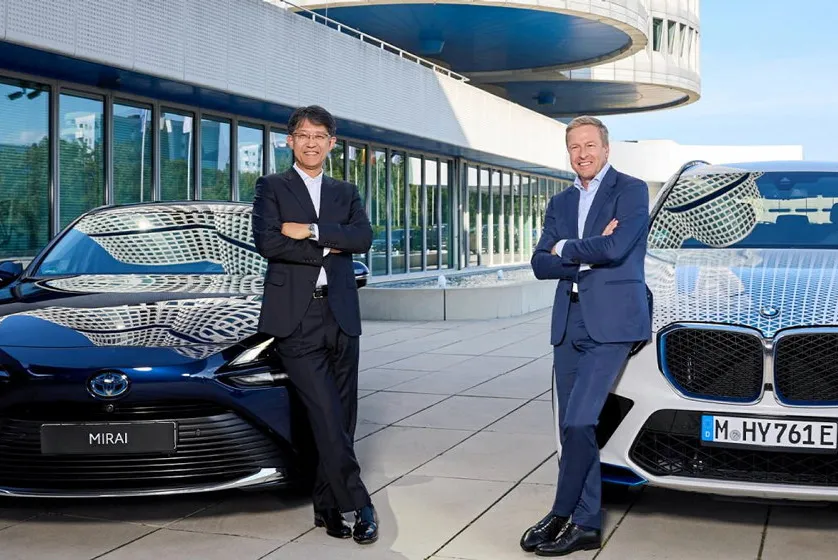
When much of the global auto industry raced to abandon gasoline engines and bet everything on electric vehicles, BMW and Toyota stood apart — and were criticized for it. Now, as rivals scale back their EV ambitions amid slowing demand and costly rollbacks, the two carmakers’ cautious strategy is being hailed as remarkably foresighted.
At the start of this decade, the world’s biggest automakers seemed to be in a sprint to electrify everything. Volvo and Bentley pledged to stop selling gasoline cars by 2030. Ford Europe said it would go all-electric before that same year. Porsche expected EVs to make up 80% of its sales by 2030, while Audi aimed to end internal combustion entirely by 2032.
Just a few years later, that electric dream is losing some charge. Several automakers have quietly delayed or abandoned their EV targets, citing weak consumer demand, soaring costs, and lagging charging infrastructure. The verdict is in: the industry moved too fast.
Two names, however, never joined the stampede — BMW and Toyota.
Both giants resisted the “EV-only” hype. BMW’s CEO Oliver Zipse has long warned that forcing a one-size-fits-all solution on consumers would backfire, potentially eliminating jobs and alienating drivers in markets not yet ready for full electrification. Toyota’s Chairman Akio Toyoda went even further, predicting that electric cars would never exceed 30% of global market share.
Instead of chasing headlines, both companies pursued what they call “multi-path” strategies — advancing electric technology while continuing to refine hybrids, hydrogen, and even next-generation combustion engines.
BMW still embraces its philosophy of the “Power of Choice.” Customers can pick from gasoline, diesel, plug-in hybrid, or fully electric models. Even as it invests over €10 billion in its Neue Klasse EV lineup — starting with the iX3, followed by the i3 and iX5 — BMW is also developing a hydrogen-powered X5 in partnership with Toyota, scheduled for 2028.
Meanwhile, Toyota, the world’s largest carmaker, continues to perfect hybrid technology — the same approach that made the Prius a global icon. The company is also investing heavily in synthetic fuels, biofuels, and hydrogen, testing a hydrogen-combustion 1.6L turbo engine in its GR Yaris and GR Corolla prototypes.
That patience is now paying off.
While Porsche and Audi backtrack on earlier promises — reintroducing gasoline-powered versions of the Macan, Boxster, and Cayman after disappointing EV sales — BMW and Toyota find themselves with products aligned to real-world demand.
The shift underscores a larger truth: the road to decarbonization won’t look the same everywhere. According to the International Energy Agency (IEA), EVs made up more than 20% of global car sales in 2024, but adoption remains deeply uneven. Norway reached 89% EV penetration, while the U.S. hovered around 9%.
In this context, BMW’s and Toyota’s diversified energy strategies — combining electric, hybrid, and hydrogen options — look not conservative, but strategic.
As the world learns that electrification is a marathon, not a sprint, the two automakers that refused to gamble everything on one path now appear to be leading the race.
