
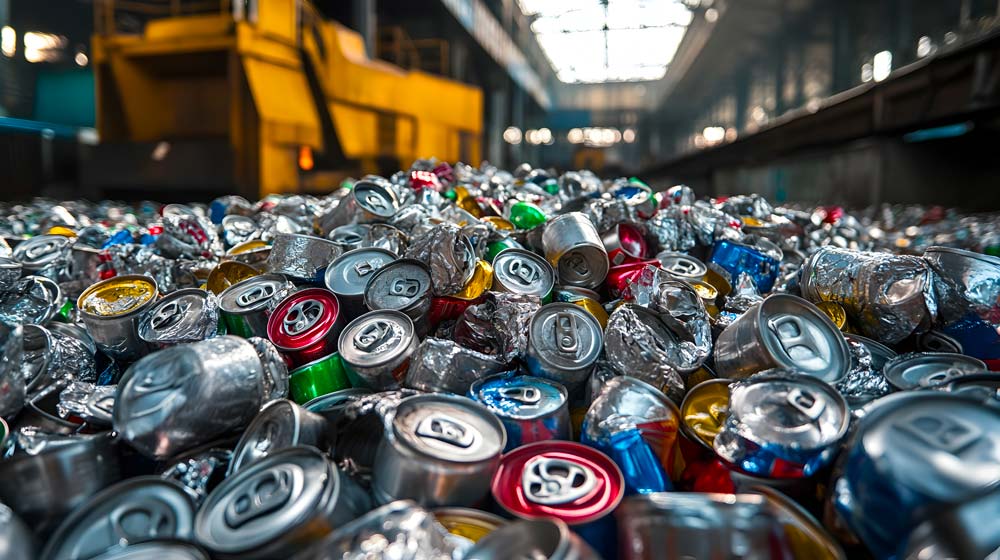
Aluminum scrap, especially drink cans, has become one of Europe’s most valuable “critical minerals” as the continent races to secure materials for its green transition.
Europe’s next big mineral shortage isn’t cobalt, lithium or even rare-earth elements. It’s empty soda cans. As the EU accelerates efforts to localize supply chains for its green-industrial strategy, aluminum scrap—once treated as low-value waste—has suddenly become one of the continent’s most strategically important resources. The shift underscores a growing paradox: while rare earths dominate headlines, it is the mundane, infinitely recyclable metals like aluminum that now threaten to derail Europe’s climate and manufacturing ambitions.
Unlike rare earths, which see only about 1% of global volumes recycled due to complex and hazardous recovery processes, aluminum boasts near-100% recyclability when collected in clean, uncontaminated form. That makes high-purity scrap—especially used beverage cans—gold in Europe’s materials market. Recycling aluminum requires just 5% of the energy needed for primary production, a crucial advantage in a continent where soaring power costs have forced multiple smelters to shut down.
But demand is rapidly outpacing supply. The EU has set a target for recycled materials to meet 25% of its critical-mineral needs by 2030, yet aluminum scrap is vanishing overseas. Europe exported a record 1.26 million tonnes of aluminum scrap in 2024, pushing the bloc into a deepening shortage even as recycling plants sit idle. The European Aluminium Association warns that 15% of the continent’s recycling capacity is already unused because there simply isn’t enough feedstock.
The geopolitical implications are mounting. As the West works to reduce dependence on China for key minerals, Europe is simultaneously hemorrhaging a resource it can recycle domestically at nearly zero geopolitical risk. EU trade chief Maroš Šefčovič recently sounded the alarm, noting that over 1 million tonnes of aluminum scrap leave Europe annually—“far too much for a continent trying to secure its own supply.”
This scarcity is reshaping policy debates. The race to electrify transportation, expand renewable energy and rebuild domestic manufacturing has exposed the Achilles’ heel of Europe’s green transition: without control over recycled input materials, even the most ambitious climate goals and industrial strategies are vulnerable.
Europe’s scramble for empty drink cans may seem trivial on the surface, but it speaks to a deeper strategic shift. In a world of energy shocks, supply-chain realignment and geopolitical fragmentation, the metals that matter most are often not the rarest—but the ones you let slip away.
