
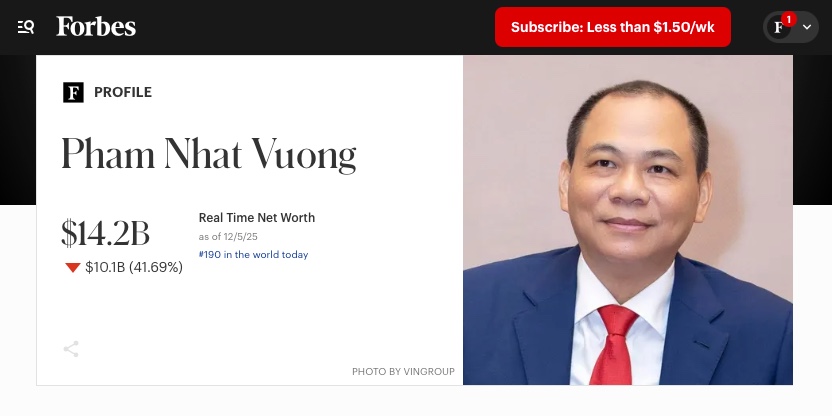
A technical price adjustment during Vingroup’s largest-ever bonus share issuance triggered a sharp — and misleading — drop in Forbes’ real-time billionaire rankings
MARKET INSIDER – Vietnam’s richest man, Pham Nhat Vuong, saw more than $10 billion wiped from his Forbes Real-Time net worth on Thursday — even as Vingroup-linked stocks powered the VN-Index higher in one of the market’s strongest sessions this month. The dramatic shift was not the result of collapsing wealth but of a technical adjustment linked to Vingroup’s historic 1:1 bonus share issuance, which Forbes appears to have misinterpreted as a real loss.
Vietnam’s VN-Index closed at 1,741.32 points, extending its eight-session winning streak despite more than 400 stocks finishing in the red. The resilience came almost entirely from the Vin group trio — Vingroup (VIC), Vinhomes (VHM), and Vinpearl (VPL) — which collectively contributed 12.62 points to the benchmark. VIC alone hit the ceiling at 142,800 đồng, adding 9.26 points to the index and setting a new all-time high. VHM and VPL also posted gains, reinforcing the Vin ecosystem’s grip on market sentiment.
But while Vin stocks soared, Forbes’ billionaire tracker moved sharply the other way. The platform cut Vuong’s estimated net worth by 41.7%, from roughly $24.3 billion to $14.2 billion, instantly pushing him out of the global top 100 and down to No. 190 — the steepest one-day drop of any billionaire worldwide.
The discrepancy stems from Vingroup’s massive capital increase, the largest in its history. Ahead of the ex-rights date, the Ho Chi Minh Stock Exchange adjusted VIC’s reference price from 267,000 đồng to 133,500 đồng to reflect the 1:1 bonus share issuance. Investors’ total asset value remained unchanged — but Forbes’ automated valuation system appears to have treated the adjustment as a real market decline rather than a dilution-neutral move.
This is not the first time the publication’s methodology has triggered controversy in Vietnam. In 2023, Forbes slashed Vuong’s estimated fortune from $39 billion to $6.7 billion in a single day, then again from $85 billion to $44 billion earlier that same month. While Forbes calculates net worth using public share prices, private-company valuations, real estate, debt, and dilution factors, its real-time model can produce abrupt swings whenever large technical corporate actions occur.
Forbes says it updates valuations of publicly traded holdings every five minutes, adjusts private-company estimates daily, and recalibrates when ownership stakes represent more than 20% of a billionaire’s net worth. But fast-moving corporate actions — especially in emerging markets — can lead to distortions that outpace editorial oversight.
In the coming days, analysts expect Forbes to revise Vuong’s figure once its system incorporates the additional shares and normalizes the price implications. Meanwhile, the market reaction tells a different story: investors remain deeply confident in the Vin ecosystem’s long-term trajectory, reinforcing the group’s central role in Vietnam’s equity market.
As Vietnam edges closer to emerging-market status in 2026 and local giants undertake increasingly complex capital restructurings, global wealth trackers may face growing pressure to refine how they assess billionaire wealth in fast-developing financial markets.
