
Missiles hit Gulf cities, Israel under fire as Middle East war risk deepens
The Middle East edged closer to full-scale war after Iran launched a sweeping retaliatory campaign against U.S. and Israeli targets across the region, following a joint airstrike that killed Iran’s Supreme Leader. The escalation marks one of the most destabilizing geopolitical shocks in decades, with missiles and drones crossing borders from Tehran to Tel Aviv and the Gulf.
What began as a targeted U.S.-Israel operation has now expanded into a multi-front confrontation involving regional capitals, critical infrastructure, and global energy corridors. For markets and policymakers worldwide, the risk calculus has shifted from diplomatic tension to open military confrontation.
Iran’s Islamic Revolutionary Guard Corps announced successive waves of ballistic missile and drone strikes targeting Israel and U.S. military facilities across the Middle East. Explosions were reported in Israel, Dubai, Doha, and Bahrain. In Israel, air raid sirens sounded across central and southern regions as the Israel Defense Forces activated missile defense systems. At least one fatality was reported in Israel, while Iranian authorities said more than 200 people were killed in the initial U.S.-Israeli strike.
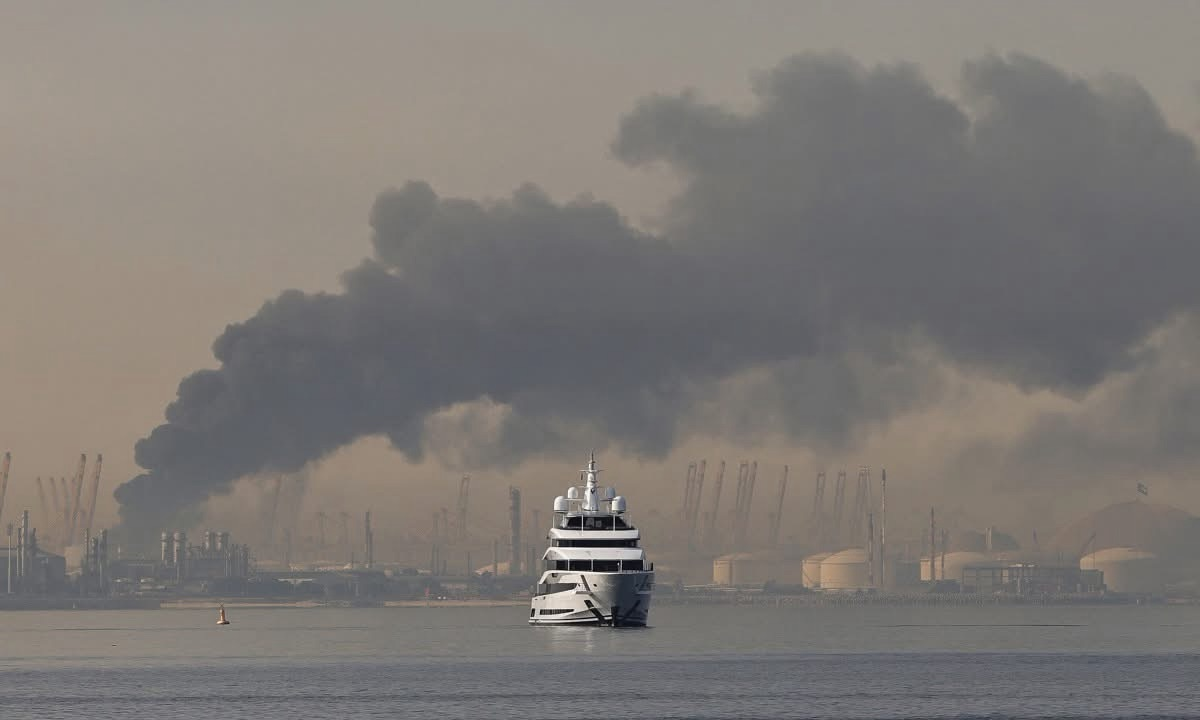
In the Gulf, debris from intercepted missiles ignited fires at Jebel Ali port in Dubai, and Dubai International Airport reported minor structural damage and temporary closure. Bahrain confirmed air defense alerts near facilities linked to the U.S. Fifth Fleet, underscoring the regional scope of the confrontation.
The trigger was a coordinated airstrike by U.S. and Israeli forces that targeted senior Iranian political and military leadership, including Supreme Leader Ali Khamenei, according to Iranian state media. Tehran has confirmed the deaths of high-ranking figures, including IRGC commander Mohammad Pakpour and defense official Ali Shamkhani. Israeli Prime Minister Benjamin Netanyahu framed the operation as a preemptive measure to halt Iran’s nuclear and ballistic missile ambitions.
In response to the leadership vacuum, Iran announced the formation of an interim governing council led by President Masoud Pezeshkian, the judiciary chief, and a Guardian Council representative. The move signals an attempt to preserve state continuity amid unprecedented internal and external pressure.
Strategically, Iran’s ballistic missile arsenal—capable of reaching U.S. bases in the region and potentially parts of Europe—has moved from theoretical deterrent to active instrument. The Strait of Hormuz, through which roughly one-fifth of global oil flows, now sits at the center of heightened military alert. Energy markets, already volatile, face the prospect of sustained supply disruption.
The broader geopolitical landscape is rapidly polarizing. Regional governments have urged restraint, while global powers assess whether escalation can be contained. Airspace closures, flight suspensions, and maritime rerouting are already rippling through logistics networks.
The critical question is no longer whether retaliation would occur—it has. The question now is whether escalation stabilizes into deterrence or spirals into prolonged regional war. For global investors, the implications stretch far beyond the battlefield: oil, defense, inflation, and safe-haven flows may define the next chapter of market volatility.
