
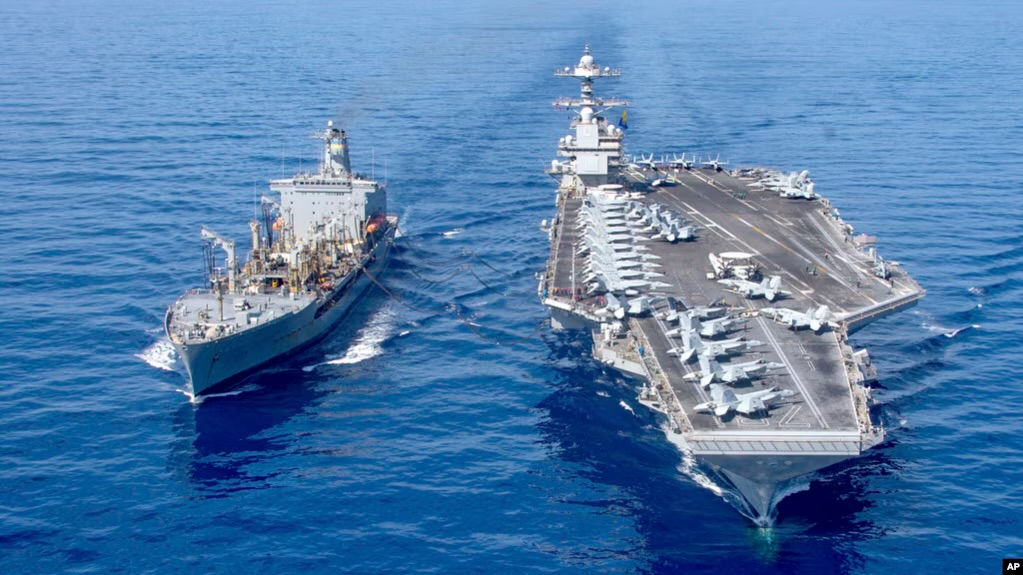
Markets price in Middle East risk as U.S. military signals escalate pressure on Tehran
Global oil markets moved sharply higher after U.S. President Donald Trump warned that a “massive Armada” was heading toward Iran, reigniting fears of a fresh geopolitical shock to global energy supplies. The comments immediately injected a risk premium into crude prices, underscoring how quickly political rhetoric can ripple through commodity markets.
By mid-day in New York, Brent crude rose more than 0.8% to above $68 a barrel, while U.S. benchmark West Texas Intermediate climbed roughly 1% to just over $63. The gains reflected investor anxiety that tensions in the Middle East—still the world’s most critical oil-producing region—could escalate into supply disruptions.
Trump’s remarks, posted on his Truth Social platform, framed the military deployment as both imminent and overwhelming. U.S. Central Command confirmed that the Abraham Lincoln Carrier Strike Group has arrived in the Middle East, officially to promote regional stability. Unofficially, markets read the move as a clear signal of deterrence aimed at Tehran.
The warning marks a sharper turn in Washington’s posture. Earlier this month, Trump publicly threatened action if Iran’s leadership continued its violent crackdown on domestic unrest, which reportedly left thousands dead. Until now, the White House had stopped short of direct military engagement. By invoking comparisons to U.S. actions against Venezuela and hinting at force “with speed and violence, if necessary,” Trump raised the stakes—both diplomatically and economically.
At the core of the standoff is Iran’s nuclear program. Trump renewed his call for Tehran to “make a deal,” warning that time is running out and suggesting any future strike would exceed last year’s bombing of Iranian nuclear facilities. For energy traders, the message was clear: escalation risk is back on the table.
The bigger global implication goes beyond a single price spike. With inflation still sensitive to energy costs and central banks watching oil closely, renewed Middle East tensions could complicate monetary policy, rattle equity markets, and reshape capital flows into safe-haven assets. The contrarian question now circulating on trading desks is whether markets are underpricing the risk—or overreacting to words that may never translate into action.
