
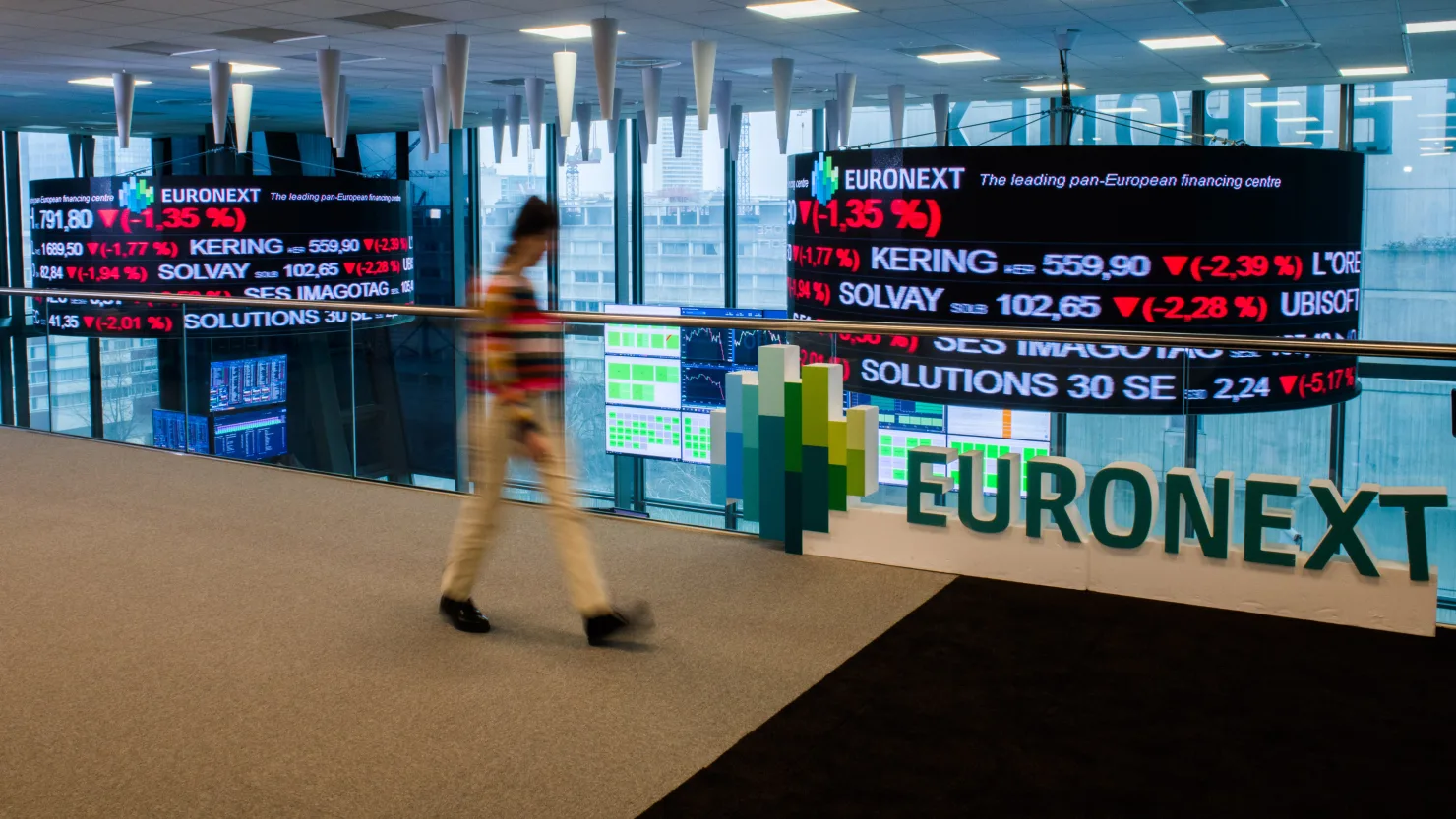
Europe’s benchmark reached 656.86 as semiconductor shares, resilient bank earnings and stronger energy profits outweighed deep losses across luxury goods and automakers.
MARKET INSIDER — European stocks closed at a record high on Tuesday, driven by strong corporate earnings, renewed enthusiasm for artificial intelligence and hopes that diplomatic progress could reduce energy-supply risks from the Iran conflict.
The pan-European STOXX 600 gained 0.7% to finish at 656.86, its highest closing level on record. The benchmark has risen approximately 10% in 2026, trailing the S&P 500’s roughly 13% advance but demonstrating that the global equity rally extends beyond US technology companies.
Key Highlights
- The STOXX 600 closed at a record 656.86, taking its 2026 gain to approximately 10%.
- Semiconductor-related companies occupy all five leading positions in the index this year.
- European banks have gained about 18%, supported by resilient margins, modest credit losses and consolidation.
- Luxury and automobile stocks remain major laggards as Chinese demand weakens and competitive pressure intensifies.
Technology shares power the index higher
Technology was the strongest major influence on Tuesday’s record close, with the STOXX 600 technology sector advancing 2.8%.
BE Semiconductor Industries rose 8.1% following an analyst upgrade, while Soitec gained almost 10%. Aixtron, ASML and Infineon also advanced as investors returned to chipmakers after several volatile weeks. Mining shares provided additional support, rising 3.6% alongside higher metals prices, Reuters reported.
The longer-term performance gap within Europe is even more striking. The five best-performing STOXX 600 companies of 2026 are all connected to semiconductor manufacturing or its supply chain.
French chip-materials producer Soitec has risen approximately 371%, while Austrian circuit-board and advanced-substrate manufacturer AT&S has gained about 330%. Technoprobe, Aixtron and STMicroelectronics have advanced approximately 123%, 116% and 101%, respectively.
These companies occupy different positions in the semiconductor ecosystem, but they share exposure to investment in AI servers, advanced processors, memory, packaging and data-centre infrastructure.
The rally has been reinforced by earnings upgrades, rising order expectations and signs of tight capacity in parts of the chip supply chain. Europe has relatively few large, pure-play AI companies, making semiconductor suppliers particularly attractive to investors seeking regional exposure to the global AI investment cycle.
AT&S’s addition to the STOXX 600 in June also reflects the growing market importance of advanced packaging and integrated-circuit substrates. The benchmark itself covers 600 companies across 17 developed European markets and represents almost 90% of the region’s investable equity market, according to the STOXX
Semiconductor volatility remains a warning
The extraordinary year-to-date returns should not be interpreted as evidence that the traditional semiconductor cycle has disappeared.
AT&S and Aixtron have each fallen more than 20% from their mid-June peaks, demonstrating how quickly expectations can change when valuations depend on continued AI infrastructure spending.
The fundamental support for semiconductor demand remains considerable. Major technology companies have already committed substantial capital to data centres, processors and networking equipment. That spending should continue flowing through to equipment manufacturers and component suppliers.
The investment risk lies in the price already assigned to that growth. If cloud providers moderate capital expenditure, new chip capacity reduces shortages or customer inventories rise, semiconductor earnings expectations could be revised downward even while the long-term AI trend remains intact.
Europe’s strongest-performing shares are therefore also among those most vulnerable to changes in market sentiment.
Banks benefit from an unusually supportive environment
European lenders have provided a second important source of strength. The EURO STOXX Banks index has returned approximately 18% this year, with French and Italian institutions among the leading performers.
Higher interest rates have allowed many banks to preserve healthier net interest margins, while credit impairments have remained relatively modest. Volatile equity, bond, currency and commodity markets have also supported trading revenue at diversified institutions.
The sector’s recovery extends well beyond 2026. The STOXX Europe Banks index has risen more than 140% since the beginning of 2024 and recently reached its highest level since 2007. Recent results from Deutsche Bank, UBS and Société Générale showed stronger profitability across investment banking, trading and retail operations, Reuters added.
Takeover activity has added another catalyst. Mediobanca, BNP Paribas and ABN Amro have benefited from expectations that consolidation could improve efficiency and strengthen earnings in a fragmented European banking market.
However, cross-border mergers remain difficult because deposit protection, regulation and capital-market rules are still divided largely along national lines. That limits the extent to which European banks can achieve the scale enjoyed by their largest US competitors.
Energy companies capture the war-driven oil windfall
Oil and gas companies have also benefited from the sharp increase in fossil-fuel prices following the outbreak of direct US-Israeli hostilities with Iran in February.
BP’s second-quarter underlying replacement-cost profit more than doubled to $5.73 billion, its strongest result since 2022. Higher oil prices, refining margins and trading performance helped the company exceed market expectations and increase its dividend. Reuters
BP shares have gained roughly 20% this year, reflecting improved earnings as well as the company’s renewed emphasis on oil and gas production, asset sales and balance-sheet discipline.
Energy’s contribution to the year-to-date market advance nevertheless differs from its role in Tuesday’s session. The STOXX 600 energy sector fell 1.7% on Tuesday as Brent crude dropped more than 5% amid hopes that diplomatic negotiations could restore more normal oil flows through the Strait of Hormuz.
That distinction is important. Semiconductor earnings and AI enthusiasm directly supported the latest record, while energy companies have contributed mainly through their accumulated gains since the war began.
If oil prices decline further because of a durable agreement with Iran, European energy earnings could lose momentum. Conversely, renewed disruption to Gulf exports would support producers but increase inflation and financing costs across the rest of the European economy.
Luxury companies lose their China growth engine
The record index level conceals deep weakness across European luxury stocks.
LVMH has declined approximately 24% this year, Hermès has fallen 26% and Kering is down about 8%. The downturn reflects weaker Chinese consumption, lower tourism expenditure and the unwinding of premium valuations built during the post-pandemic luxury boom.
China became responsible for roughly one-third of global luxury demand during the past decade, both through domestic purchases and spending by Chinese travelers. Slower economic growth, property-market pressure and more cautious consumer behavior have therefore had an outsized effect on European fashion houses.
Jewelry has shown greater resilience than apparel and leather goods, but the broader sector faces a difficult question: whether the weakness represents a temporary cyclical slowdown or a more lasting change in Chinese consumption patterns.
For investors, the answer will depend on sales trends in mainland China, Asia-Pacific tourist spending, inventory levels and whether brands must use discounts to stimulate demand. Discounting may protect revenue but can weaken the scarcity and pricing power that support luxury-sector valuations.
European automakers face a structural challenge
Automobiles have been another major drag, with the STOXX Europe automobiles and parts index down approximately 16% in 2026.
Porsche AG has fallen about 28%, while Stellantis has lost nearly half its market value. The sector faces slower electric-vehicle demand, higher financing costs, regulatory uncertainty and intensifying competition from Chinese manufacturers.
European vehicle demand has shown some signs of stabilization, but improving industry registrations do not necessarily translate into stronger profitability for every manufacturer. Stellantis reported higher first-half registrations in the EU30 region, yet investors remain focused on pricing, product competitiveness and margin pressure. Stellantis
Chinese automakers have expanded rapidly in electric and hybrid vehicles, combining lower production costs with faster product-development cycles. European companies must respond by investing heavily in batteries, software and new platforms at the same time that slower sales constrain cash flow.
That combination makes the auto sector’s weakness more structural than the cyclical slowdown affecting some luxury companies.
What the STOXX 600 record means for investors
The STOXX 600’s record close is not evidence of a uniform European economic boom. It is the product of sharp sector rotation.
Capital has moved toward semiconductor suppliers benefiting from AI investment, banks earning stronger returns on equity and energy companies capturing higher commodity prices. At the same time, investors have reduced exposure to businesses dependent on Chinese luxury spending and traditional European automotive manufacturing.
The index’s broad construction helps explain how it can reach a record while some of the continent’s most recognizable companies remain deeply negative for the year. Gains of more than 100% in a small group of semiconductor shares can offset substantial declines elsewhere.
The immediate outlook will depend on whether European earnings can continue exceeding expectations, whether AI-related spending remains strong and whether easing oil prices reduce inflation without eliminating energy-sector profits.
The record therefore sends two messages. European equities are participating meaningfully in the global market rally, but the gains are increasingly concentrated in companies aligned with AI infrastructure, financial-sector profitability and geopolitical commodity shocks. Investors buying the benchmark should understand that its headline strength conceals one of the widest sector divides in recent years.
