
$1 Million Machine Maker Halves Staff as US Tariffs Crush Europe’s Industrial Core and Auto Giants
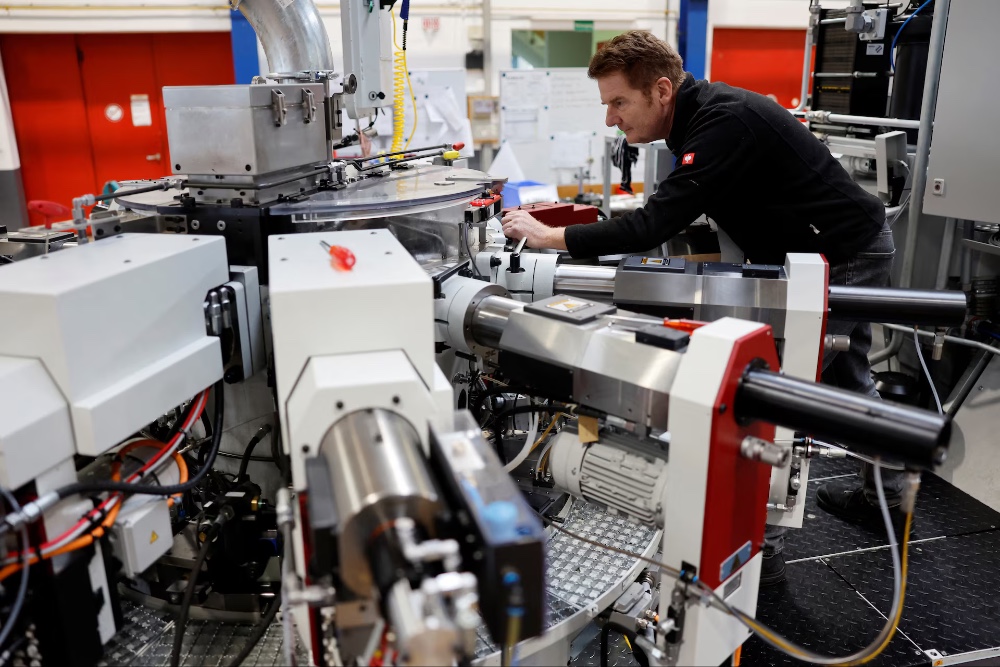
MARKET INSIDER – For decades, the sprawling factory floor of K.R. Pfiffner Group in Utzensdorf, Switzerland, represented the pinnacle of European industrial precision. Today, it’s a chilling barometer of a global slowdown. The company, which crafts million-dollar machines vital for titans like Mercedes-Benz (MBGn.DE) and Robert Bosch (ROBG.UL), is slashing its workforce from 105 to just 25. This brutal cut is not an isolated event; it is the ripple effect of a dual shockwave hitting the global economy: crippling US trade tariffs and a deepening recession across the critical automotive supply chain.
Pfiffner’s crisis vividly illustrates how Washington’s trade policy, coupled with a sharp slowdown in key export market China, has shattered business confidence across Europe’s manufacturing heartland. When President Donald Trump announced the 39% tariffs, Pfiffner CEO Andreas Ewald said the pipeline of US orders was “killed.” The tariffs, alongside a weaker dollar, made their Swiss-made precision tools approximately 50% more expensive overnight for American buyers, a margin no B2B exporter can absorb. This localized pain now threatens to accelerate mass layoffs across the continent.
The scale of the crisis extends far beyond one Swiss village. The mechanical and engineering sector, a bedrock of the Swiss economy, fears losing 30,000 jobs by 2026 if tariffs remain. Already, major Pfiffner clients like Bosch have announced 13,000 layoffs, with Continental (CONG.DE) and Mercedes-Benz also tightening headcounts. Data from consulting firm EY reveals that in the year through June, German industrial firms shed over 114,000 jobs—more than quadruple the cuts from the previous year. This rapid contraction prompted the German Chambers of Industry and Commerce to warn this is a downturn “we’ve not seen in our lifetimes.”
The human cost is palpable. Norbert Steuer, a 59-year-old logistics veteran scheduled to be laid off, noted that job uncertainty immediately creates a “downward spiral” as people stop buying cars, TVs, and phones. This consumer paralysis—a psychological recession—is now echoing globally, even as the US and Switzerland recently moved closer to a potential deal to lower the devastating tariffs. In response, Pfiffner’s Taiwanese parent company, FFG, has begun shifting some technology and production to its US plants, a clear sign that trade protectionism is fundamentally restructuring the world’s manufacturing map.
The swift, deep job cuts in Swiss and German precision manufacturing signal that the global industrial recession is no longer theoretical—it is here. The crucial question is not whether the auto sector will recover, but whether multinational corporations, driven by protectionist policies, will permanently decouple supply chains.
For global investors, the Pfiffner factory is a stark warning: while a trade deal might temporarily save some jobs, the era of frictionless globalized manufacturing, and the associated high profit margins, may be permanently over.
