
Carrier strike group deployment raises stakes over protests, nuclear risk, and regional security
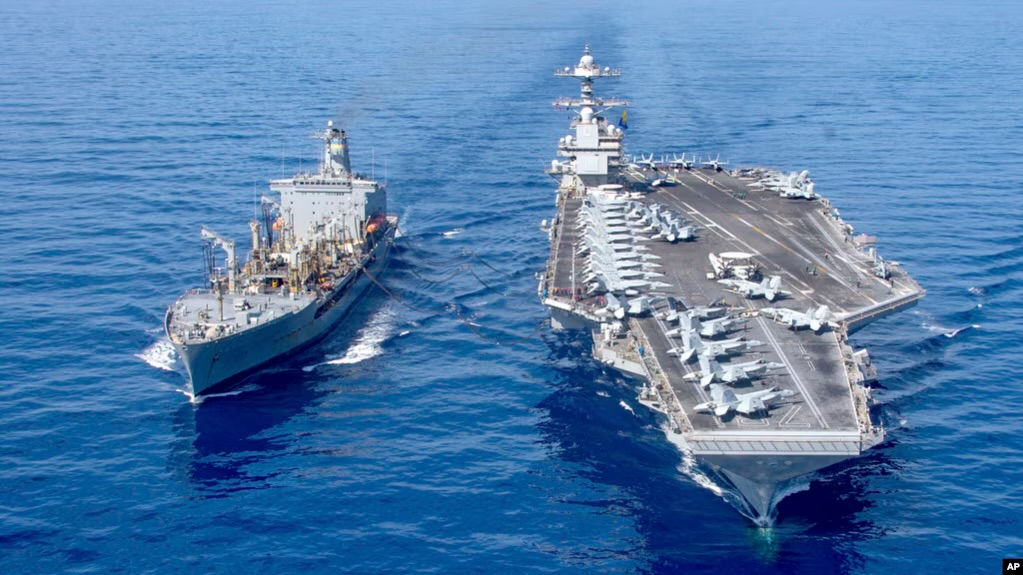
MARKET INSIDER – U.S President Donald Trump said the United States is sending an “armada” toward Iran, signaling a sharp escalation in pressure on Tehran even as he stressed he hopes military force will not be necessary. Speaking aboard Air Force One after meetings with global leaders in Davos, Trump framed the move as both a deterrent and a warning—against renewed violence toward protesters and any attempt to restart Iran’s nuclear program.
U.S. officials confirmed that the aircraft carrier USS Abraham Lincoln and several guided-missile destroyers are expected to arrive in the Middle East in the coming days, with additional air-defense systems under consideration. The deployments, which began shifting from the Asia-Pacific last week, expand Washington’s military options at a moment of heightened tension following months of unrest inside Iran and lingering uncertainty after U.S. strikes on Iranian nuclear facilities last June.
Trump said the buildup was precautionary. “We have a lot of ships going that direction, just in case,” he told reporters, adding that Washington is watching Tehran “very closely.” The administration argues the posture is designed to protect U.S. forces in the region while preserving the ability to respond quickly if Iran escalates—either domestically or on the nuclear front.
The nuclear dimension remains central. Trump reiterated that the United States would strike again if Iran attempted to revive its nuclear program after last year’s attacks on key sites. According to international benchmarks cited by the International Atomic Energy Agency, Iran previously held roughly 440 kilograms of uranium enriched to 60% purity—material that, if further refined, could be sufficient for around 10 nuclear weapons. The IAEA has not verified Iran’s stockpile for at least seven months, intensifying global concern over transparency and compliance.
Inside Iran, the political calculus is equally volatile. Protests that erupted in late December over economic hardship spread nationwide and were met with a severe crackdown. Rights groups estimate more than 4,500 unrest-related deaths, the vast majority protesters, while Iranian officials acknowledge over 5,000 fatalities including security personnel. Trump claimed his threats led Tehran to halt nearly 840 planned executions—an assertion Iran has not independently confirmed—but warned that renewed killings would trigger an even harsher response.
The forward-looking question for investors and policymakers alike is whether this show of force stabilizes the region or merely resets the escalation ladder. With energy markets, global shipping routes, and nuclear nonproliferation all in play, the U.S. “armada” is less about imminent war than about leverage—and whether deterrence still works in a Middle East shaped by protest politics and nuclear ambiguity.
