
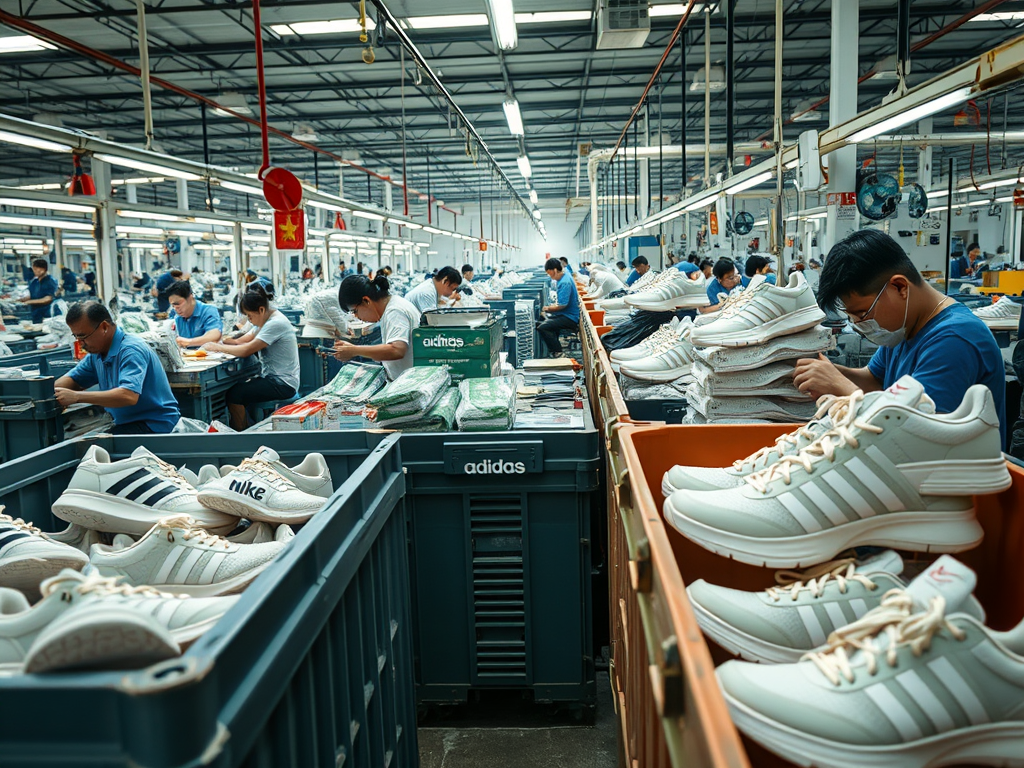
Market Insider – For decades, China has been synonymous with the title of “The World’s Factory,” churning out everything from cars and toys to computers. Yet, in one specific, high-growth sector—the multi-billion-dollar athletic footwear industry—Vietnam has definitively seized that crown. This transition is a powerful case study for investors and international businesses seeking to diversify their global supply chains away from China.
The bustling industrial parks surrounding Ho Chi Minh City are now the epicenter of global sneaker production. Factories produce foam soles, soft linings, cotton laces, and mesh fabric, which are then assembled into the final products for the world’s leading brands. Containers packed with shoes from Nike, Adidas, Saucony, and Brooks Sports are a common sight, traveling down the Dong Nai River to be loaded onto ocean freighters.
The Scale of Vietnam’s Dominance
Vietnam has surpassed China to become the No. 1 global supplier of athletic footwear for many of the industry’s titans.
According to Nike’s annual report for the fiscal year 2024 (ending May 31, 2024), Vietnam is their single largest manufacturing hub. In footwear, the top three production locations for Nike are:
| Location | Share of Nike Footwear Production |
| Vietnam | 50% |
| Indonesia | 27% |
| China | 18% |
Vietnam, Indonesia, and China collectively account for 95% of Nike’s total footwear volume, underscoring Vietnam’s critical role at the top of the supply chain.
A Market Poised for Explosive Growth
The shift towards Vietnam is happening in a sector with high growth potential. The global athletic footwear market was estimated at $116.20 billion in 2025 and is projected to surge to $168.92 billion by 2032, maintaining a Compound Annual Growth Rate (CAGR) of 5.49% over that period (Fortune Business Insights).
Decades of Industrial Migration
The move away from China has been a gradual, multi-stage process:
- The 1970s and 80s: Brands initially migrated to Asia to leverage lower costs, with South Korea and Taiwan (China) becoming the early centers for high-volume production.
- The 1980s-90s: As China opened its economy, its immense labor force attracted Taiwanese and Korean manufacturers, like the massive Pou Chen factories, which became “miniature towns” of production.
- The 2000s: Vietnam Enters the Scene: Vietnam’s economic reforms started attracting serious investor attention. By the mid-2000s, it began producing basic shoe models.
- The 2010s: Cost and Diversification: Rising labor costs and rampant intellectual property violations in China forced brands to diversify. Vietnam emerged as the preferred alternative due to its younger workforce and a government actively courting foreign investment. By the time of the US-China trade war, Vietnam was already producing advanced running shoes for the global market, with China’s output increasingly reserved for its large domestic market.
- The 2020s: The Pandemic Accelerator: The COVID-19 border closures in China exposed a dangerous over-reliance. Corporate leadership accelerated investment into Vietnam to mitigate future risk.
Building a Localized Ecosystem
The Vietnamese ecosystem is now robust enough that it is largely self-reliant. For example, Jones & Vining, a 90-year-old American company that manufactures shoe molds, has been in Vietnam since 2011, following Puma, Nike, and Adidas. CEO Jim Salzano noted that footwear production in Vietnam is “very independent of China,” despite some raw materials still needing to be imported.
The growth has transformed local life. Along the routes connecting factories to the Ho Chi Minh City port, highways are now jammed with trucks carrying goods, a stark contrast to the rice paddies of previous decades. This industry has created millions of jobs, lifting local communities. As one of the first workers at the Viet Vinh factory in 1995 recalled: “That job gave us income and changed our lives for the better.”
Investor Takeaway
The athletic footwear industry provides a clear roadmap for supply chain diversification. For investors, Vietnam represents a key growth hub—not just for footwear, but for other industries following the same “China Plus One” strategy. The rapid, successful shift of major global brands confirms Vietnam’s critical status as the indispensable, low-risk manufacturing center for consumer goods. The market’s reaction in 2017—when a proposed US tariff on Vietnamese goods caused Nike and Adidas stock to tumble—underscores just how essential Vietnam has become to the global trade landscape.
