
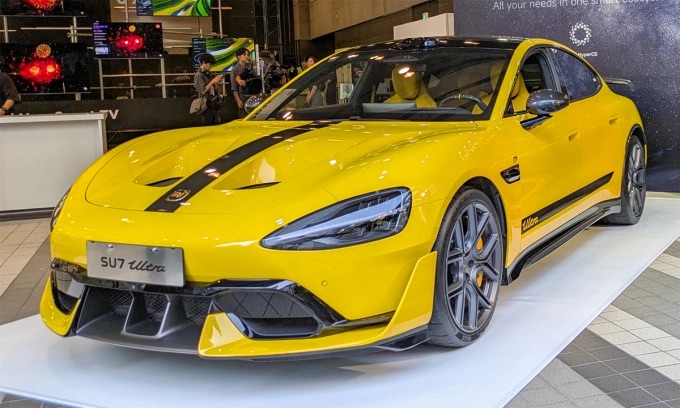
Tokyo, June 29, 2025 — Chinese technology giant Xiaomi unveiled its flagship electric vehicle, the SU7 Ultra, in Tokyo’s Akihabara district on Sunday, marking its first major EV showcase in Japan. While no sales launch date has been set for the Japanese market, the move signals Xiaomi’s ambition to expand beyond smartphones and smart home devices into the competitive electric mobility sector.
The SU7 Ultra, presented in three variants — Standard, Track Edition, and a Nürburgring Limited Edition — comes with starting prices ranging from 529,900 yuan ($73,000) for the base model to 814,900 yuan ($112,000) for the exclusive Nürburgring edition, of which only ten units will be produced in 2025.
The Tokyo showcase also included scale models of the EV. A 1:18 SU7 Ultra miniature is priced at 16,800 yen ($112), while the standard SU7 model is sold at 14,800 yen ($99), reflecting Xiaomi’s push to engage with Japanese consumers at multiple levels.
Retail Expansion in Japan
Beyond EVs, Xiaomi is rapidly strengthening its retail footprint in Japan. Currently operating two stores in Saitama, the company plans to open three more outlets in the Tokyo metropolitan area — including Chiba — by year-end. Further expansion into Osaka and Nagoya is slated for 2026, with nationwide rollout under consideration.
Zheng Yan, Vice President of Xiaomi Technology Japan, said the company will adopt the same strategy used in China by selling EVs through its smartphone and electronics retail stores. Xiaomi aims to operate 5–10 stores across Japan by 2025, expanding its product portfolio to include larger home appliances such as air conditioners.
Global EV and Retail Strategy
Xiaomi’s entry into Japan aligns with its broader vision of “Human x Car x Home” — an ecosystem where smartphones, home devices, and electric vehicles integrate seamlessly. A typical scenario, the company notes, is a driver arriving home in a Xiaomi EV to find the front door unlocking automatically and interior lights switching on.
Globally, Xiaomi has been ramping up its EV and retail strategy. Having launched iWeibingtric car business in China earlier this year, the company has already announced plans to enter Europe’s EV market by 2027. President Lu Weibing recently outlined a bold target of opening 10,000 Xiaomi stores worldwide within the next five years, signaling the group’s ambition to evolve into a holistic technology and mobility powerhouse.
