
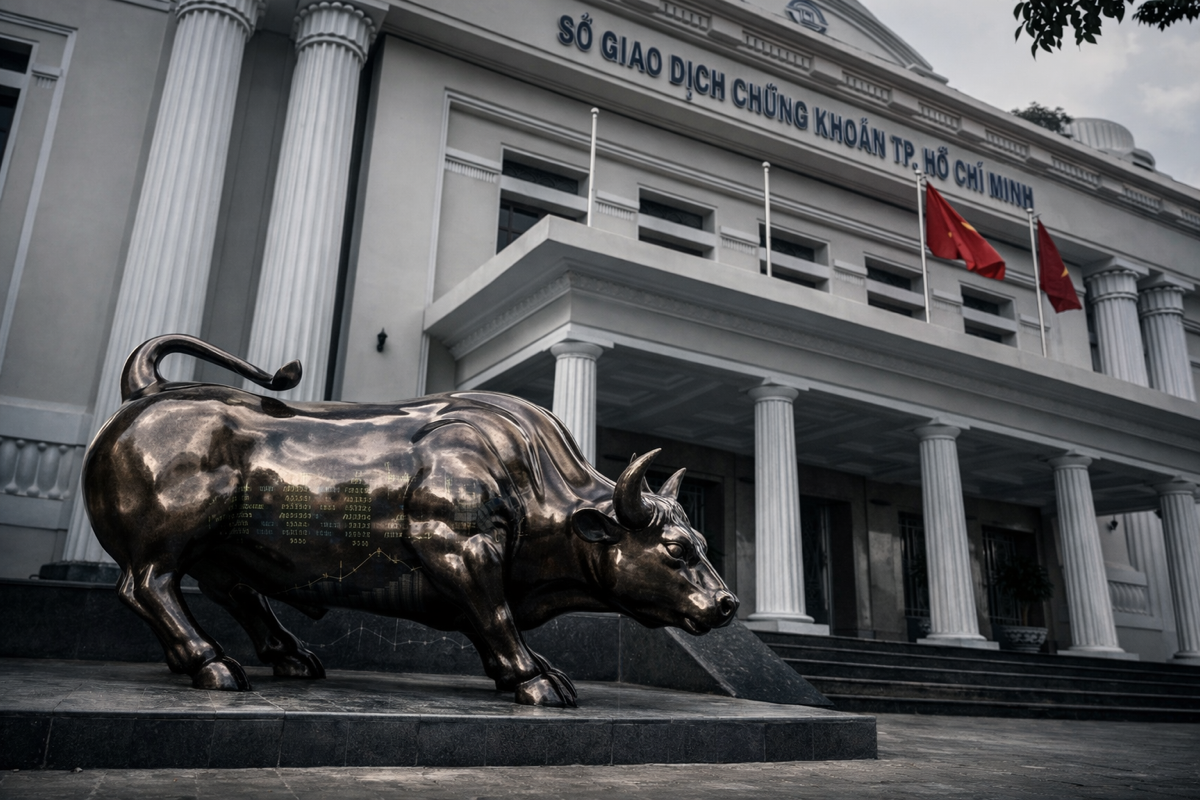
Twenty-seven Vietnamese stocks may attract passive inflows as FTSE begins the country’s emerging-market transition in September.
MARKET INSIDER – Vietnam’s long-awaited stock-market upgrade is approaching its first major capital-flow test. As FTSE Russell prepares to move Vietnam into its Secondary Emerging Market category on September 21, 2026, analysts estimate that 27 Vietnamese stocks could eventually attract around $1.5 billion in index-driven buying. For global investors, the upgrade marks more than a classification change: it could begin a multi-year integration of one of Southeast Asia’s fastest-growing equity markets into mainstream emerging-market portfolios.
FTSE Russell is expected to announce the official results of its September 2026 FTSE Global Equity Index Series, or FTSE GEIS, review on August 21. The review is particularly significant because it comes just one month before Vietnam’s formal reclassification from frontier to Secondary Emerging Market status.
Yuanta Securities estimates that 27 Vietnamese companies could enter relevant FTSE indices, generating approximately $1.5 billion in cumulative passive buying once Vietnam reaches its full intended weighting.
The money, however, is unlikely to arrive overnight.
FTSE’s integration is expected to take place across four stages over roughly one year, limiting the risk of market disruption while giving international index funds time to build positions.
The first phase becomes effective on September 21, with Vietnam receiving 10% of its eventual investable weighting. Yuanta estimates that this could trigger approximately $150 million in initial purchases.
A second adjustment in March 2027 is expected to lift the cumulative weighting to 30%, bringing another estimated $300 million. Further additions in June and September 2027 could generate roughly $525 million each, completing the estimated $1.5 billion allocation.
That phased schedule is critical for investors attempting to trade the upgrade. September’s $150 million is meaningful, but relatively modest compared with Vietnam’s overall market liquidity. The larger potential catalyst is the approximately $1.35 billion that could follow during the subsequent three phases.
Vingroup Stocks Could Capture Almost Half the Money
The projected inflows are highly concentrated.
Vingroup’s VIC is expected to be the single biggest beneficiary, potentially attracting approximately $554 million once the entire inclusion process is completed. That represents nearly 37% of Yuanta’s estimated total buying, with more than $55 million potentially arriving during September’s initial phase alone.
Vinhomes, or VHM, ranks second with projected cumulative inflows of nearly $174 million, including approximately $17.4 million in the first phase.
Steelmaker Hoa Phat Group, or HPG, could receive around $85.5 million, followed by VPBank at more than $56 million and consumer conglomerate Masan Group at over $55 million.
Other major Vietnamese companies potentially benefiting include technology leader FPT with an estimated $53.7 million, Vietcombank with nearly $52 million, dairy producer Vinamilk with $48.5 million, SSI Securities with more than $39 million and Sacombank with over $38 million.
The concentration matters because large-cap stocks are expected to capture around 53% of the projected purchases. VIC and VHM alone account for nearly 49%.
As a result, Vietnam’s FTSE upgrade may initially look less like a broad-market liquidity event and more like a concentrated repricing of a relatively small group of index heavyweights.
$1.4 Trillion in Global Assets Makes the Upgrade Significant
The longer-term opportunity extends beyond the immediately projected $1.5 billion.
ETFs and index-linked investment products associated with the relevant benchmarks manage an estimated $1.397 trillion in assets globally. Yuanta calculates that roughly $1.54 billion could ultimately be allocated to Vietnam based on the country’s index representation.
For an equity market still transitioning from frontier-market status, access to this pool of institutional capital is strategically important.
Emerging-market classification makes Vietnamese equities investable for a much broader universe of global funds whose mandates previously restricted or limited exposure to frontier markets. It can also improve international research coverage, institutional participation and eventually market liquidity.
Vietnam’s appeal is reinforced by its broader macroeconomic story. The country has emerged as a major manufacturing and foreign direct investment destination in Southeast Asia, benefiting from supply-chain diversification, expanding exports and a growing domestic consumer economy.
The challenge has long been translating that economic story into an equity market that large international institutions can access efficiently.
FTSE reclassification represents an important step toward closing that gap.
Why $150 Million May Not Move the Entire Market
Investors expecting September 21 to unleash a sudden wall of foreign capital may need to temper expectations.
Only about 10% of the estimated FTSE-related allocation is expected during the first stage. At roughly $150 million, that amount is unlikely to transform liquidity or valuations across the entire Vietnamese market.
The impact could nevertheless be substantial for individual companies.
Yuanta identifies Masan Consumer, VIC and VHM among stocks where expected index buying is particularly large relative to normal trading liquidity. When required passive purchases represent several days of average trading volume, index inclusion can create temporary supply-demand imbalances even if the overall amount entering the market appears modest.
This is why investors may find the ratio between expected FTSE purchases and average daily trading value more useful than simply ranking stocks by absolute inflows.
A $50 million purchase can have limited impact on an extremely liquid stock but become a major catalyst for one where normal daily turnover is much lower.
Has the FTSE Upgrade Already Been Priced In?
There is another complication: Vietnam’s emerging-market upgrade is hardly a surprise.
FTSE Russell confirmed the reclassification in April, giving investors months to position ahead of implementation. That creates the classic possibility of a “buy the rumor, sell the news” dynamic.
Selective buying could accelerate ahead of the August 21 index announcement as traders attempt to anticipate which stocks will officially enter FTSE GEIS. But analysts expect the effect to be concentrated among likely index constituents rather than producing another indiscriminate rally across Vietnamese equities.
That distinction is increasingly important after investors have already had substantial time to incorporate the upgrade into valuations.
The first September tranche may therefore prove less important than what happens afterward.
If foreign ownership rises consistently through the March, June and September 2027 implementation stages, Vietnam could begin seeing a more durable improvement in institutional liquidity rather than a temporary index-rebalancing trade.
FTSE Could Be Only the Beginning for Vietnam
The strategic importance of Vietnam’s upgrade goes beyond $1.5 billion.
Moving from frontier to emerging-market status represents an institutional milestone for a market that has spent years reforming settlement infrastructure, foreign-investor access and trading regulations to meet international standards.
It could also strengthen the case for Vietnam eventually gaining inclusion or a higher profile across other major global emerging-market benchmarks. Such developments would potentially expose Vietnamese equities to substantially larger pools of international capital.
For investors, however, the FTSE story should not be reduced to simply buying every stock expected to enter an index. Passive flows can create powerful short-term technical effects, but they do not replace earnings growth, valuation discipline or corporate fundamentals.
The more sophisticated trade may be identifying companies where three factors intersect: strong fundamentals, substantial expected FTSE demand and relatively limited liquidity available to absorb that demand.
Vietnam’s September upgrade will therefore be an important milestone—but not necessarily the climax of the story. The $150 million expected in the first phase may attract the headlines; the more consequential question is whether the remaining $1.35 billion becomes the beginning of sustained global institutional allocation to Vietnamese equities rather than merely a one-year index-rebalancing exercise.
