
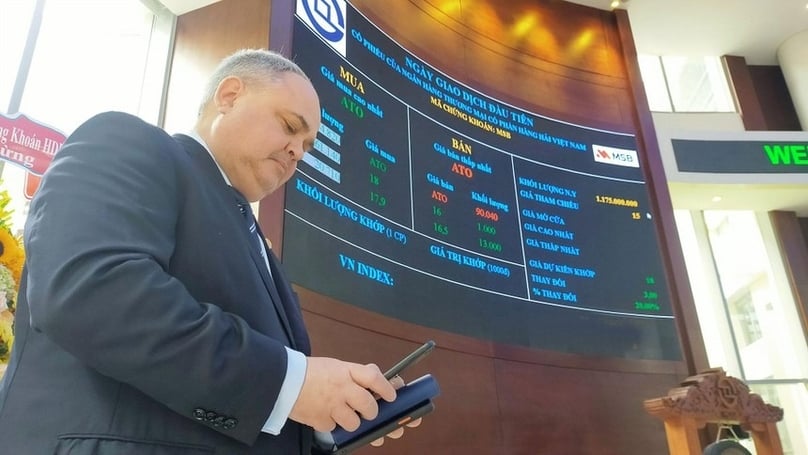
Vietnam’s largest banks, property developers and securities firms will enter FTSE Russell’s global benchmarks from September 21, but the phased rollout means only 10% of their full investable weight will be added initially.
MARKET INSIDER — FTSE Russell has finalized a list of 27 Vietnamese stocks eligible to join the FTSE Global All Cap Index as the country moves from Frontier to Secondary Emerging Market status.
The list remained unchanged after the adjustment period ended on September 4. It includes three large-cap, three mid-cap and 21 small-cap companies, ranging from Vietcombank and Vingroup to MSB, SSI and FPT.
Vietnam’s inclusion begins on September 21, but investors should not expect the country’s full projected index weight—or all associated passive capital—to arrive immediately. FTSE Russell will implement the change in four stages through September 2027.
Key Highlights
- FTSE Russell confirmed 27 Vietnamese stocks for inclusion, including VCB, VIC and VHM as large caps.
- Only 10% of each stock’s eligible investability weight will enter FTSE indexes in September 2026.
- Vietnam’s projected weight in the FTSE Emerging All Cap Index will rise from 0.049% initially to 0.488% when inclusion is completed.
Which Vietnamese stocks made the final list?
FTSE Russell selected the companies after applying the FTSE Global Equity Index Series, or GEIS, eligibility rules using data through June 30, 2026.
The final group comprises:
Large cap: Vietcombank (VCB), Vingroup (VIC), Vinhomes (VHM)
Mid cap: BIDV (BID), Hoa Phat Group (HPG), VPBank (VPB)
Small cap: FPT, GEX, HDB, HCM, MCH, MSN, NVL, STB, SHB, SSB, SSI, TCX, VCI, VJC, VNM, MSB, VRE, VPL, VIX, VND and VPS
The composition gives financial companies a prominent role. Nine banks and six securities firms are represented, reflecting the size, liquidity and expanding market capitalization of Vietnam’s financial sector.
Property and consumer companies also feature, while FPT provides the list’s main large technology exposure and Hoa Phat represents the country’s industrial sector.
FTSE Russell’s size classifications are based on its regional methodology rather than the way Vietnamese investors commonly describe these companies. A stock regarded as a domestic blue chip may therefore appear in FTSE’s small-cap group because it is compared with companies across the Asia-Pacific ex-China ex-Japan universe.
Inclusion will take place in four stages
Vietnam will officially become a Secondary Emerging Market when trading opens on Monday, September 21.
FTSE Russell will remove the country from its Frontier Index Series in a single step. Its addition to FTSE GEIS and related emerging-market benchmarks, however, will occur through four tranches.
FTSE said the phased approach is intended to support an orderly transition, give the market time to absorb anticipated capital flows and ensure adequate liquidity and funding under Vietnam’s non-prefunding settlement model. The index provider will assess whether tracker funds can replicate each tranche before proceeding with the next. (lseg.com)
This sequencing reduces the risk that index funds will be required to acquire their entire Vietnamese allocation during a single rebalancing session.
It also means the September event is the beginning of a year-long process—not a one-day influx of all capital benchmarked to FTSE emerging-market indexes.
Vietnam’s initial index weight will remain small
Based on closing prices on August 21 and the index constituents scheduled to take effect in September.
These projections show why expectations for immediate passive inflows should be moderated. The initial weights are only one-tenth of the levels expected when the transition is completed.
Actual purchases will also depend on the assets managed by funds tracking each benchmark, their replication methods, market prices, foreign-ownership availability and portfolio positions accumulated before the effective date.
Index inclusion does not guarantee that every projected dollar of demand will be executed during the closing auction—or that constituent share prices will rise. Some active and passive investors may buy in advance, allowing part of the expected demand to be reflected before the official rebalance.
Why the upgrade matters beyond short-term fund flows
FTSE Russell first placed Vietnam on its upgrade watchlist in 2018. The eventual promotion followed reforms addressing two longstanding barriers for foreign institutions: prefunding requirements and the handling of failed trades.
Vietnam introduced a non-prefunding mechanism allowing qualifying foreign institutional investors to purchase shares without depositing the full transaction value before placing an order. Authorities also established procedures for dealing with trades when investors fail to deliver funds on time.
FTSE Russell concluded in April that Vietnam met all requirements for Secondary Emerging status. The index provider said improved access to global brokers, simplified account opening and stronger settlement infrastructure were important to making the market easier for international funds to replicate.
Promotion makes Vietnamese stocks eligible for widely followed benchmarks including the FTSE All-World, FTSE Emerging and FTSE Global All Cap indexes. FTSE Russell says approximately $20 trillion is benchmarked to its indexes globally, although only a fraction tracks the specific indexes receiving Vietnamese stocks.
The larger long-term benefit may therefore be institutional recognition rather than the first tranche of passive buying. Emerging-market status increases Vietnam’s visibility among global asset managers and creates a broader international comparison group for local companies.
Inclusion is not permanent
The 27-stock list should not be treated as fixed through September 2027.
Vietnamese securities will continue to face FTSE’s requirements covering market capitalization, liquidity, investable free float and available foreign ownership. Newly eligible stocks can be added during subsequent reviews using the same tranching factor in effect at the time.
Conversely, a partially included company that fails the retention criteria can be removed before receiving its remaining scheduled allocation. FTSE explicitly confirms that Vietnamese securities will be tested for foreign-ownership headroom. (lseg.com)
That provision is especially important in Vietnam, where foreign ownership limits can restrict the shares available to international investors even when a company has a large domestic market capitalization.
What investors should watch next
The September 18 closing auction—the final trading session before the changes take effect—could see elevated turnover as index-tracking funds prepare their portfolios.
Investors should monitor foreign net purchases, negotiated block transactions and closing-auction volumes in the 27 stocks. Price movements before that date may reflect anticipation of the rebalance rather than changes in company fundamentals.
The second issue is implementation quality. Smooth operation of the non-prefunding model, global-broker arrangements and failed-trade procedures will influence FTSE Russell’s decision to proceed with the later tranches.
Finally, investors should distinguish a structural market upgrade from a blanket recommendation on every constituent. FTSE eligibility is based principally on size, liquidity, free float and market accessibility—not valuation, earnings quality or future share-price performance.
The confirmed list is an important milestone for Vietnam’s capital market. But the greater test begins after September 21, when the country must demonstrate that its trading and settlement reforms can support international capital at emerging-market scale.
