
Brookings senior fellow Robert Kagan says Democratic control of Congress, the Iran war and depleted U.S. missile inventories could encourage Moscow and Beijing to test Washington’s resolve.
MARKET INSIDER — Russia and China could become more assertive over the next two years if they conclude that President Donald Trump’s political influence is weakening after Democrats captured both chambers of Congress in the U.S. midterm elections, according to Robert Kagan, a senior fellow at the Brookings Institution. Speaking to CNBC’s Squawk Box Asia, Kagan warned that the war with Iran has strained American military resources, including missile-defense inventories and naval deployments, potentially limiting Washington’s capacity to respond to security challenges in Asia. His assessment highlights growing concerns over U.S. strategic commitments, Taiwan’s security and the geopolitical risks facing global investors.
Key takeaways
- Brookings senior fellow Robert Kagan warned that Russia and China may see a narrowing opportunity to advance their strategic interests as Trump’s political position weakens.
- U.S. military operations connected to the Iran conflict have placed pressure on missile-defense inventories and naval deployments, raising questions about readiness in the Indo-Pacific.
- A potential Trump-Xi-Putin meeting at the APEC summit in Shenzhen could become a major diplomatic event, although its agenda and prospects remain uncertain.
Why Could Russia and China Become More Assertive?
Kagan’s argument centers on how geopolitical rivals interpret changes in American political power.
Following the November 3 midterm elections, Democrats secured control of both the House of Representatives and the Senate, creating new constraints on Trump’s domestic legislative agenda.
Kagan suggested that Beijing and Moscow could interpret the election results as evidence that the president’s political influence is diminishing.
“If it’s clear that Donald Trump is on his way out,” Kagan told CNBC, Russia and China might conclude that the next two years offer a window to act before a potential change in American leadership.
The assessment is a warning about possible strategic calculations, not evidence that either government has decided to launch new military operations.
Trump remains president, and the midterm election results do not alter his constitutional authority as commander in chief.
Nevertheless, divided government could complicate negotiations over defense spending, foreign policy and other measures requiring congressional cooperation.
Kagan’s concern is that perceptions of political weakness, combined with military overstretch, may affect how rival powers assess Washington’s willingness and ability to respond to international crises.
Has the Iran War Weakened U.S. Military Readiness?
A central part of Kagan’s warning concerns the resources consumed by U.S. military operations in the Middle East.
He argued that the conflict involving Iran has exposed limitations in America’s capacity to sustain intensive military operations while maintaining readiness for potential confrontations elsewhere.
In particular, he highlighted the depletion of missile-defense interceptors used to protect U.S. forces and allies against Iranian attacks.
According to Congressional Budget Office estimates cited by CNBC, operations since June 2025 may have consumed as much as two-thirds of certain U.S. missile-defense interceptor inventories.
That estimate does not mean two-thirds of every category of American missile or air-defense weapon has been exhausted. Different systems have separate inventories, production schedules and operational requirements.
Nevertheless, interceptor availability matters because replenishing sophisticated defensive weapons can take years.
Kagan warned that these weapons are especially important in the Indo-Pacific, where U.S. forces could face substantial missile threats in a potential conflict involving China.
The concern extends beyond ammunition stocks.
The deployment of three U.S. aircraft carriers to the Middle East has reduced the naval capacity immediately available for other regions, according to the account discussed by Kagan.
Aircraft carriers and their accompanying strike groups provide capabilities including air operations, surveillance, deterrence and support for allied forces.
Their allocation to one theater can affect the resources available elsewhere, although deployment patterns change and do not by themselves establish an inability to respond to a new crisis.
For military planners, the underlying challenge is maintaining credible commitments across multiple regions while rebuilding equipment inventories.
Why Is Taiwan Central to the U.S.-China Risk?
Taiwan remains one of the most sensitive potential flashpoints between Washington and Beijing.
China claims Taiwan as part of its territory and has not ruled out the use of force to achieve unification.
Taiwan operates under its own elected government and rejects Beijing’s claim of sovereignty.
The United States maintains unofficial relations with Taiwan and provides defensive support under the Taiwan Relations Act, but it does not have a mutual-defense treaty requiring an automatic military response to an attack.
Kagan suggested that Trump’s preference for economic negotiations with China could influence Beijing’s assessment of Washington’s willingness to confront it over security issues.
He argued that the president appeared more interested in securing commercial agreements than pursuing a confrontational strategy.
The administration’s handling of arms sales to Taiwan has also attracted attention.
According to the supplied CNBC report, Trump approved an approximately $11 billion arms package for Taiwan in December but subsequently held back a second package valued at roughly $14 billion, describing it as a potential bargaining instrument in discussions with Beijing.
The details and status of those packages require confirmation against official U.S. notifications and statements.
For Taiwan, the reliability and timing of military support matter alongside the broader diplomatic relationship.
Former CIA Director William Burns said in 2023 that Chinese President Xi Jinping had instructed the People’s Liberation Army to develop the capability to conduct an invasion of Taiwan by 2027.
Burns emphasized that this did not mean Beijing had decided to invade in 2027 or at any other specific time.
That distinction remains important. Military preparation and political intent are not the same, and no publicly established invasion timetable can be inferred from the 2027 readiness objective.
Could Trump, Xi and Putin Meet at APEC?
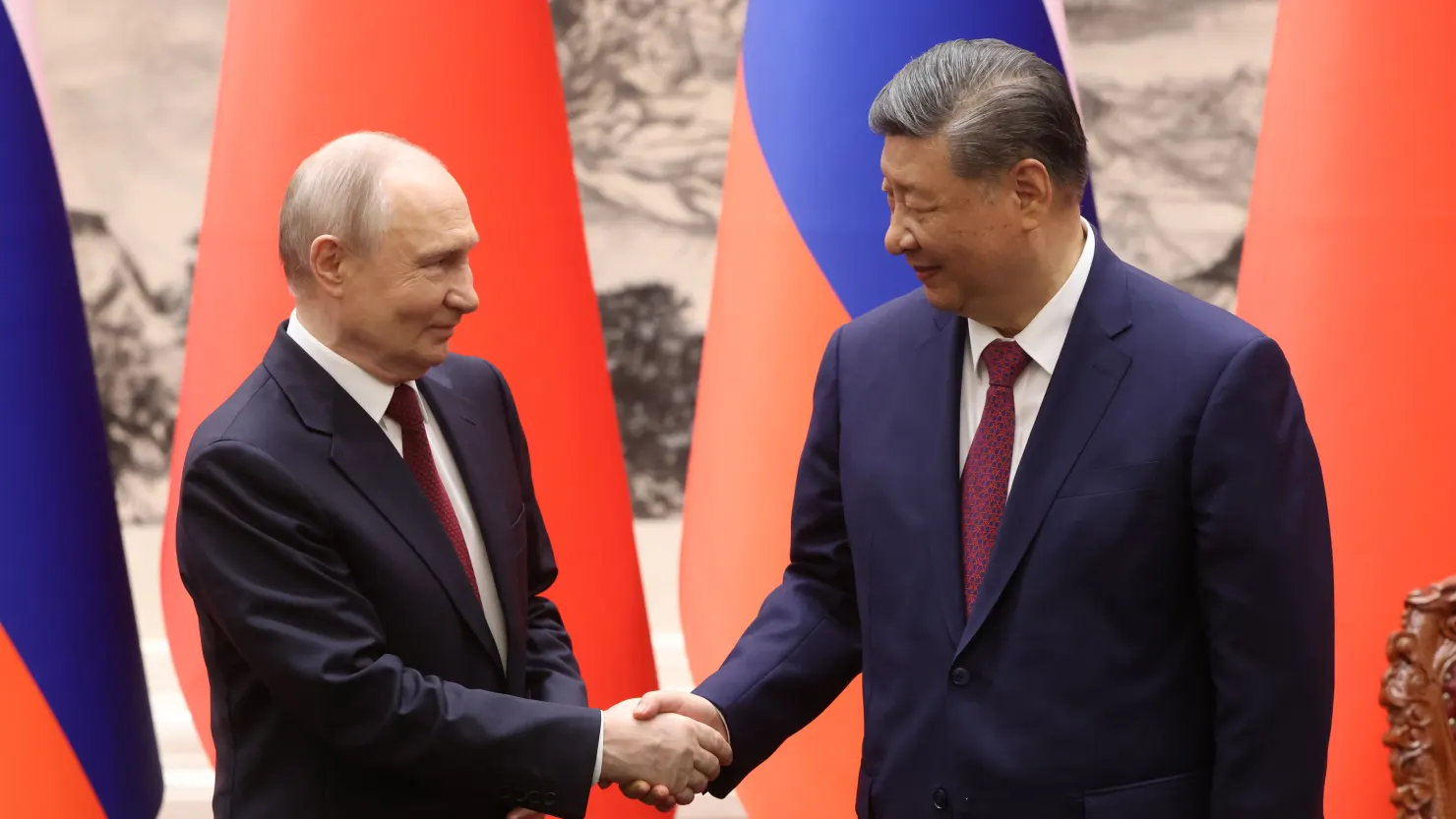
The geopolitical debate comes as Washington, Beijing and Moscow discuss the possibility of a trilateral meeting involving Trump, Xi and Russian President Vladimir Putin.
The proposed meeting could take place during the Asia-Pacific Economic Cooperation leaders’ gathering in Shenzhen later in November.
Chinese Foreign Ministry spokesperson Mao Ning said on November 4 that Beijing was communicating with relevant parties about a possible meeting among the three leaders.
No confirmed agenda was announced in the account provided.
Putin had reportedly suggested a three-way summit in October, potentially including discussions about ending the war in Ukraine.
The reported proposal did not include Ukrainian President Volodymyr Zelenskyy, raising questions about the format and legitimacy of any negotiations concerning Ukraine’s future.
A meeting among the three leaders could provide an opportunity to discuss strategic stability, regional security and major economic disputes.
However, the existence of diplomatic contacts does not establish that a summit will take place or produce substantive agreements.
The significance would depend on the participants, agenda, commitments and subsequent actions.
What Are the Risks for Financial Markets?
The potential consequences of increased geopolitical competition extend well beyond defense policy.
For global investors, the most important transmission channels include energy prices, trade disruptions, supply-chain security, defense spending and shifts in risk appetite.
The Iran conflict has already highlighted the sensitivity of oil markets to disruptions in the Middle East.
A further escalation involving Russia or China could create additional uncertainty for commodity prices, shipping routes and international commerce.
Taiwan-related tensions would be especially consequential for the global technology industry because of the island’s central role in advanced semiconductor manufacturing.
A disruption to semiconductor production or cross-strait shipping could affect companies across electronics, automotive manufacturing, artificial intelligence infrastructure and industrial equipment.
Financial markets could also respond through changes in demand for U.S. Treasuries, gold, the dollar and other assets commonly used during periods of geopolitical stress.
However, the direction and magnitude of those reactions would depend on the specific event and prevailing financial conditions.
Geopolitical warnings should not be treated as evidence that a military confrontation is imminent.
Kagan’s comments represent one expert’s assessment of strategic risks rather than a confirmed forecast of Russian or Chinese actions.
Why It Matters for Asia and Emerging Markets
For Asian economies, the interaction between U.S. military commitments and China’s regional ambitions is particularly important.
Japan, South Korea, Taiwan and Southeast Asian countries all have economic or security interests affected by the balance of power in the Indo-Pacific.
Vietnam, for example, has substantial trade relationships with both the United States and China while maintaining interests in maritime stability and uninterrupted regional commerce.
A deterioration in U.S.-China relations could affect export demand, foreign investment decisions and regional supply-chain planning.
For investors in emerging Asian markets, geopolitical uncertainty may also influence currency movements, capital flows and risk premiums.
At the same time, efforts to diversify production and supply chains could create opportunities for economies able to offer stable manufacturing environments.
The net impact would depend on the severity of geopolitical tensions and whether businesses respond by delaying investment or reallocating production.
Outlook: What Investors Should Watch Next
Three developments will help determine whether Kagan’s warning translates into a more significant geopolitical risk.
First, the scale and pace of U.S. missile-defense replenishment and naval redeployments will provide evidence of Washington’s ability to sustain commitments in multiple regions.
Second, U.S.-China diplomacy, Taiwan arms-transfer decisions and military activity in the Taiwan Strait will offer more concrete indicators of regional security conditions.
Third, confirmation of a Trump-Xi-Putin meeting, together with any substantive agreements on Ukraine, Iran or broader strategic issues, could influence perceptions of geopolitical stability.
For investors, the appropriate distinction is between an elevated risk environment and an inevitable escalation.
Kagan’s warning underscores the possibility that political change in Washington and military commitments in the Middle East could influence the calculations of rival powers. Whether those perceptions lead to more aggressive action remains uncertain.
