
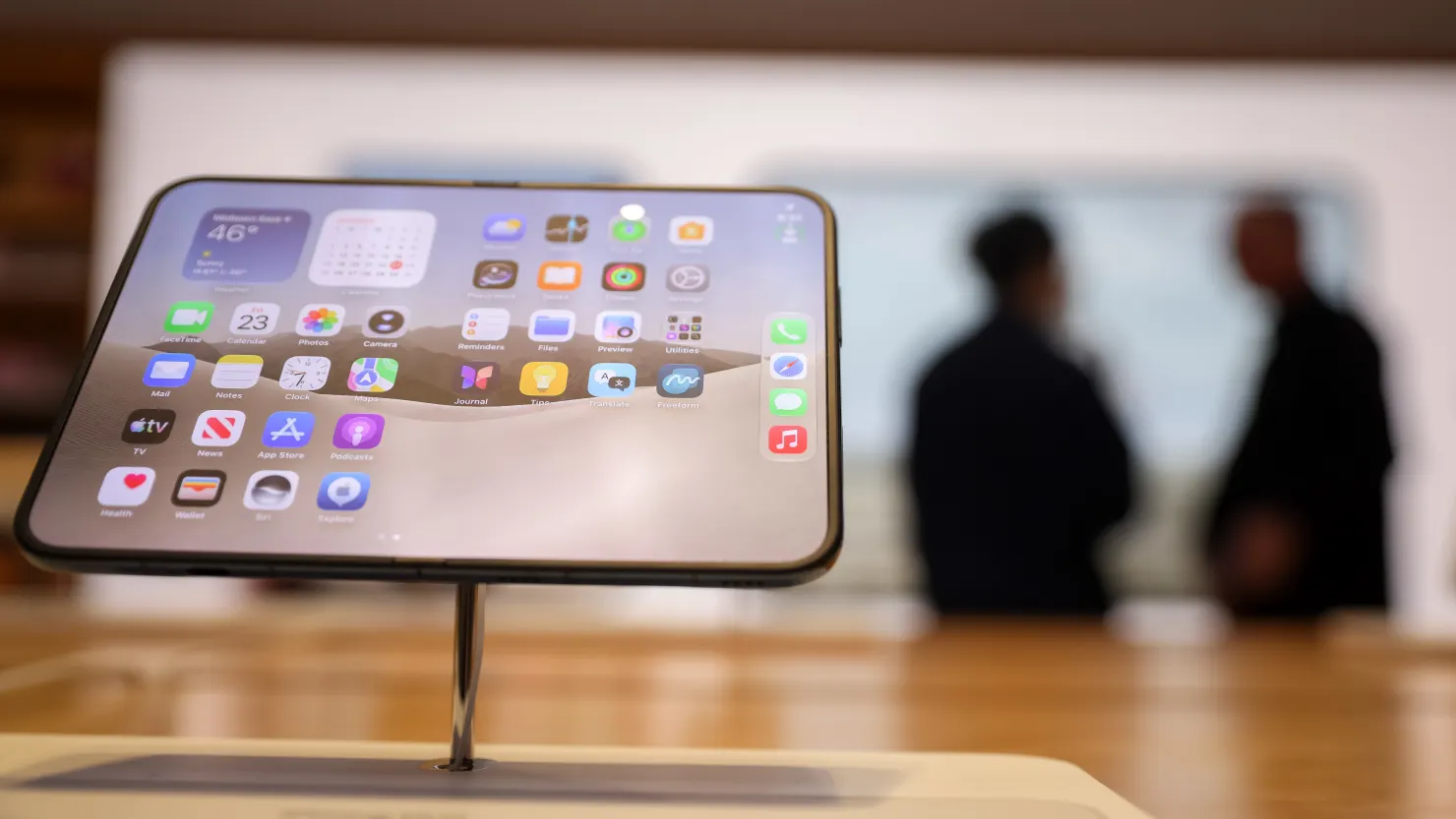
Apple says a small number of its $1,999 foldable iPhones have developed inner-display problems, raising questions about repair costs, hinge reliability and consumer confidence.
MARKET INSIDER — Apple has acknowledged reports of broken inner displays on its new iPhone Duo, just days after the $1,999-and-up foldable smartphone went on sale on Friday, October 23, 2026. Some early buyers reported bright horizontal lines appearing across the device’s folding screen, prompting Apple to offer replacements through AppleCare. The company said on Monday, October 26, that the issue affected a small number of units but did not disclose how many devices were involved. The complaints highlight a longstanding challenge for foldable smartphones: delivering the durability consumers expect from premium devices.
Key takeaways
- Apple acknowledged inner-screen failures affecting what it described as a small number of iPhone Duo units and directed affected customers to AppleCare for replacements.
- Apple’s published repair information lists an out-of-warranty inner-display repair price of $999, approximately half the phone’s $1,999 starting price.
- Repair specialists at iFixit identified the hinge assembly as a possible vulnerability, although the precise cause of the reported failures has not been established.
What Is Happening to iPhone Duo Screens?
Apple’s first foldable iPhone has encountered an early reliability challenge despite strong initial consumer interest.
The iPhone Duo launched to long queues at retail stores and extended preorder waiting times, according to CNBC. Its folding design allows users to open the device into a larger display intended for multitasking, video viewing and other activities that benefit from additional screen space.
However, some customers reported display failures within days of receiving their devices.
Images and accounts shared on Reddit and X described bright horizontal lines extending from the hinge area across the inner screen. Some users said the damage appeared while opening or closing the device.
Apple confirmed that it was investigating complaints involving the inner display.
“We are aware of an issue impacting the inner display on a small number of iPhone Duo units,” an Apple representative told CNBC.
The company advised customers experiencing the problem to contact AppleCare for a replacement.
Apple has not publicly identified a root cause or announced a broader product recall.
The scale of the issue also remains uncertain. Most initial reports originated from anonymous social media accounts, and some images circulating online were reportedly fabricated.
Consequently, the available evidence does not establish a failure rate for the iPhone Duo or demonstrate that the problem affects the wider production run.
Could Apple’s Foldable Hinge Be Causing the Damage?
Independent repair specialists have raised questions about whether the iPhone Duo’s hinge architecture could contribute to the reported failures.
Device repair company iFixit examined the handset shortly after launch, dismantling its components and testing its resistance to dust.
In a teardown video published on Sunday, October 25, iFixit technician Shahram Mokhtari discussed accounts from users who reported hearing a crunching sound while folding or unfolding the device.
Mokhtari observed that the hinge’s shape changes around the area where some damage had been reported.
iFixit Chief Executive Kyle Wiens also highlighted the complexity of the mechanism, explaining that foldable hinges contain numerous precisely manufactured components.
Small manufacturing variations or particles trapped within the assembly could potentially damage the flexible display, he suggested.
These observations represent a technical hypothesis, not a confirmed diagnosis of the iPhone Duo failures.
Flexible screens operate under different mechanical conditions from conventional smartphone displays. Repeated folding introduces stress around the hinge, while the design must also protect delicate display layers from dust and other particles.
Even small changes in component alignment can become important when manufacturers are working with extremely tight tolerances.
For Apple, determining whether the failures arise from isolated manufacturing defects, environmental contamination or a broader design issue will be critical to assessing the scale of the problem.
Why Does a $999 Screen Repair Matter?
The financial implications for consumers are substantial.
According to Apple’s repair information cited by CNBC, replacing an iPhone Duo’s inner display outside warranty costs $999.
That represents approximately 50% of the device’s $1,999 starting price.
The unusually high repair cost reflects a broader challenge facing foldable smartphones: their flexible display assemblies are more complex than the rigid screens used in conventional handsets.
For consumers, the cost changes the economics of ownership.
A premium smartphone is generally expected to remain usable for several years. If its most important component is expensive to replace, buyers may place greater emphasis on warranty coverage, accidental-damage protection and long-term reliability.
Apple has said affected customers should contact AppleCare for replacements, but the company’s statement does not establish that every type of screen damage will qualify for free service.
Coverage may depend on the circumstances of the failure and applicable warranty terms.
The repair price could also influence purchasing decisions among consumers who are considering a foldable phone for the first time.
How Does the Problem Compare With Samsung’s Early Foldable Phones?
Apple is not the first major smartphone manufacturer to encounter durability concerns during the introduction of foldable technology.
Samsung faced similar scrutiny in 2019 when early reviewers of its original Galaxy Fold reported broken or malfunctioning displays.
Those problems became a defining challenge for the emerging product category, highlighting the difficulty of engineering screens that can repeatedly bend without compromising durability.
The comparison is relevant because Apple’s entry into the foldable market was expected to bring its established hardware engineering, software integration and customer-service infrastructure to a technology category already pioneered by Android manufacturers.
Early reviews of the iPhone Duo have praised the larger unfolded display, particularly for multitasking and entertainment.
However, reviewers have also noted that some applications are not yet optimized for its wider screen dimensions.
Apple said developers were already updating applications to support the new form factor.
The combination of hardware reliability and software compatibility will be important in determining whether foldable smartphones can appeal to consumers beyond technology enthusiasts and early adopters.
What Does This Mean for Apple and Its Supply Chain?
The immediate financial impact of the reported failures cannot be quantified without information about affected units, replacement costs and overall sales.
Nevertheless, the episode introduces a potential risk to Apple’s premium smartphone strategy.
At a starting price of $1,999, the iPhone Duo targets customers willing to pay substantially more for a different mobile computing experience.
Those buyers may also have particularly high expectations for product quality, after-sales service and durability.
For investors, the issue raises questions about warranty expenses, manufacturing yields and the potential need for design or production adjustments.
If the failures prove isolated, replacements may be sufficient to resolve the matter without materially affecting demand.
A more widespread manufacturing or design problem, however, could increase service costs, complicate production and weaken consumer confidence.
These are possible scenarios rather than confirmed financial consequences.
The implications also extend to Asia’s technology manufacturing ecosystem.
Foldable devices rely on specialized displays, precision hinges, advanced materials and complex assembly processes, areas in which Asian manufacturers play important roles.
Apple’s experience could influence future engineering requirements, quality-control standards and component procurement across the broader foldable smartphone industry.
For suppliers, the key question is whether Apple’s investigation identifies an isolated production issue or a technical challenge requiring changes to components or assembly processes.
Why It Matters
The iPhone Duo’s early screen complaints illustrate a fundamental tension in the premium smartphone market.
Manufacturers are introducing increasingly sophisticated hardware to justify higher selling prices, but technological complexity can also create new reliability risks and ownership costs.
For Apple, the challenge is particularly significant because its brand positioning depends heavily on product quality, customer satisfaction and integration between hardware and software.
A foldable phone that delivers a superior multitasking experience but creates uncertainty over screen durability may struggle to attract buyers who prioritize long-term value.
The issue also underscores why early sales enthusiasm should not automatically be interpreted as evidence of sustainable mass-market demand.
The more meaningful test will be whether the iPhone Duo can maintain consumer satisfaction after months of everyday folding, unfolding and transport.
What Investors Should Watch Next
Three developments will determine the significance of the iPhone Duo’s early display problems.
First, investors should monitor whether Apple releases further information about the number of affected devices or identifies a specific manufacturing or design defect.
Second, any changes to warranty policies, repair pricing or replacement procedures could indicate how the company intends to manage customer concerns.
Third, future teardown assessments, independent durability tests and longer-term customer reports should help establish whether the failures are isolated or more widespread.
Apple’s response may prove as important as the defect itself. The company’s ability to resolve early hardware issues while preserving consumer confidence will help determine whether its first foldable iPhone becomes a lasting premium product category or faces a more difficult adoption curve.
