
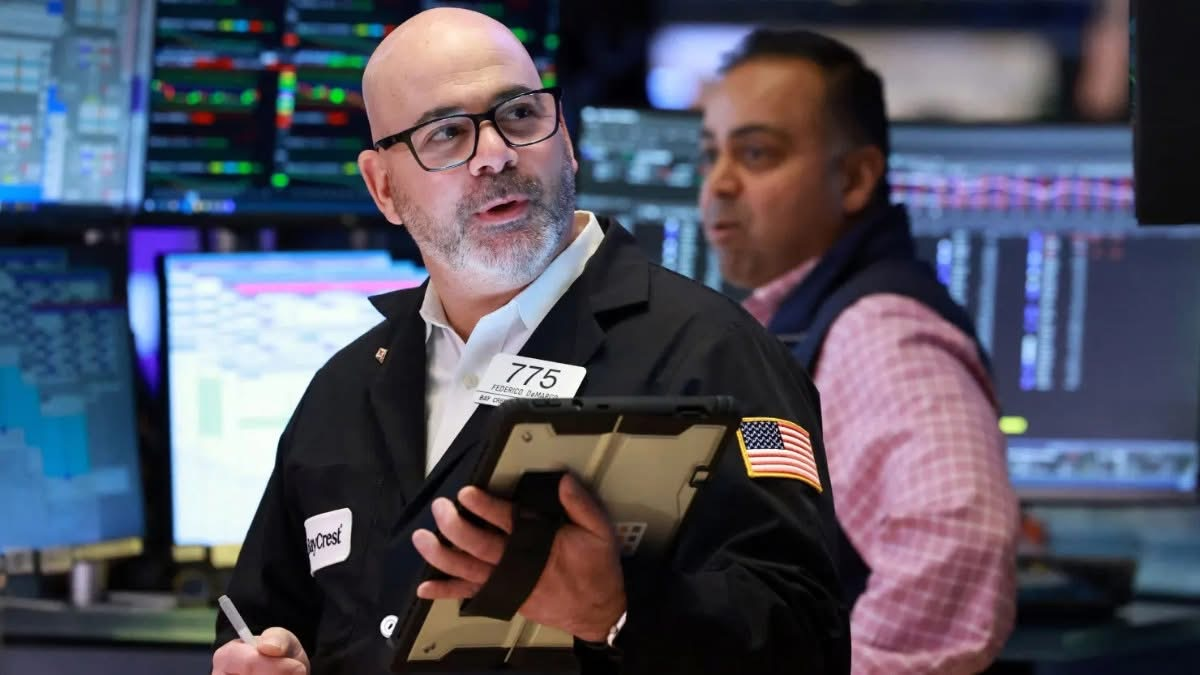
Wall Street futures held near unchanged after rising oil prices pressured stocks, leaving investors to assess whether corporate earnings can support valuations amid geopolitical and interest-rate risks.
MARKET INSIDER — US stock futures were little changed early on July 21, 2026, after rising oil prices and renewed US-Iran tensions pushed the Dow Jones Industrial Average down 307.16 points in the previous session. Dow futures edged up less than 0.1%, while S&P 500 and Nasdaq 100 futures were broadly flat. Investors shifted their attention to quarterly earnings from General Motors, 3M and Chubb, followed later in the week by Alphabet, IBM and Tesla, with artificial-intelligence spending and management guidance expected to shape market direction.
Key takeaways
- The Dow fell 0.59% on July 20, while the S&P 500 lost 0.19% and the Nasdaq Composite slipped 0.05%.
- West Texas Intermediate crude settled 0.9% higher at $83.23 a barrel and Brent gained 1.3% to $89.22.
- Investors are watching whether major companies maintain spending and earnings guidance despite higher energy costs, bond yields and geopolitical uncertainty.
Why were US stock futures little changed?
The muted futures market reflected a balance between resilient technology stocks and the renewed inflation and geopolitical risks generated by higher oil prices.
Futures linked to the Dow added about 14 points, while S&P 500 and Nasdaq 100 contracts showed little movement. The restrained trading followed modest losses across all three major US indexes on July 20.
The Dow closed at 51,839.26, down 307.16 points or 0.59%, according to Associated Press market data. The S&P 500 declined 0.19% to 7,443.28, while the Nasdaq Composite slipped 0.05% to 25,508.07.
Apple was a major drag on the Dow, falling about 2%. Chip shares recovered some of the steep losses recorded during the previous week, helping prevent a larger decline in the Nasdaq.
The VanEck Semiconductor exchange-traded fund posted a modest gain, supported by Micron Technology and Advanced Micro Devices. AMD rose after expanding an artificial-intelligence partnership with Microsoft, according to the Associated Press.
| Market indicator | July 20 close or latest move |
|---|---|
| Dow Jones Industrial Average | -0.59% |
| S&P 500 | -0.19% |
| Nasdaq Composite | -0.05% |
| West Texas Intermediate crude | $83.23, up 0.9% |
| Brent crude | $89.22, up 1.3% |
| Apple | About -2% |
| Dow futures | Less than +0.1% |
How are Middle East tensions affecting stocks?
Oil remains the most direct transmission channel between the Middle East conflict and global financial markets.
US crude futures settled at $83.23 a barrel on July 20, while Brent closed at $89.22 after briefly moving above $90. Prices rose as President Donald Trump threatened retaliation over the deaths of US service members in attacks attributed to Iran.
Trump said Iran would pay “many times over” for each American life lost, according to a Reuters report. The warning heightened concerns that further military escalation could disrupt energy production or shipping through the Gulf.
Oil later eased during Asian trading on July 21 as diplomatic mediation generated hope for a temporary ceasefire. Brent traded around $88.88 a barrel, Reuters reported, illustrating how markets were responding rapidly to changing political headlines.
A sustained oil increase would affect equities through several channels. Higher fuel costs can reduce consumer spending, compress corporate margins and keep inflation elevated. Persistent inflation can also delay monetary easing or push government bond yields higher, increasing the discount rate applied to future corporate earnings.
Energy producers may benefit from higher crude prices, but airlines, transport companies, manufacturers and consumer-facing businesses face greater cost pressure.
Why are earnings becoming the market’s next test?
Earnings season provides investors with company-level evidence on whether economic and geopolitical pressure is beginning to affect revenue, margins or investment plans.
General Motors and 3M were scheduled to report before the July 21 opening bell. Chubb was due to publish results after the market close. Alphabet, IBM and Tesla were among the major companies expected later in the week.
The reports matter because US equities have already completed a strong three-month advance. High valuations leave less room for disappointing results, particularly among technology companies that have benefited from enthusiasm over artificial intelligence.
“Earnings are continuing to flow in, but they may provide more support than a catalyst,” Callie Cox, chief market strategist at Ritholtz Wealth Management, said in the original CNBC report. She noted that demanding expectations and rising global yields were forcing investors to compare potential equity growth with increasingly attractive fixed-income returns.
Investors will focus on three questions:
- Are companies maintaining their forecasts for the second half of 2026?
- Is AI-related capital expenditure continuing at its previous pace?
- Are energy, financing and supply-chain costs beginning to weaken margins?
Solid results may stabilise equities, but companies may need to exceed expectations and provide confident guidance to generate a sustained rally.
What will investors look for in AI earnings?
Alphabet’s results will offer insight into demand for Google Cloud, the monetisation of AI products and the cost of building computing infrastructure. Capital expenditure will be particularly important because large technology companies are spending heavily on data centres, advanced chips and energy capacity.
IBM can provide a different view of corporate AI adoption through its software, consulting and infrastructure businesses.
Tesla’s report will be assessed through vehicle deliveries, automotive margins, pricing and spending on autonomous-driving and AI projects. Investors will also watch management commentary on consumer demand and the effect of financing costs.
Semiconductor shares remain sensitive to evidence that AI infrastructure spending is either accelerating or losing momentum. Their partial rebound on July 20 suggested some investors saw value after the previous week’s sell-off, but it did not eliminate concern over high expectations.
How did Asian markets respond?
Asia-Pacific markets strengthened overall on July 21 as oil retreated from its earlier highs and investors responded to possible Middle East mediation.
The MSCI Asia-Pacific equity index rose about 0.25% after three consecutive sessions of losses, Reuters reported. Japan’s Nikkei 225 gained more than 1%, while South Korea’s Kospi rose strongly, supported by renewed demand for technology and semiconductor shares.
Australia underperformed, while Chinese and Hong Kong equities were initially slightly lower.
The regional moves demonstrate Asia’s competing exposures. Japan, South Korea and Taiwan can benefit when global technology sentiment improves, but all three are major energy importers and remain vulnerable to higher oil and gas prices.
For emerging Asian markets, prolonged energy inflation could weaken trade balances, pressure currencies and reduce the scope for central-bank rate cuts. Countries with large fuel-subsidy programmes could also face higher fiscal costs.
What are the implications for Vietnamese investors?
Vietnamese equities are exposed indirectly through both oil prices and global risk appetite.
Higher crude prices may benefit upstream energy companies and some oil-service businesses. However, they can increase costs for transport, logistics, aviation, manufacturing and construction-material companies.
A prolonged rise in energy prices could also add to Vietnamese inflation and put pressure on the dong, especially if US Treasury yields remain elevated. Those conditions would complicate the State Bank of Vietnam’s effort to support growth while maintaining currency and price stability.
Technology and export-oriented stocks may take direction from Alphabet and other large US companies. Continued AI infrastructure expenditure would support demand across the Asian electronics supply chain, while cautious guidance could weigh on semiconductor and technology valuations across the region.
Why it matters
The market is shifting from broad macroeconomic optimism to a more demanding test of corporate performance. Companies must demonstrate that profits can withstand higher energy costs, elevated bond yields and geopolitical disruption.
The S&P 500 remained up 8.7% for 2026 through July 20, while the Nasdaq had gained 9.7%, according to the Associated Press. Those advances mean earnings expectations already incorporate substantial optimism.
With major indexes near high levels, management guidance may matter more than backward-looking quarterly profits. Investors will want evidence that demand remains firm and that AI investment is producing revenue rather than simply increasing capital expenditure.
Outlook: What should investors watch next?
The immediate focus is the July 21 earnings from General Motors, 3M and Chubb, followed by results and guidance from Alphabet, IBM and Tesla. Investors should also monitor Brent crude, developments in US-Iran diplomacy and US Treasury yields. A sustained fall in oil could ease inflation concerns and support equities, while renewed escalation or cautious corporate guidance would increase pressure on growth stocks and other highly valued assets.
