
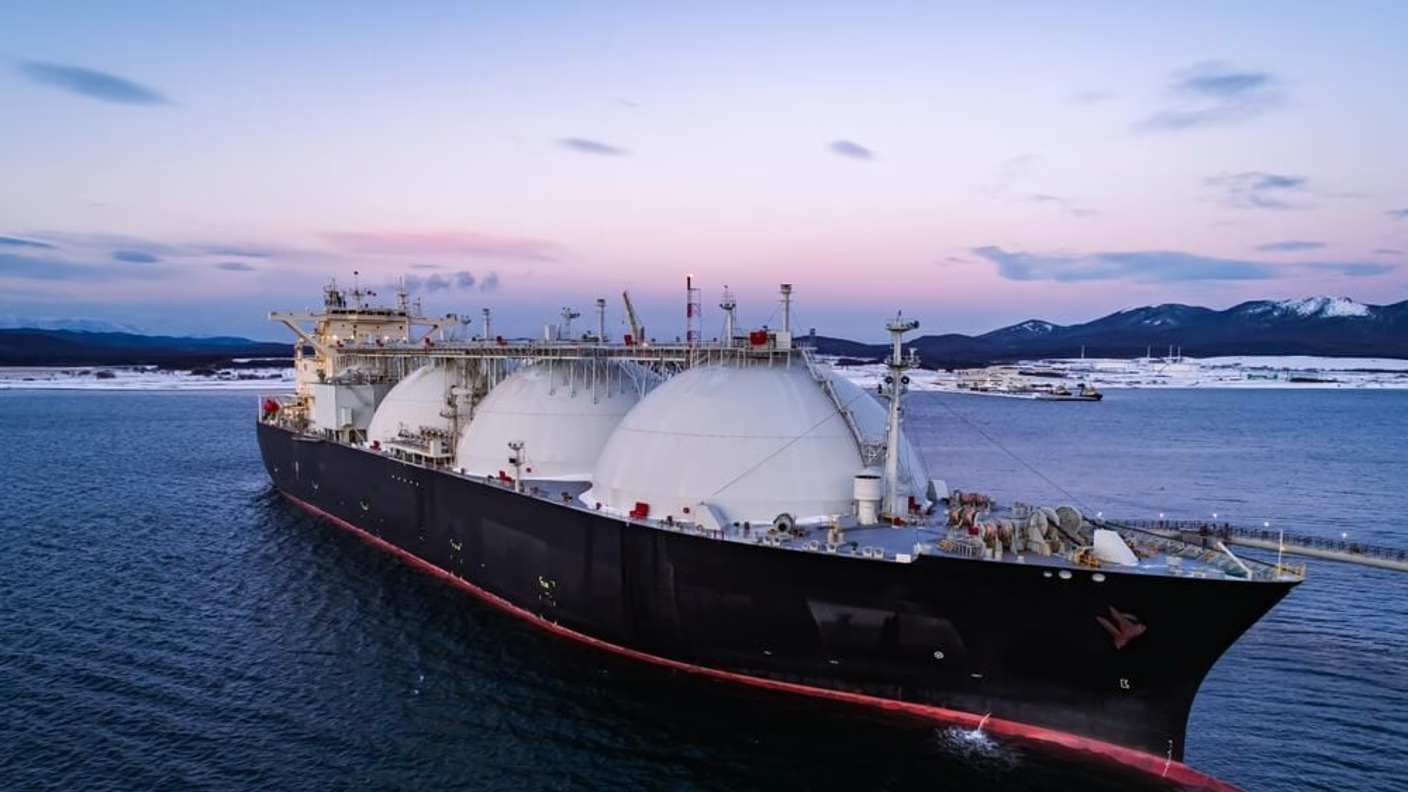
TotalEnergies launches a new LNG supply route to South Korea, offering Asia greater energy security beyond Middle East chokepoints
MARKET INSIDER – A new liquefied natural gas (LNG) shipping route from Mexico to Asia is reshaping the global energy map at a time when geopolitical tensions continue to expose the vulnerability of traditional supply chains. French energy giant TotalEnergies has dispatched the first LNG cargo from Mexico’s Pacific coast directly to South Korea—creating an alternative route that avoids both the Strait of Hormuz and the Panama Canal, two of the world’s most strategically sensitive maritime corridors.
The milestone comes as Asian economies seek to strengthen energy security following months of disruption fears in the Middle East. With global LNG demand expected to remain robust—particularly across Asia—the new export corridor could become an increasingly important pillar of regional energy supply while reducing shipping times, transportation costs, and geopolitical risk.
According to vessel-tracking data from MarineTraffic, the LNG carrier Pacific Success, chartered by TotalEnergies, departed the Energia Costa Azul (ECA) LNG terminal on Mexico’s Pacific coast on July 9 and is bound for South Korea. The shipment marks the commercial debut of Mexico’s first Pacific-facing LNG export terminal, a project designed to transport abundant U.S. natural gas directly to Asian buyers without relying on traditional Gulf Coast export facilities.
The ECA LNG terminal is emerging as a strategic addition to North America’s expanding LNG export network alongside LNG Canada and the proposed Alaska LNG project. Its Pacific location offers a significant competitive advantage by shortening sailing distances to Asia while avoiding congestion and geopolitical chokepoints that have become increasingly unpredictable in recent years.
That advantage has become even more valuable following repeated disruptions surrounding the Strait of Hormuz, through which roughly one-fifth of global LNG trade has historically passed. Before recent regional conflicts, more than 80% of LNG shipped through Hormuz was destined for Asian markets. Although shipping activity has partially recovered after a U.S.-Iran ceasefire agreement, energy traders continue to diversify supply routes as insurance against future disruptions.
TotalEnergies owns a 16.6% stake in the ECA LNG project, with the remaining interest held by Sempra Infrastructure. The French energy major has also secured a 20-year agreement to purchase 1.7 million tonnes of LNG annually from the facility, whose designed production capacity reaches 3.25 million tonnes per year. Japanese trading house Mitsui & Co. has separately signed a long-term contract for 800,000 tonnes annually, highlighting strong Asian demand even before full commercial operations begin.
Construction of the project is expected to be substantially completed during the summer of 2026, with long-term supply contracts taking effect shortly thereafter. The development underscores a broader shift in the global LNG market, where buyers are increasingly prioritizing supply diversification, logistical resilience, and geopolitical stability alongside pricing.
For global energy markets, the first cargo from Mexico’s Pacific coast represents more than a single shipment—it signals the emergence of a new strategic LNG corridor linking North American gas directly to Asia. As geopolitical tensions continue to reshape global trade flows, infrastructure that reduces reliance on traditional chokepoints may prove just as valuable as the energy itself, redefining the next chapter of global LNG competition.
