
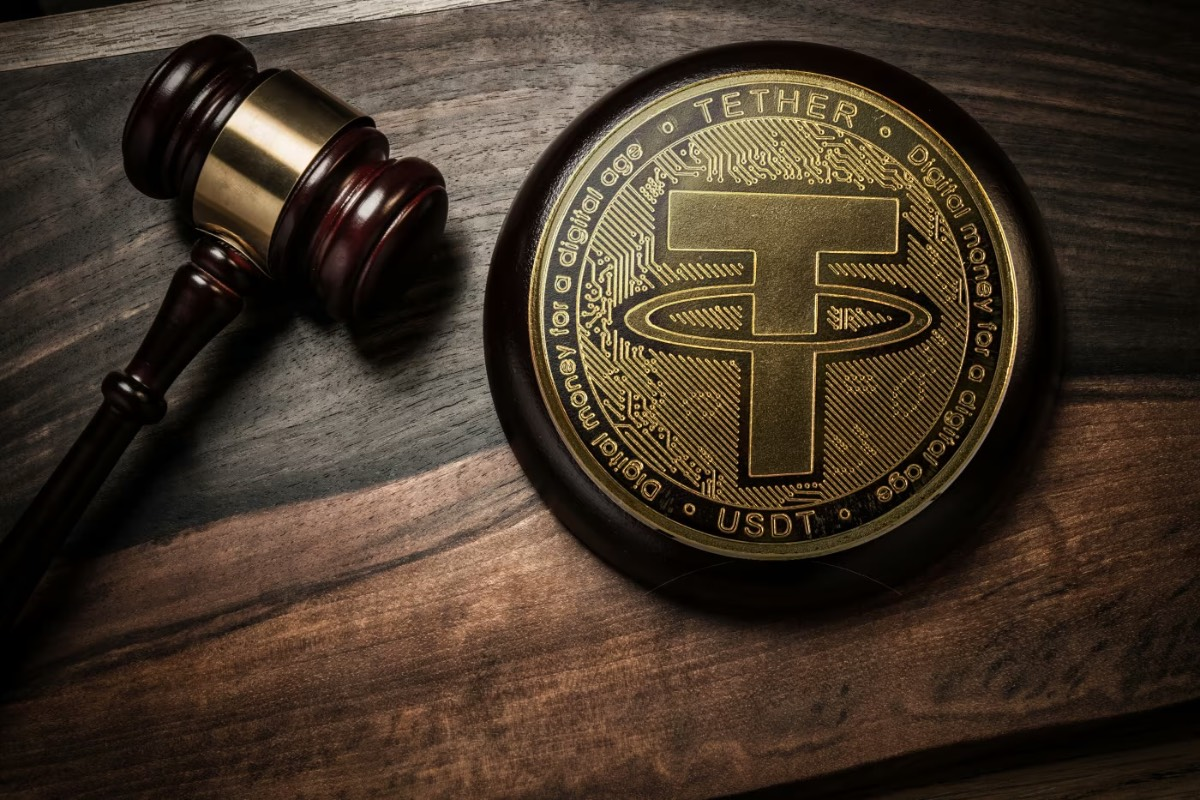
The forfeiture case shows how stablecoin issuers and blockchain records can extend U.S. sanctions enforcement beyond banks.
MARKET INSIDER — U.S. prosecutors are seeking the forfeiture of approximately $61.2 million in Tether’s USDT stablecoin, alleging that the funds represent proceeds from sanctioned Iranian petroleum sold to buyers in China.
The civil complaint, filed in Manhattan federal court, claims that Hong Kong-incorporated Blessed Trust and Hexa Whale used Binance accounts, cryptocurrency addresses and the U.S. financial system to help move more than $1.5 billion for Iran and entities linked to the Islamic Revolutionary Guard Corps. The targeted tokens have been frozen, but permanent forfeiture still requires a court judgment. The case illustrates both the appeal of stablecoins for sanctions evasion and their vulnerability to issuer-assisted enforcement.
Key Highlights
- U.S. prosecutors are seeking approximately $61.2 million of USDT held across 10 cryptocurrency addresses.
- The government alleges that a broader network moved more than $1.5 billion in proceeds from Iranian oil sales to Chinese buyers.
- Tether is expected to destroy the frozen tokens and issue replacements to U.S. authorities, demonstrating the centralized control behind dollar-backed stablecoins.
The funds have been frozen, but not finally forfeited
The U.S. Attorney’s Office for the Southern District of New York filed the civil forfeiture complaint on September 14.
The targeted assets consist of approximately 61.19 million USDT held across 10 addresses on the TRON blockchain. Tether has already frozen the balances, some of which have been restricted since June or July 2025.
A federal magistrate judge issued a seizure warrant authorizing the assets to be transferred into an FBI-controlled wallet. To execute the seizure, Tether will “burn,” or permanently remove, the USDT held at the targeted addresses and issue replacement tokens of equal value for transfer to the U.S. government.
The process avoids requiring access to the private keys controlling the original wallets.
However, seizure and forfeiture are legally distinct. The warrant allows authorities to take custody of the assets, while the civil case asks the court to award permanent ownership to the United States.
The Justice Department emphasized that a civil forfeiture complaint contains allegations, not proven facts. The government must establish that the property was involved in, or represents proceeds traceable to, violations of U.S. sanctions, money-laundering or terrorism-financing laws. U.S. Justice Department complaint
Prosecutors allege a $1.5 billion oil-payment network
The complaint alleges that Blessed Trust and Hexa Whale helped convert payments from Chinese petroleum-sector clients into cryptocurrency and transmit the funds through a network of related addresses.
Both companies were incorporated in Hong Kong, according to the filing.
Blessed Trust allegedly represented itself to financial and cryptocurrency firms as a wealth-management or digital-asset custody provider. Hexa Whale described itself as a commodities brokerage. Prosecutors contend that the businesses were instead providing on-ramp services that converted fiat currency into cryptocurrency for parties involved in Iranian petroleum transactions.
At least seven interconnected addresses, described in the complaint as “Entity A,” allegedly received and distributed more than $1.5 billion in proceeds from black-market oil sales.
The Justice Department claims those funds were sent to Iranian cryptocurrency exchange Nobitex, money-service businesses associated with the IRGC and addresses linked to Sepehr Energy, an Iranian company previously sanctioned for allegedly managing oil sales on behalf of the armed forces.
The $61.2 million being targeted represents the balances authorities were able to identify and freeze—not the entire value allegedly moved through the network.
Binance accounts and the U.S. financial system
Prosecutors allege that Blessed Trust, Hexa Whale and associated parties used trading accounts at Binance to transmit cryptocurrency linked to Iranian oil payments.
The complaint does not accuse Binance of owning the targeted funds or establish that the exchange knowingly participated in the alleged scheme.
“Binance has zero tolerance for sanctions violations or illicit activity,” a company spokesperson said, adding that the exchange investigates, freezes or restricts accounts when sanctions risks are identified and will continue cooperating with law enforcement.
The distinction is important. Accounts on a centralized exchange can be opened or controlled by customers who misrepresent their identities, business activities or ultimate beneficiaries. An exchange’s potential responsibility depends on its customer-verification procedures, transaction monitoring, response to warnings and knowledge of the activity.
The case may nevertheless increase scrutiny of Binance because the exchange remains subject to compliance obligations arising from its 2023 settlement with U.S. authorities.
Prosecutors also allege that the network used U.S.-dollar correspondent accounts to process hundreds of millions of dollars in transactions. One Hong Kong company allegedly sent approximately $37.15 million to Hexa Whale and $443.49 million to Blessed Trust through at least one U.S.-based correspondent account.
These transactions strengthen the asserted connection to U.S. jurisdiction. The alleged use of American banking infrastructure and U.S.-linked stablecoin services gives prosecutors additional grounds to pursue assets even when the companies and commercial activity are based outside the country.
Why USDT was useful—and vulnerable
The complaint says Iranian-linked actors favored stablecoins such as USDT because they offer liquidity, rapid settlement and relative protection from exchange-rate volatility.
A token designed to maintain a value of one U.S. dollar can move across borders without relying on a conventional international bank transfer for every transaction. On networks such as TRON, fees are generally low and transfers can settle quickly.
These characteristics make stablecoins useful for legitimate remittances, trading and commercial payments. They can also appeal to sanctioned actors seeking to move dollar-equivalent value outside traditional banking channels.
Yet USDT is not equivalent to a decentralized asset such as Bitcoin.
Tether manages the smart contracts through which USDT is issued and can freeze tokens associated with specified addresses. It can also destroy and replace those tokens, as the government proposes in this case.
That control makes centralized stablecoins considerably more recoverable than crypto assets whose issuers cannot block transfers.
The case therefore demonstrates an apparent paradox: stablecoins can help users avoid conventional banks, but their issuers can become enforcement points resembling financial institutions.
Blockchain transparency helped investigators follow the money
Cryptocurrency addresses are pseudonymous rather than automatically anonymous.
A wallet address does not display its owner’s legal name, but every transfer is recorded on a public blockchain. Investigators can examine transaction amounts, timing, counterparties, address-activation patterns and payment of network fees.
The complaint says authorities used transaction flows and clustering methods to conclude that the Entity A addresses were controlled by the same party or by coordinated parties.
For example, addresses activated from the same source, funded through common pass-through wallets or supported by the same address for transaction fees may be treated as part of a connected cluster.
Blockchain analysis cannot by itself prove beneficial ownership. Investigators generally combine it with exchange records, bank transfers, corporate documents, seized communications and other evidence.
But once an address is linked to a real-world entity, its historical activity can reveal an extensive transaction network. That creates a form of permanent financial visibility that cash and some informal banking systems do not provide.
China remains central to Iran’s oil revenues
China has been Iran’s largest oil customer, accounting for more than 80% of its shipped crude in 2025, or approximately 1.4 million barrels per day, according to Kpler data cited by Reuters.
Many cargoes have reportedly been purchased by independent Chinese refiners commonly known as “teapots,” often at discounts reflecting sanctions, shipping and enforcement risks.
The U.S. Treasury warned financial institutions in April that Chinese refiners and their intermediaries may use front companies, brokers in Asia and the United Arab Emirates, ship-to-ship transfers and falsified maritime documentation to disguise Iranian-origin crude.
Treasury said China purchased approximately 90% of Iranian oil exports and warned that foreign financial institutions continuing to facilitate the trade could face secondary sanctions. U.S. Treasury sanctions alert
Iran has also reportedly used an oil-for-goods structure under which Chinese buyers create credits that can be used to pay Chinese suppliers without sending conventional cross-border payments to Iran. Between $2 billion and $2.5 billion may have passed through one such structure over the previous year, according to people familiar with the arrangement. Reuters investigation
The forfeiture case appears to address a parallel crypto-based payment channel rather than the entire commercial relationship.
Implications for exchanges and stablecoin issuers
The immediate financial impact on Binance or Tether is limited relative to the scale of their businesses. The more important consequences involve compliance expectations.
Exchanges will face pressure to look beyond whether a customer appears on a sanctions list. They may need to investigate corporate ownership, oil-sector counterparties, wallet clusters and the economic purpose of high-value stablecoin transfers.
Stablecoin issuers may receive more freezing and seizure requests as governments become more capable of tracing blockchain transactions. Cooperation can strengthen the legitimacy of regulated stablecoins, but it also highlights their dependence on issuers and legal authorities.
For institutional investors, the case reinforces the importance of understanding the control structure behind each digital asset. A token may circulate on a public blockchain while remaining subject to centralized freezing, redemption and reissuance.
What happens next
Potential claimants can contest the forfeiture and argue that the funds were legitimate, were not traceable to prohibited activity or belonged to innocent owners.
The court will determine whether the government has met the legal standard required to keep the assets permanently.
Investors should also watch whether prosecutors bring criminal charges against individuals connected to Blessed Trust, Hexa Whale or other entities identified in the transaction network. The civil complaint itself does not announce such charges.
Further action involving exchanges, payment firms, Chinese refineries or correspondent banks would indicate that Washington intends to expand the case beyond the frozen wallets.
The $61 million seizure is small compared with Iran’s overall petroleum trade. Its strategic importance lies elsewhere: it shows that moving sanctioned oil revenue into stablecoins does not necessarily remove it from the reach of U.S. authorities—particularly when the tokens, exchanges or banking channels retain identifiable points of control.
