
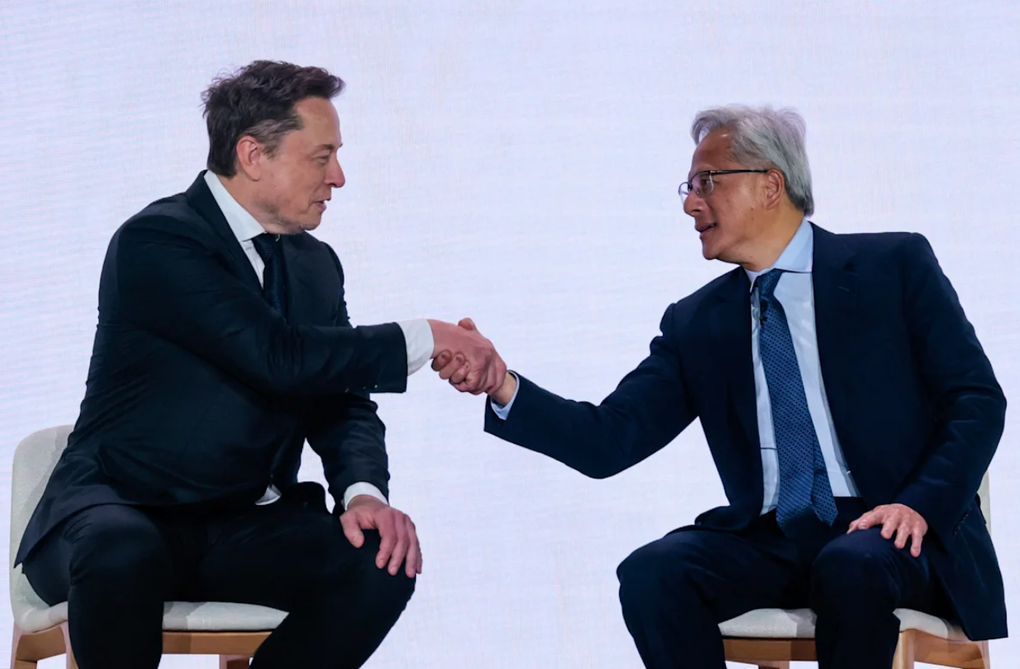
The Tesla and SpaceX chief calls Nvidia’s former leader irreplaceable, questions his political spending and discusses a potential merger as AI reshapes his businesses.
MARKET INSIDER — Elon Musk defended former Nvidia chief executive Jensen Huang following his departure from the artificial intelligence chipmaker, while expressing regret over spending at least $474 million on the 2026 U.S. midterm elections. Speaking at The New York Times DealBook Summit on Wednesday, November 18, Musk compared Huang’s exit to removing basketball legend Michael Jordan from a winning team. The Tesla and SpaceX chief executive also discussed potential synergies between his companies, the possibility of a merger and growing demand for AI computing infrastructure, offering investors a glimpse into his views on corporate leadership, politics and technology investment.
Key takeaways
- Musk called Jensen Huang effectively irreplaceable following his resignation as Nvidia CEO, arguing that the company had lost an exceptional leader.
- Musk said he regretted spending at least $474 million on the U.S. midterm elections, acknowledging that the political outcome had fallen short of his objectives.
- The billionaire highlighted increasing overlap between Tesla and SpaceX in artificial intelligence, robotics and chip design, while stressing that any merger would require shareholder approval.
Why Does Musk Believe Jensen Huang Is Irreplaceable?
Musk delivered a forceful defense of Huang, whose leadership helped transform Nvidia into one of the most influential companies in the global artificial intelligence industry.
Speaking with Andrew Ross Sorkin at the DealBook Summit, Musk questioned the wisdom of removing a successful executive from a company enjoying exceptional commercial momentum.
He compared the decision to taking Michael Jordan off a basketball team during a winning streak.
The analogy reflects Huang’s central role in Nvidia’s development from a graphics processor manufacturer into a leading supplier of computing infrastructure used to train and operate advanced AI models.
Nvidia’s graphics processing units, networking technology and software ecosystem have become critical components of the AI infrastructure developed by major technology companies.
Huang’s influence has extended beyond product development to customer relationships, strategic partnerships and Nvidia’s position within the broader semiconductor industry.
Musk said he had heard similar concerns from others, including President Donald Trump, who he said believed Huang should have remained chief executive.
However, Musk acknowledged that the decision ultimately belonged to Nvidia’s board of directors.
The comments highlight a corporate governance dilemma: how boards balance leadership performance against reputational, ethical and regulatory concerns.
What Led to Jensen Huang’s Departure From Nvidia?
Huang resigned in November following reports about his personal relationships and scrutiny of potential national-security implications.
According to the supplied CNBC account, his departure followed disclosure of an extramarital relationship with a woman reportedly suspected of having connections to Chinese intelligence, alongside separate reporting about relationships with employees.
Those allegations require careful distinction.
The existence of reporting about intelligence suspicions does not establish that the woman was a spy, that Huang knowingly engaged with an intelligence operative or that Nvidia’s proprietary information was compromised.
The supplied report does not establish any such findings.
Huang is also expected to testify before the U.S. Congress in December regarding national-security and export-control issues.
The expected testimony places Nvidia’s leadership transition within a wider debate over the security of advanced semiconductor technology and U.S. restrictions on technology exports to China.
Nvidia occupies a strategically sensitive position because its most advanced AI chips have applications across commercial computing, scientific research and potentially military systems.
U.S. policymakers have consequently treated exports of advanced computing technology as an important national-security issue.
For Nvidia investors, the immediate questions concern management continuity, board oversight, customer confidence and the company’s ability to maintain its technological advantage.
Huang’s departure could increase uncertainty over leadership and strategy, although the supplied account does not establish any deterioration in Nvidia’s operating performance.
Why Does Musk Regret Spending $474 Million on the Midterms?
Musk also reflected on his political involvement in the November 3 U.S. midterm elections, acknowledging that his substantial financial contributions had not delivered the outcome he wanted.
He said he felt foolish about spending at least $474 million, although he suggested the election results might have been worse for his preferred candidates without that support.
Musk explained that his objective had been to prevent a single political party from controlling the presidency and both chambers of Congress.
Democrats ultimately won majorities in the House of Representatives and Senate, while Trump remained president.
The outcome created divided government, but it did not deliver the congressional balance Musk had sought through his political spending.
Musk said that, given another opportunity, he would have spent less.
The remarks represent a notable reassessment by one of the country’s most prominent political donors.
They also illustrate the limitations of campaign spending as a means of securing electoral outcomes.
Financial contributions can support advertising, voter outreach and campaign infrastructure, but they cannot guarantee electoral success.
For investors, Musk’s political activities matter partly because of his leadership roles at businesses exposed to government regulation, public contracts and policy decisions.
Tesla operates in industries affected by automotive safety rules, trade policy and energy incentives.
SpaceX has substantial relationships with government agencies and operates in a strategically important aerospace sector.
Political engagement can therefore raise questions about reputational exposure, executive attention and potential conflicts between commercial and personal objectives.
Is Musk Distancing Himself From Trump’s MAGA Movement?
Musk appeared to create some distance between himself and the political movement associated with Trump.
During the interview, he said he did not identify as MAGA, the acronym for Make America Great Again.
He also questioned what the term meant.
The remarks followed a period in which Musk had been closely associated with Republican political efforts and had committed substantial resources to the midterm elections.
However, his comments should not be interpreted as confirmation that he has ended his political involvement or withdrawn support from all Republican policies.
The supplied interview provides no such commitment.
Instead, the comments suggest Musk may be reconsidering the scale and public presentation of his political engagement.
For shareholders, the relevant question is whether that shift leads to greater management attention on his companies or changes their relationships with policymakers.
Could Tesla and SpaceX Merge?
Musk also addressed speculation about a potential combination of Tesla and SpaceX.
He said the two companies now have areas of strategic overlap that were less significant in earlier years.
These include artificial intelligence, robotics, software engineering and semiconductor design.
Tesla has invested heavily in autonomous driving technology, AI computing and its Optimus humanoid robot program.
SpaceX has developed advanced engineering and computing capabilities for aerospace operations, satellite communications and other technology-intensive activities.
Musk suggested that the increasing overlap could create opportunities for cooperation or corporate integration.
However, he stopped short of announcing a transaction.
He emphasized that any merger would require shareholder approval and might not succeed.
Musk also acknowledged that a transaction detrimental to shareholders could expose him and the companies to legal challenges.
The distinction is important because a strategic rationale does not necessarily translate into an economically attractive merger.
Investors would need to evaluate valuation, ownership structure, governance arrangements, potential conflicts of interest and the allocation of capital between the businesses.
A combination could also face regulatory review, particularly given SpaceX’s government relationships and the scale of Tesla’s public-market investor base.
No merger terms, valuation or timetable were announced in the supplied interview.
How Does Anthropic Fit Into Musk’s AI Strategy?
Musk disclosed another connection between his business interests and the expanding AI infrastructure market.
He said SpaceX rents computing capacity to Anthropic under short-term agreements that either company can terminate.
According to Musk, Anthropic has expressed interest in an additional 10 gigawatts of capacity.
That figure represents a substantial potential power requirement, but the interview does not establish that SpaceX has contracted to supply or construct that amount of infrastructure.
Nor does it clarify the timetable, commercial terms or capital investment that would be required.
The disclosure came as Anthropic priced its initial public offering at $83 per share, raising approximately $81.3 billion in what the company described as the largest IPO on record.
The offering underscores the scale of investor interest in AI businesses and the capital needed to support their expansion.
It also highlights the growing interdependence of AI model developers, computing infrastructure providers and energy suppliers.
Demand for computing capacity has become a significant driver of investment in data centers, power generation, transmission infrastructure and advanced semiconductors.
For investors, however, the central question remains whether revenue growth and utilization rates can justify the substantial capital required.
Why It Matters for Investors
Musk’s DealBook appearance brought together three issues with implications for financial markets.
The first is leadership concentration at major technology companies.
His defense of Huang highlights the perceived value of visionary founders and executives, but it also raises questions about succession planning and the independence of corporate boards.
The second is the relationship between business leaders and politics.
Musk’s regret over his midterm spending suggests that even exceptionally large political contributions may deliver uncertain returns in terms of policy influence.
The third is the convergence of AI, robotics, aerospace and computing infrastructure.
Musk’s comments about Tesla, SpaceX and Anthropic illustrate how companies operating in different industries increasingly depend on similar technological capabilities.
For Asian semiconductor manufacturers and electronics supply chains, continued AI investment could support demand for advanced chips and related components.
However, U.S. export restrictions, corporate governance developments and the financial sustainability of AI infrastructure spending remain important sources of uncertainty.
Outlook: What Investors Should Watch Next
Investors should monitor three developments following Musk’s interview.
First, Nvidia’s leadership transition and Huang’s expected congressional testimony could influence perceptions of governance and U.S.-China technology-security risks.
Second, any formal disclosure concerning cooperation or a possible merger between Tesla and SpaceX would provide a basis for assessing the financial and strategic implications.
Third, additional information about SpaceX’s computing arrangements with Anthropic could help clarify whether the relationship represents a meaningful commercial opportunity or remains exploratory.
Musk’s remarks offer insight into his thinking, but they do not establish a merger agreement, a new AI infrastructure commitment or a definitive change in political strategy.
For markets, the distinction between executive commentary and binding corporate decisions remains essential.
