
Ho Chi Minh City — For a country where a credit card application has traditionally meant a stack of paperwork, a salary certificate, and a multi-week wait, Circle is making an unusual bet: that Vietnamese consumers are done waiting.
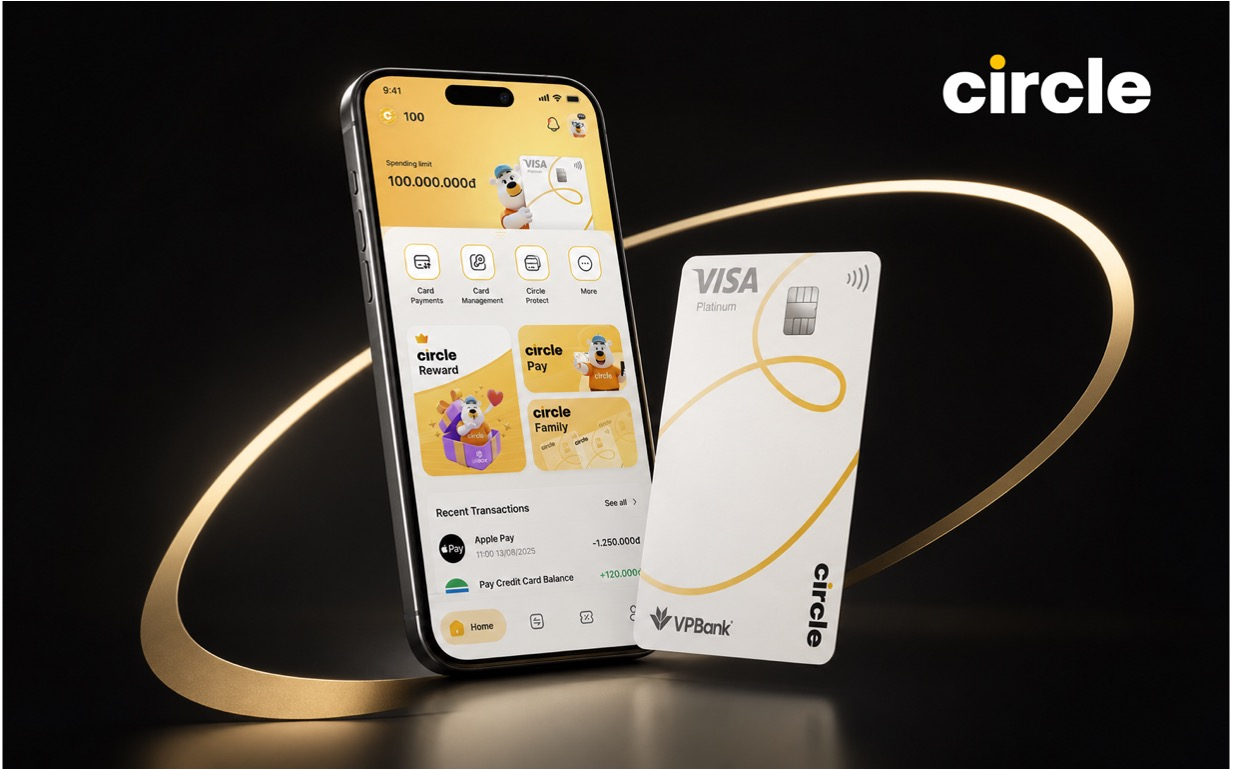
The Singapore-based fintech, which launched publicly in mid-2026, has built what is likely Vietnam’s first credit-led neobank platform – a co-branded Visa Platinum credit card paired with an AI-native app without a traditional bank account in the mix – designed around a single premise: financial products should move at the pace of a swipe, not at the pace of a branch queue.
The numbers Circle points to are aggressive by any regional standard. Approval in under five minutes. No physical documents. Underwriting powered by AI models trained on alternative, big-data signals rather than the payslips and documentation traditional banks still lean on. And rather than positioning as a budget alternative, Circle has gone the other way – pitching itself as a premium card, with discounts of up to 50% across a network of more than 600 merchants nationwide. A stand-out feature on Circle’s app is the ability to see ‘offers around you’ on an integrated map so that customers can find the nearest cà phê sữa đá at a discount.
It’s a combination – instant access, premium positioning, built around customer needs – that Vietnam’s banking sector has rarely attempted at the same time.

Circle operates via a BIN sponsorship arrangement with VPBank and runs on an end-to-end independent tech stack designed from scratch for the digital generation – an architecture that lets it move at software speed while still working inside Vietnam’s regulated credit card rails. Initial backing has come from 500 Global, GSR Ventures, and Iterative Capital – names from Silicon Valley that need no introduction.
The Founders’ Bet
Circle’s founding story is less “garage startup” and more “insiders who got tired of watching the gap.” The company was built by three co-founders who each spent decades on the inside of the systems they’re now trying to replace.
Chief Executive Officer Arnab Ghosh spent over 15 years in financial services in Vietnam, including senior leadership roles at McKinsey and Visa, where he helped shape regional banking strategy. Chief Investment & Partnership Officer Marco Breu spent 25 years at McKinsey, including twelve as managing partner of its Vietnam office. And Chief Operating Officer Rahn Wood brings over 30 years in banking operations at institutions including HSBC and ANZ, plus stints at three local Vietnamese banks – the operator’s eye for making a financial product actually run.
That background matters to the Circle pitch. Founders who have spent years inside regional financial strategy are not guessing what’s broken in local credit access – they’ve underwritten it, sold it, and fixed it from the inside. The company frames its mission plainly: Vietnam’s emerging middle class and digitally fluent young professionals have outgrown a credit system still built for an older, paper-based economy – and building the alternative takes someone who has the scars to prove they understand what’s broken.

“The Revolut of Vietnam”?
The comparison has started to surface in investor and fintech circles: Circle as Vietnam’s answer to Revolut (the world’s largest digital bank recently valued at over $115 billion) – a card-first product that uses a sharp, modern user experience as the wedge into a much bigger financial services relationship. Revolut spent years operating on a lighter-touch license building scale and trust before taking on the heavier compliance load of a full bank. Others watching the space have gone further, drawing a parallel to Nubank, the Brazilian fintech that also started its remarkable life focusing on a single credit card product before growing into the largest digital bank in Latin America, now serving over 135 million users.
Whether Circle follows either trajectory is a story still to be written but the comparison itself says something about how the company is being noticed by people who watch this sector closely: not as just another app-based lender, but as a potential platform play.
The Ownership Structure No Other Neobank Has
Perhaps the most structurally interesting fact about Circle is the one that’s easiest to miss: it is not owned, directly or indirectly, by a traditional bank in Vietnam. Nearly every other challenger bank in Vietnam today sits inside or is majority-controlled by an incumbent bank thereby being part of its balance sheet and strategy.
That independence is a trade-off: it’s harder to get off the ground without a bank’s balance sheet behind you but it also means Circle isn’t boxed in by an institution’s capital injection, risk appetite or strategic mandate. Also, an independent, venture-backed neobank has a cleaner path to expanding beyond Vietnam’s borders than a product born inside a bank that has no reason to operate outside its home market.
For investors, that’s a different risk-and-reward profile than backing a bank-tethered fintech – one with a plausible route to a valuation re-rating if the regional expansion thesis plays out.
What Comes Next
Circle has not confirmed details, but sources close to the company suggest it is preparing to raise fresh funds as it looks to scale beyond its early traction – a step that would follow the pattern of neobanks elsewhere in Asia that initially used a card product to demonstrate market traction before raising larger rounds to build out additional services.
For now, the company’s focus is narrower: deliver near-vertical growth and prove that Vietnamese consumers will trust a five-minute approval and a no-paperwork sign-up with their next credit card product. If that bet pays off, the bigger question whether Circle becomes Vietnam’s Revolut, its Nubank, or something with no easy comparison at all, will start to answer itself.
