
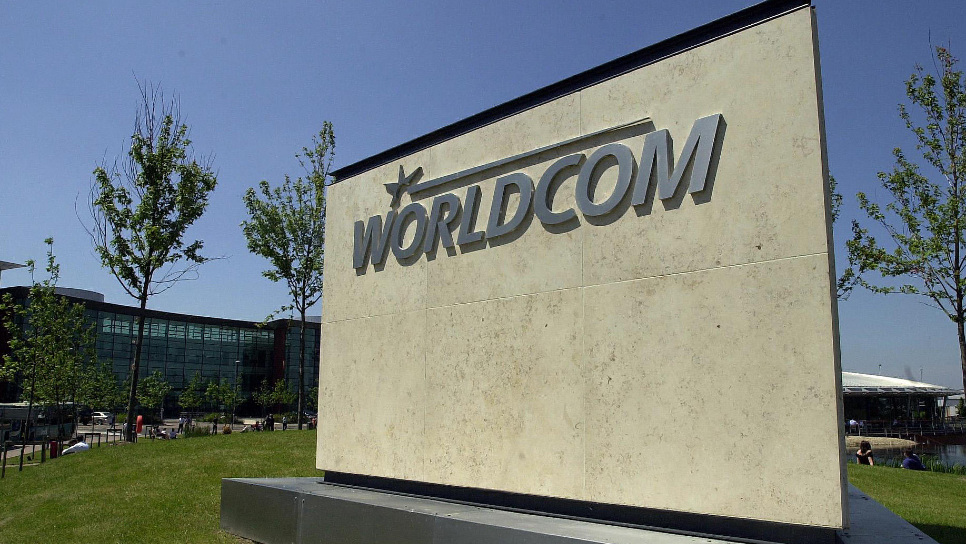
Once a Wall Street darling, WorldCom’s meteoric rise and spectacular collapse became one of the most infamous corporate scandals in U.S. history — a cautionary tale of greed, deception, and broken trust.
NEW YORK (Market Insider) — Two decades ago, WorldCom was a global telecommunications powerhouse — the second-largest long-distance carrier in the U.S., valued at nearly $180 billion. But behind its dazzling numbers lay one of the largest accounting frauds in history, a deception built not on complex derivatives or exotic schemes, but on a few manipulated Excel entries that turned losses into billions in fake profits.
From Gym Teacher to Telecom Tycoon
The story began in 1983 in Mississippi, when Bernie Ebbers, a former high school gym teacher, co-founded Long Distance Discount Service (LDDS), offering low-cost long-distance calls. Ebbers soon mastered a different kind of game — mergers and acquisitions.
Throughout the 1990s, LDDS (later renamed WorldCom) acquired more than 60 competitors, including MCI Communications in a landmark $37 billion deal. At its peak, WorldCom’s shares hit $60, Ebbers’ net worth soared to $1.4 billion, and Wall Street hailed him as a visionary leading America’s digital revolution.
The Fall: From Market Star to Financial Mirage
The empire began to unravel after regulators blocked a $129 billion merger with Sprint in 2000, citing monopoly concerns. Then came the dot-com crash, hammering telecom valuations. Under pressure to maintain investor confidence, WorldCom’s leadership turned to accounting manipulation.
The scheme was shockingly simple: reclassify operating expenses—such as network leasing costs—into capital expenditures. This inflated profits by billions. On paper, WorldCom reported a $1.6 billion profit in 2001 instead of a $1.2 billion loss, and another $172 million “profit” in Q1 2002. The fraud ultimately ballooned to over $11 billion in falsified earnings between 1999 and 2002.
The Whistleblower Who Exposed It All
The cover-up might have continued if not for Cynthia Cooper, WorldCom’s internal audit vice president. While reviewing financial records at night with her colleague Gene Morse, she discovered suspicious “prepaid capacity” entries that made little sense. Despite obstruction from CFO Scott Sullivan, Cooper secretly escalated her findings to the board’s audit committee and independent auditor KPMG.
Her persistence uncovered one of the largest corporate frauds in U.S. history. In 2002, TIME magazine named Cooper Person of the Year for her courage and integrity — a reminder that ethics, not balance sheets, define real leadership.
Collapse of a Giant
By mid-2002, WorldCom owed $41 billion, with creditors including JPMorgan, Mellon Bank, and Citibank. Ebbers resigned in April, owing the company over $400 million. That July, WorldCom filed for Chapter 11 bankruptcy, listing $107 billion in assets — the largest U.S. bankruptcy ever at the time.
Its stock plummeted from $63.50 to just $0.20, wiping out $180 billion in investor value — the equivalent of watching a blue-chip stock shrink to the price of a cup of iced tea. More than 17,000 employees lost their jobs.
Justice and Reform
In 2005, Bernie Ebbers was sentenced to 25 years in prison for securities fraud and conspiracy. CFO Scott Sullivan received five years after testifying against his former boss. The scandal, along with Enron’s collapse, spurred the Sarbanes–Oxley Act (SOX) of 2002 — landmark legislation tightening corporate accountability, mandating executive responsibility, and reinforcing the independence of auditors.
After restructuring, WorldCom rebranded as MCI in 2003 and was later acquired by Verizon Communications in 2006.
Legacy of a Corporate Tragedy
WorldCom’s implosion remains a cautionary symbol of corporate greed and moral failure. It showed how unchecked ambition and manipulated numbers could destroy a global empire overnight.
As one analyst famously remarked:
“Profits can be fabricated — but trust, integrity, and accountability are the real currency of business. Once lost, no balance sheet can restore them.”
