
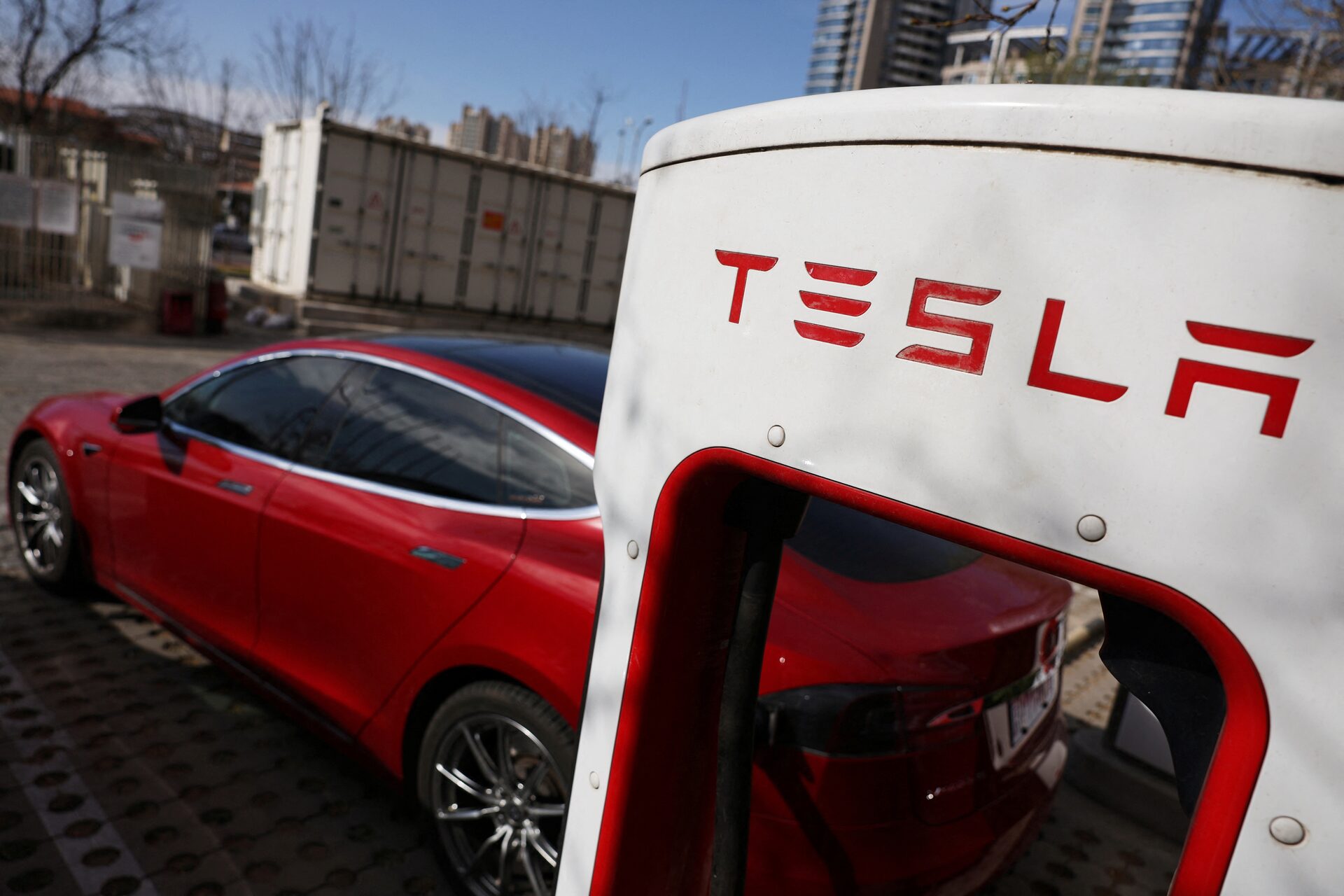
After viral fights at charging stations, Tesla tests app-based waiting lines as EV congestion becomes a global problem
MARKET INSIDER – The biggest bottleneck in the electric vehicle revolution may no longer be battery technology or vehicle prices — it’s human behavior at charging stations. Tesla has begun testing a virtual queuing system at its overloaded Supercharger stations after viral videos of drivers arguing and physically confronting each other exposed the growing tension inside the world’s largest EV charging network.
The pilot program highlights a new reality facing the global EV industry: as electric vehicle adoption accelerates, charging infrastructure is becoming a critical pressure point from California to China. For investors and automakers alike, the challenge is no longer simply selling more EVs — it is ensuring the charging experience remains efficient, scalable, and socially manageable.
More than a year after first promising the feature, Tesla has quietly launched the trial at five Supercharger locations, four of them in the San Francisco Bay Area, one of the company’s densest markets worldwide. The fifth site, located in New York’s Bronx borough, reflects another growing issue: heavy congestion caused by ride-hailing and commercial drivers relying on fast charging throughout the day.
Under the new system, drivers arriving at a fully occupied Supercharger station can join a virtual waiting line directly through the Tesla app. The app tracks their location and displays how many vehicles are ahead of them, effectively digitizing the often chaotic process of deciding “who arrived first.”
The feature was originally announced in February 2025 after a widely shared video showed Tesla owners shoving and arguing over charging access at a busy station. Although Tesla said at the time the rollout would begin in the second quarter of 2025, the pilot only officially launched in Q2 2026 — roughly one year behind schedule.
Tesla has already experimented with other congestion-control measures. In 2023, the company introduced idle congestion fees of $1 per minute for drivers who continued charging beyond 90% battery capacity at crowded stations. The new queuing system tackles a different operational challenge: organizing demand before a charging slot even becomes available.
The timing is significant because Tesla’s charging network is increasingly becoming industry-wide infrastructure rather than a closed ecosystem. Around 70% of Tesla’s more than 80,000 Supercharger stalls are now accessible to non-Tesla electric vehicles, turning the network into a backbone for the broader EV market. That openness improves utilization rates but also intensifies congestion pressure as more automakers adopt Tesla’s charging standard.
Tesla previously claimed waiting issues affected only about 1% of charging sessions globally. Yet with more than 53 million charging sessions recorded in the first quarter of 2026 alone, even a 1% congestion rate translates into hundreds of thousands of frustrated drivers annually. That scale transforms what once seemed like isolated inconvenience into a genuine infrastructure management challenge.
The larger question is whether software alone can solve the problem. Tesla’s virtual queue system ultimately relies on drivers voluntarily respecting the digital line rather than enforcing it physically. If adoption grows faster than charging expansion, automakers may soon face an uncomfortable reality: the future of electric mobility depends as much on crowd management and urban logistics as on engineering breakthroughs.
