
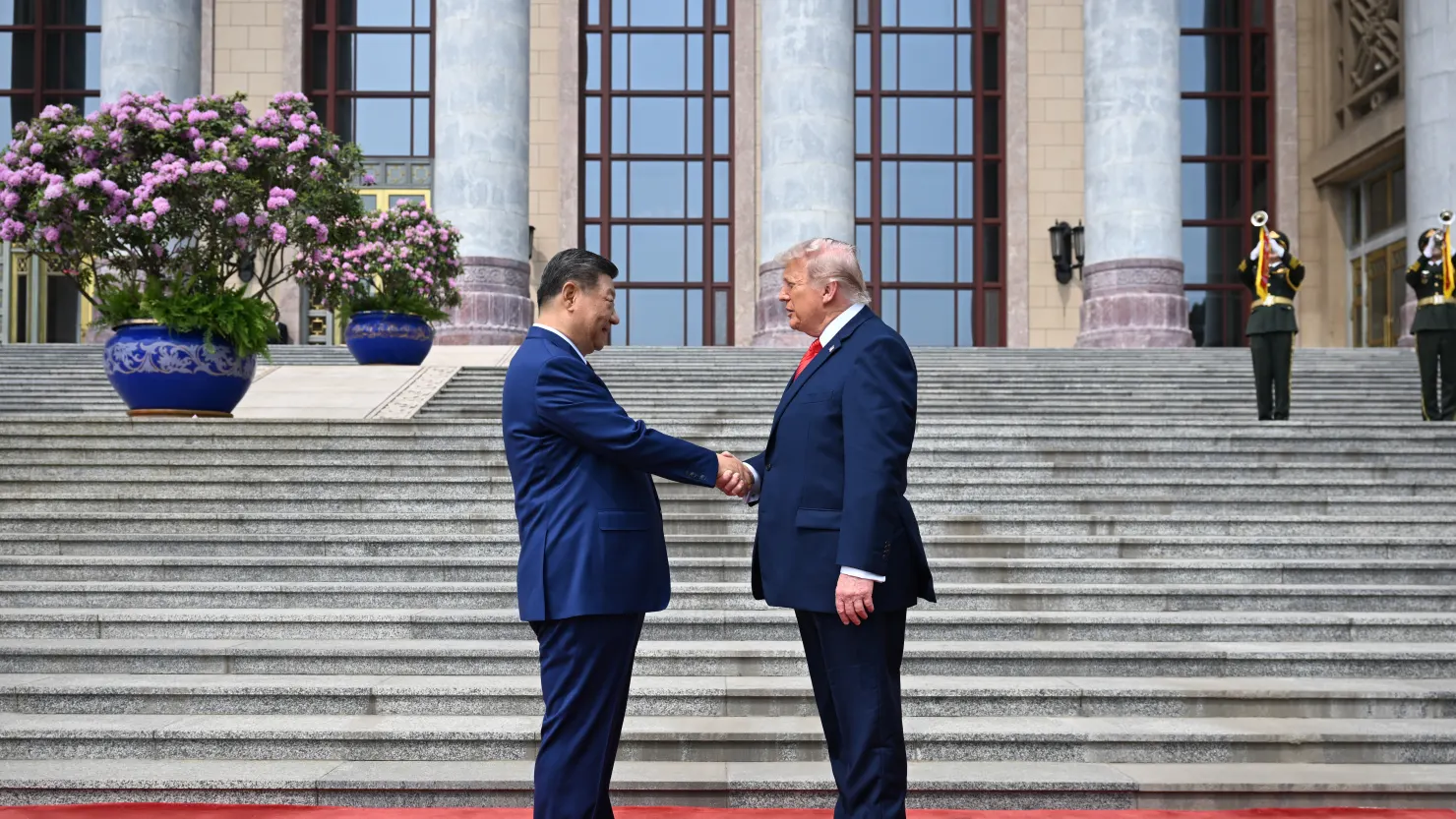
Investors watch Beijing talks for clues on tariffs, tech controls, and the next phase of U.S.-China relations
MARKET INSIDER – Asia-Pacific markets traded cautiously on Thursday as global investors turned their attention to Beijing, where U.S. President Donald Trump arrived for a closely watched summit with Chinese President Xi Jinping that could reshape the trajectory of global trade, technology supply chains, and financial markets.
The high-stakes meeting comes at a fragile moment for the world economy. Inflation remains sticky in the United States, China is battling slowing domestic demand, and multinational corporations are increasingly caught between competing geopolitical blocs. With executives such as Elon Musk and Jensen Huang joining Trump’s delegation, markets are signaling that the future of semiconductors, AI infrastructure, and export controls may matter as much as tariffs themselves.
Regional equity markets reflected that uncertainty. Japan’s Nikkei 225 edged higher while South Korea’s KOSPI advanced modestly. Hong Kong’s Hang Seng Index outperformed regional peers, fueled by optimism that the Trump-Xi talks could ease pressure on Chinese equities and stabilize trade flows. Meanwhile, Australia’s market slipped as investors weighed broader risks tied to commodities and China’s economic outlook.
One of the session’s biggest movers was Samsung Electronics, whose shares surged more than 5% after a dramatic selloff tied to escalating labor tensions. The company is facing the threat of a massive strike involving more than 41,000 workers, raising fears about disruptions across the global semiconductor supply chain. South Korea’s finance minister warned the dispute could hurt exports, economic growth, and financial stability — a reminder that supply-chain fragility remains a major market risk even as AI-driven tech optimism pushes Wall Street to record highs.
Analysts at Goldman Sachs expect the Trump-Xi meeting to focus primarily on tactical trade issues rather than delivering a sweeping geopolitical reset. Key topics reportedly include tariffs, semiconductor restrictions, rare earth exports, and potential Chinese purchases of U.S. agricultural products, energy, and aircraft. Investors are also watching for any signals around Taiwan, AI chip access, and future export-control policies that could affect companies from Nvidia to Tesla.
Despite lingering tensions, Wall Street appears increasingly comfortable betting on technology and AI as dominant long-term themes. Overnight, the S&P 500 and Nasdaq-100 both reached fresh record highs, even after hotter-than-expected U.S. inflation data. That divergence — booming equity markets amid geopolitical tension and inflation risks — highlights a growing investor belief that governments may ultimately avoid full-scale economic decoupling because the cost to global growth is simply too high.
The bigger question now is whether the Trump-Xi summit marks the start of a temporary tariff truce — or merely a pause before a deeper economic rivalry intensifies. Either way, markets from Silicon Valley to Shenzhen are trading as if every handshake in Beijing now carries trillion-dollar consequences.
