
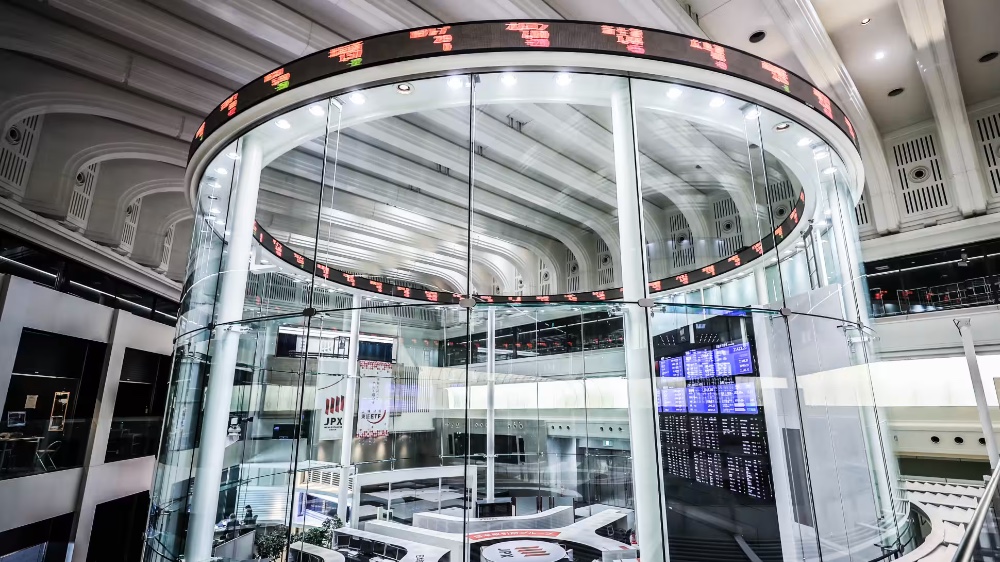
Escalating attacks on Gulf shipping are reviving inflation fears just as the Fed, ECB and Bank of Japan consider higher rates.
MARKET INSIDER — Asian equities fell broadly on Thursday as Brent crude held above $100 a barrel and the 10-year U.S. Treasury yield remained near its highest level since 2023.
The combination is particularly damaging for regional markets: expensive oil raises costs for Asia’s energy-importing economies, while higher Treasury yields reduce the relative appeal of equities and tighten global financial conditions.
Investors are now waiting for U.S. producer and consumer inflation data that could determine whether the Federal Reserve raises rates next week. Policy decisions from the European Central Bank and Bank of Japan add further uncertainty to an already difficult September.
Key Highlights
- Brent traded near $101.40 as attacks on shipping and Saudi energy infrastructure raised the risk of prolonged Middle East supply disruption.
- The 10-year Treasury yield held around 4.84% after a $6 billion U.S. government bond buyback failed to meet market expectations.
- Asian technology, consumer and rate-sensitive stocks declined as investors prepared for possible tightening by the Fed, ECB and BOJ.
Asian markets retreat across the region
MSCI’s broadest index of Asia-Pacific shares outside Japan fell approximately 1% in early trading.
Japan’s Nikkei 225 and South Korea’s KOSPI initially declined by more than 1%, while losses also spread to Hong Kong, mainland China, Australia and Taiwan.
Later readings showed the Nikkei down about 0.8%, South Korea’s benchmark approximately 0.9% lower and Australia’s S&P/ASX 200 falling 1.5%. Hong Kong’s Hang Seng lost around 1.4%.
The broad decline reflects a combination of sector-specific and macroeconomic pressure.
Technology companies are sensitive to higher bond yields because much of their valuation depends on earnings expected in future years. Consumer, transport and manufacturing businesses face higher fuel and input costs, while property and infrastructure companies are exposed to rising financing expenses.
Energy producers can benefit from higher oil prices, but they have been too small a segment of most Asian indexes to offset weakness elsewhere.
Brent above $100 changes the inflation debate
Brent crude traded near $101.40 a barrel after breaking above $100 on Wednesday for the first time since July.
The level is psychologically and economically important. Investors had previously treated periodic Middle East escalation as temporary, expecting negotiations or additional supply to bring prices back down.
The latest attacks are challenging that assumption.
The United States and Iran have carried out their largest wave of strikes on shipping since the conflict began. American forces have disabled Iranian oil tankers, while Tehran has attacked or threatened U.S.-linked vessels and facilities across the Gulf.
Fighting has also expanded between Saudi Arabia and Iran-aligned Houthi forces in Yemen. Attacks on Saudi cities and energy infrastructure create a second source of risk to regional production and exports.
Brent is now approximately 50% higher than a year earlier, while U.S. gasoline has risen above $4 a gallon and diesel has reached record levels.
A short-lived oil spike would mainly affect headline inflation. Sustained prices above $100 could spread into freight, food, aviation, chemicals, manufactured goods and wages, making the shock harder for central banks to ignore.
Higher oil prices are especially difficult for Asia
Most large Asian economies are net energy importers.
Japan and South Korea purchase nearly all their crude requirements from overseas, while India, China and several Southeast Asian countries also depend heavily on imported oil.
A higher energy bill can weaken trade balances, reduce household purchasing power and pressure currencies. Governments may also face larger fiscal costs if they use subsidies or tax reductions to protect consumers from fuel-price increases.
For manufacturers, the impact extends beyond electricity and transport. Oil is a major input for plastics, chemicals, synthetic fibers, packaging and industrial processes.
India is particularly sensitive because crude imports affect inflation, the current account and the rupee simultaneously. Japan faces a similar challenge as expensive oil offsets some of the benefit exporters receive from currency movements.
China has greater negotiating power and access to discounted supply, but its large consumption means a prolonged increase still raises costs across the economy.
Treasury yields add a second source of pressure
The benchmark 10-year U.S. Treasury yield held near 4.84% after reaching its highest level since 2023 in the previous session.
Oil-driven inflation expectations explain part of the rise, but they are not the only factor.
Investors are also demanding additional compensation for holding long-term U.S. debt because of large fiscal deficits, heavy government issuance and uncertainty over future inflation.
The Treasury Department announced that it would buy back as much as $6 billion of longer-dated bonds. Although that was three times the size of its previous operation, some investors had expected purchases of up to $10 billion.
Yields rose rather than fell following the announcement, indicating that the operation was too small to overcome broader selling pressure.
A buyback can improve liquidity in older, less actively traded securities and adjust the maturity profile of government debt. It does not eliminate the underlying fiscal deficit or permanently reduce the supply of Treasury securities if the government must issue new debt elsewhere.
That distinction is important. The bond market is signaling concern about both near-term inflation and the longer-term quantity of debt investors will need to absorb.
Why rising yields hurt equities
Government-bond yields form the foundation for asset pricing.
When investors can earn close to 5% on relatively low-risk U.S. government securities, they require higher expected returns to own volatile equities.
That pressure is most pronounced for expensive growth stocks, real estate companies, utilities and businesses dependent on debt-financed expansion.
Higher yields also increase corporate borrowing costs, mortgage rates and the cost of refinancing government debt. For emerging markets, they can attract capital toward dollar assets and place pressure on currencies and domestic bond markets.
The current environment is particularly difficult because yields are rising alongside energy prices.
In a conventional growth-driven selloff in bonds, stronger economic activity can support corporate profits. In an inflation-driven move, companies face both higher costs and higher discount rates.
That explains why the latest increase in yields has produced a broader risk-off response.
U.S. inflation data could decide the Fed meeting
The U.S. Producer Price Index for August is due Thursday at 8:30 a.m. Eastern time, followed by the Consumer Price Index on Friday.
Both releases come immediately before the Federal Reserve’s September 15–16 policy meeting.
Fed funds futures imply approximately a 60% probability of a quarter-point rate increase.
A stronger-than-expected PPI reading would suggest that higher input costs are moving through supply chains, reinforcing the case for tighter policy. A hot CPI report would be still more consequential, particularly if price growth is broad rather than confined to energy.
Softer underlying inflation could allow the Fed to hold rates at 3.5%–3.75%, even if headline inflation remains elevated because of oil.
Investors will focus on whether shelter, services and wage-sensitive categories are accelerating. Those components are more persistent and more responsive to monetary policy than gasoline prices.
ECB and BOJ add to the tightening risk
The European Central Bank is expected to raise rates as higher oil and natural-gas prices renew inflation pressure across the eurozone.
Markets will pay close attention to whether ECB officials signal that the move begins a longer tightening sequence.
The Bank of Japan meets next week and is also widely expected to increase its policy rate.
Expectations of faster BOJ tightening, the unwinding of short-yen positions and speculation about Japanese capital returning home have pushed the yen about 4% higher in September to approximately 153.6 per dollar.
A stronger yen can reduce Japan’s imported energy costs, but it also lowers the domestic value of overseas earnings for exporters.
The currency’s next move will depend on BOJ communication. A rate increase accompanied by hawkish guidance could sustain the rally. A pause—or language suggesting no urgency for subsequent moves—could trigger renewed yen weakness.
Japan presents the clearest example of the policy dilemma facing Asian central banks: higher rates support the currency and reduce imported inflation, but they also raise financing costs and pressure equity valuations.
September’s risk cocktail
September has historically been a weak month for equities, but seasonal patterns alone do not explain the current selloff.
Markets are confronting several connected risks:
- a widening Middle East conflict;
- crude oil above $100;
- food and agricultural commodity inflation;
- long-term U.S. fiscal concerns;
- simultaneous central-bank tightening; and
- the possibility of an accelerated yen carry-trade unwind.
Agricultural prices deserve particular attention. Rising food costs could keep headline inflation elevated into early 2027 even if crude stabilizes, according to rates strategists.
The risk is that investors who expected the oil shock to fade are forced to reposition at the same time central banks remove liquidity.
What investors should watch
The first indicator is Brent’s ability to hold above $100. A quick reversal would ease inflation concerns, while several weekly closes above the threshold would strengthen the case for a prolonged energy shock.
Shipping data from the Strait of Hormuz and Gulf insurance premiums will provide more useful information than individual military statements. Falling vessel traffic would indicate that supply disruption is worsening in practice.
The second signal is the U.S. inflation mix. Energy-led headline inflation is less threatening than acceleration in core services and wages.
Investors should also monitor the 10-year Treasury yield around 4.85%–5%. A sustained move through 5% could force another adjustment in global equity valuations and place additional pressure on emerging-market currencies.
Finally, the BOJ’s language will determine whether the yen rally continues and whether Japanese investors have a stronger incentive to move capital home.
Asian markets are not responding to oil or yields in isolation. They are adjusting to the prospect that a prolonged energy conflict will keep inflation high, force central banks to tighten and leave borrowing costs elevated across the global economy.
That combination presents a more serious challenge than a temporary geopolitical selloff—and explains why investors are reducing risk before the inflation data arrive.
