
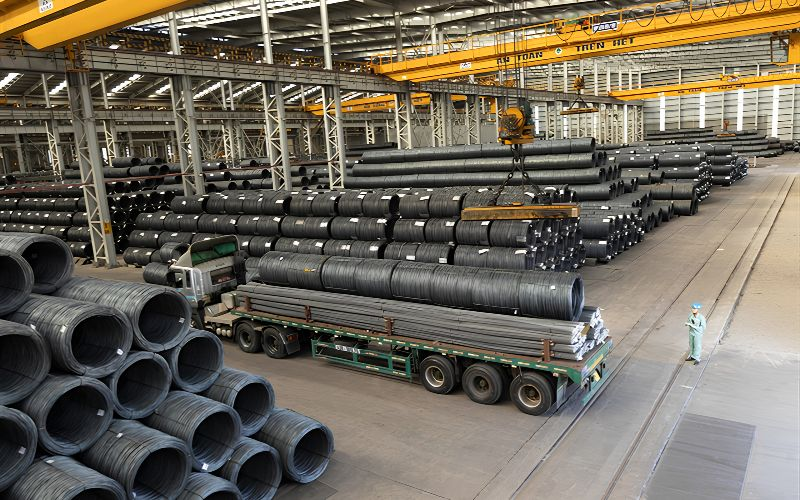
Manufacturing competitiveness is often assessed through labor costs, production capacity, and factory efficiency. Yet these factors provide only part of the picture when raw material prices and international transportation costs can change considerably within a short period.
Steel and freight costs are particularly relevant to manufacturers producing structural components, machinery, industrial equipment, and other metal-intensive products. A factory may offer competitive production prices, but fluctuations in material and shipping costs can change the economics of fulfilling international orders.
The challenge is not necessarily that both costs are rising. Steel prices and freight rates respond to different market conditions, and their movements vary between regions and trade routes.
For manufacturers, business owners, and investors, understanding this volatility is becoming essential when evaluating production costs, supply chain resilience, and the long-term competitiveness of manufacturing locations.
What Is Driving Volatility in Steel and Freight Markets?
Steel and international freight are influenced by global demand, production capacity, energy costs, and trade disruptions. However, their prices do not necessarily move in the same direction.
Steel Prices and Global Supply Imbalances
Steel prices depend on several interconnected factors, including demand from construction and manufacturing, raw material availability, and production costs.
Iron ore, metallurgical coal, and scrap prices influence steelmaking economics, although their importance varies depending on the production process. Electricity and fuel costs also affect production expenses.
Beyond these inputs, the industry faces a structural challenge: excess production capacity. According to the OECD Steel Outlook 2026, global excess steelmaking capacity reached approximately 640 million tonnes in 2025 and is projected to increase to 745 million tonnes by 2028.
This imbalance can intensify competition between producers and put downward pressure on steel prices. However, excess capacity does not mean prices will decline uniformly. Regional differences remain substantial. Manufacturers face different energy costs, domestic demand conditions, product specifications, and trade restrictions.
Tariffs and trade remedies can further influence the price of imported steel, creating differences between markets even when international raw material prices follow similar trends.
Consequently, two manufacturers producing comparable steel products in different countries may face different material procurement costs.
Freight Rates and International Shipping Disruptions
International freight rates respond to shipping capacity, fuel prices, cargo demand, port conditions, and route availability. Geopolitical disruptions have added uncertainty to these variables.
The UNCTAD Review of Maritime Transport 2025 documented how disruptions affecting Red Sea shipping forced vessels to use longer routes around the Cape of Good Hope. These diversions increased voyage distances, operating costs, and delivery times while affecting effective shipping capacity.
However, higher operating costs do not automatically translate into higher freight rates on every route. Drewry’s World Container Index illustrates these differences. On October 29, 2026, the composite index declined 3% to USD 4,429 per 40-foot container. During the same week, Shanghai–Los Angeles rates fell 6%, while Shanghai–Rotterdam rates increased 1%.
These contrasting movements show why businesses cannot rely on a global average to estimate transportation costs for a specific trade lane. Cargo characteristics also matter. Large fabricated steel structures may require breakbulk or specialized project cargo services, whose pricing is not directly represented by container freight indices. For manufacturers, the relevant exposure depends on the products being shipped, their destination, and the logistics services required.
The relationship between material procurement, manufacturing costs, and international delivery is also discussed in a factory interview conducted by Guillaume Rondan from MoveToAsia. Speaking with a QA/QC Manager at a Vietnamese steel structure fabrication facility, the conversation explores how manufacturers approach raw material sourcing, production requirements, and export costs when supplying overseas customers.
How Cost Volatility Affects Manufacturing Margins and Pricing
Steel and freight price movements become a financial concern when they affect expected margins, commercial commitments, and the accuracy of future quotations.
Their impact depends not only on how much costs change, but also on when those changes occur and which party is responsible for absorbing them.
Raw Material Costs and Contractual Exposure
For steel-intensive manufacturers, raw materials can represent a substantial share of production expenses. The timing of procurement is especially important. Consider a manufacturer that submits a fixed-price quotation based on current steel prices but purchases the required materials several months later.
If prices increase during that period, the supplier may face additional expenses that were not included in the original quotation. Unless the contract permits adjustments, these costs may reduce the expected margin.
The reverse situation is also possible. When market prices decline, buyers may request lower prices even though the manufacturer has already purchased materials at higher rates. This creates a mismatch between current market conditions and actual manufacturing costs. For businesses managing long production cycles, quotations need to account for procurement timing and potential price changes.
Shorter quotation validity periods, advance material purchasing, and agreed price-adjustment mechanisms can help allocate risk between buyers and suppliers.
These arrangements cannot eliminate volatility, but they can reduce uncertainty over how unexpected cost changes will be handled.
Freight Costs and Delivery Pricing
Transportation introduces another layer of financial exposure. A manufacturer may complete production within budget but encounter higher shipping expenses before dispatch. The impact depends partly on the agreed commercial terms.
Under some arrangements, international buyers organize transportation themselves. Under others, the seller includes freight and certain related expenses in the quoted price.
The applicable Incoterms rule helps define responsibilities and cost allocation, while the sales contract establishes the commercial pricing conditions.
For large industrial products, freight costs can be particularly difficult to estimate because dimensions, weight, loading requirements, and available transport services influence the final quotation. As a result, a competitive factory price does not necessarily translate into a competitive delivered price.
Financial Planning Under Uncertain Costs
Beyond individual orders, volatility complicates financial forecasting. Businesses may need to purchase materials earlier, maintain larger inventories, or allocate additional working capital to protect production schedules. These measures can reduce exposure to certain disruptions but also increase storage expenses and capital requirements.
For management teams, the central question is whether the company can maintain acceptable margins under different cost scenarios.
That uncertainty becomes particularly important when evaluating longer-term manufacturing investments and deciding where production should take place.
Why Companies Are Reassessing Manufacturing Locations
A manufacturing location offering low factory costs is not necessarily the most economical option once material procurement, transportation, and supply chain exposure are considered. This distinction is increasingly relevant when businesses compare production sites across countries.
Looking Beyond Factory Prices
Traditional manufacturing comparisons often emphasize labor costs, overhead, and operational efficiency. These factors remain important, but they do not capture the complete cost of delivering finished products to customers.
Total landed cost provides a broader perspective by considering production prices alongside transportation, insurance, customs duties, and other applicable delivery expenses.
For example, a factory with lower labor costs may depend on imported steel or specialized components. The materials must first be transported to the manufacturing location before finished products are shipped to overseas customers.
A facility closer to the final market might have higher operating costs but require less international transportation. Neither arrangement is automatically more competitive.
The outcome depends on product characteristics, material intensity, trade arrangements, production volumes, and delivery requirements.
For heavy fabricated steel structures, transportation may account for a different proportion of total costs than for lightweight consumer products. Likewise, access to qualified local materials may influence manufacturing economics differently across industries.
The competitiveness of a location therefore needs to be evaluated against the requirements of the specific product rather than broad country-level cost comparisons.
Manufacturing Diversification and Regional Production
Cost volatility also influences how businesses distribute manufacturing activities geographically. Instead of relying entirely on one production location, companies may consider adding regional capacity, qualifying alternative suppliers, or allocating selected product categories to different countries. These strategies can provide flexibility when trade conditions, transportation costs, or material availability change.
However, diversification also creates additional expenses. Companies may need to duplicate tooling, qualify new manufacturers, coordinate inventories across locations, and manage different production standards.
Moving a standardized component to another qualified supplier may be relatively straightforward. Transferring complex industrial assemblies requiring specialized equipment, engineering expertise, and customer approvals can be considerably more difficult.
The objective is therefore not simply to increase the number of manufacturing locations, but to establish alternatives that are technically and commercially viable.
Long-Term Investment Considerations
Manufacturing investments require a longer perspective than short-term market movements. A temporary decline in freight rates may improve one location’s competitiveness, but it does not necessarily justify constructing a new production facility.
Similarly, a temporary increase in steel prices should not automatically undermine an otherwise viable investment. Companies need to examine structural factors such as material availability, industrial infrastructure, workforce capabilities, logistics reliability, and access to major markets.
Scenario analysis can help investors evaluate how project returns change under different assumptions for production volumes, raw material prices, and transportation expenses.
The purpose is not to predict every price movement. It is to determine whether an investment remains commercially viable across a reasonable range of market conditions.
Southeast Asia’s Position in a Changing Manufacturing Cost Environment
Southeast Asia remains relevant to international manufacturing diversification, but the region should not be treated as a single production market.
Vietnam, Thailand, Malaysia, and Indonesia differ in industrial capabilities, supporting industries, logistics infrastructure, and access to raw materials. These differences influence how manufacturers operating in each country respond to international cost volatility.
The Role of Local Industrial Supply Chains
The availability of domestic materials and components can influence a manufacturing location’s exposure to external price movements. For steel-intensive industries, domestic steel production does not necessarily guarantee access to every required steel grade or certification.
Manufacturers may still depend on imported materials for specific technical applications, even when fabrication takes place locally.
A similar situation exists in machinery and electronics manufacturing, where factories may rely on imported motors, precision components, electronic controls, or other specialized inputs.
These dependencies create supply chains exposed to international transportation and procurement conditions before production even begins. Developing local supporting industries can reduce some of these risks, but localization is not automatically the lowest-cost option.
Domestic suppliers must also meet the required technical standards, production capacity, quality expectations, and commercial conditions. Consequently, the economic value of local sourcing varies by industry.
Vietnam’s Manufacturing Position

Vietnam provides a useful example of the opportunities and limitations facing export-oriented manufacturing economies.
According to the National Statistics Office of Vietnam, the country’s manufacturing Index of Industrial Production increased by 11.4% year-on-year during the first half of 2026. The Ministry of Industry and Trade also reported that manufactured and processed industrial products represented 87.4% of Vietnam’s merchandise export turnover during the first ten months of 2026.
These figures demonstrate manufacturing’s importance to Vietnam’s industrial economy. They do not, however, establish that every manufacturing sector has a sufficiently developed domestic supply chain. For international companies, Vietnam’s competitiveness still depends on the availability of qualified suppliers, appropriate materials, technical expertise, and reliable export logistics.
The government’s supporting-industry development programme for 2026–2035, approved under Decision No. 929/QD-TTg on May 25, 2026, reflects a policy objective of strengthening domestic industrial capabilities and increasing localization.
However, policy targets should not be confused with manufacturing capabilities already available in the market. A steel fabrication project requiring certified materials and specialized welding procedures has different production requirements from an electronics assembly operation or a consumer goods factory.
For investors and manufacturers, understanding these sector-specific differences is essential when evaluating Vietnam against other regional production locations.
Regional Manufacturing Competitiveness
Steel and freight cost volatility can change the relative economics of manufacturing across Southeast Asia, but its impact is unlikely to be uniform.
Countries with established supporting industries may face lower exposure to certain imported inputs. Others may offer advantages through specialized industrial clusters, logistics infrastructure, or proximity to particular export markets.
The outcome depends on how these characteristics interact with each industry’s cost structure. For emerging manufacturing economies, competitiveness therefore involves more than labor costs or expanding production capacity. Reliable material access, industrial specialization, and logistics performance all influence the ability to maintain stable manufacturing operations under changing market conditions.
This is why regional investment opportunities are better assessed at the industry and project level rather than through broad comparisons of national manufacturing costs.
Conclusion
Steel and freight cost volatility affects more than individual manufacturing budgets. It can alter margins, investment assumptions, and the relative competitiveness of production locations.
For businesses evaluating manufacturing decisions, the most useful comparison considers total delivered cost alongside exposure to external market changes and operational reliability.
The strongest manufacturing strategy is not necessarily the one offering the lowest initial factory price, but the one that remains commercially viable under changing market conditions.
