
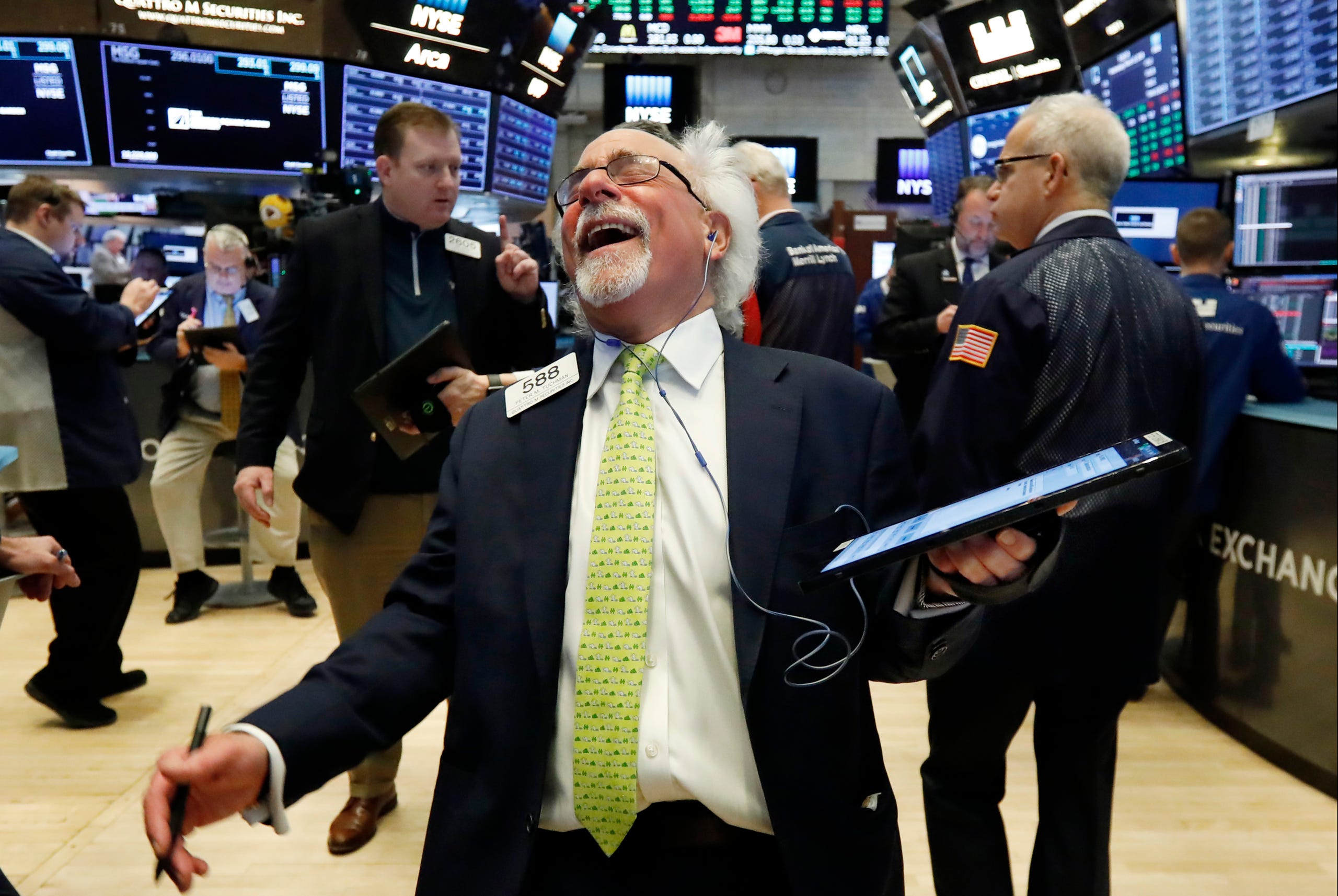
Wall Street rallies as Democrats capture Congress and Trump accepts the election results, while healthcare and clean-energy stocks gain and oil prices retreat.
MARKET INSIDER — U.S. stocks surged on Wednesday, November 4, 2026, after Democrats won control of both chambers of Congress in the midterm elections and President Donald Trump signaled his willingness to accept the results and work with the opposition. The Dow Jones Industrial Average jumped 1,236 points, or 2.4%, in morning trading, while the S&P 500 gained 1.7% and the Nasdaq Composite advanced 2.1%. Investors welcomed the reduction in immediate political uncertainty and the prospect of greater congressional oversight of Trump’s economic agenda, although the Democratic victory also raised questions about future regulation of artificial intelligence infrastructure and other industries.
Key takeaways
- Democrats won majorities in the House and Senate, creating a divided U.S. government for the remainder of Trump’s presidential term.
- The Dow rose 1,236 points, while healthcare and clean-energy stocks outperformed; the Invesco Solar ETF gained 9%.
- West Texas Intermediate crude oil fell 3% as investors considered whether the election results could increase pressure for a resolution to the Iran conflict.
Why Did Wall Street Rally After the Midterm Elections?
The immediate catalyst was the removal of two major sources of uncertainty: the outcome of the congressional elections and the risk of a disputed political transition.
Democrats secured control of both the House of Representatives and the Senate, giving them greater authority to scrutinize the Trump administration’s policies and influence the legislative agenda.
Trump told The New York Times he was “absolutely willing” to accept the results. He also indicated to The Wall Street Journal that Republicans would work with Democrats.
Those comments helped reassure investors concerned that a contentious election aftermath could disrupt financial markets.
Jay Woods, chief market strategist at Freedom Capital Markets, attributed part of the rally to Trump’s initial response.
Woods also pointed to the prospect of legislative gridlock, which investors sometimes favor because it can limit abrupt policy changes.
However, divided government does not eliminate political uncertainty. Negotiations over federal spending, trade policy and taxation could still produce market volatility.
The strength of Wednesday’s rally therefore reflected an improvement in near-term sentiment rather than certainty about the economic outlook.
Which Stocks Benefited Most From the Democratic Victory?
The market advance extended beyond large technology companies, with economically sensitive stocks and industries potentially benefiting from Democratic policies attracting investors.
Walmart shares gained 1.3%, while Bank of America rose 2.6%.
Healthcare companies were among the strongest performers.
Molina Healthcare and Centene each advanced approximately 6%, while hospital operator HCA Healthcare climbed 7%.
The gains reflected investor expectations that a Democratic-controlled Congress could provide a more supportive legislative environment for healthcare coverage and related spending.
Clean-energy companies also rallied.
The Invesco Solar ETF jumped 9%, reflecting renewed optimism about the outlook for renewable-energy businesses following the election.
These movements suggested investors were reassessing which industries might benefit from a change in congressional priorities.
However, the size of the gains does not establish that new legislation or government support will follow.
Democrats will control Congress, but Trump will retain the presidency, meaning major legislative changes could still face negotiations or presidential vetoes.
Why Did AI and Data-Center Stocks Face Pressure?
Not every part of the stock market participated in the rally.
Companies exposed to the artificial intelligence infrastructure boom faced renewed scrutiny after Democrats won several important state-level elections.
In Texas, Democratic gubernatorial candidate Gina Hinojosa won after campaigning on a proposal to impose an immediate moratorium on new data-center development.
The result raised concerns about possible restrictions in one of America’s most important markets for large-scale computing infrastructure.
Texas has attracted substantial investment in data centers because of its energy resources, land availability and expanding technology infrastructure.
Restrictions on new projects could affect construction schedules, electricity demand and capital expenditure plans.
Shares of CoreWeave declined on Wednesday, while SpaceX, which is headquartered in Texas, also came under pressure, according to the supplied market report.
For investors, the developments highlight a growing tension between the rapid expansion of AI computing capacity and the political challenges associated with electricity consumption, grid reliability and local infrastructure.
Data centers require significant power and cooling capacity, creating potential conflicts over energy prices, water use and land development.
The Texas election result does not automatically establish that a moratorium will take effect. Any restriction would depend on the governor’s legal authority, implementation decisions and potential legislative or judicial challenges.
Nevertheless, the political debate could become increasingly important for companies investing heavily in AI infrastructure.
Could Divided Government Support U.S. Stocks?
One explanation for Wednesday’s rally is the historical tendency of investors to view divided government as a potential constraint on major policy changes.
With Democrats controlling Congress and Trump remaining in the White House, legislation affecting taxation, federal spending and business regulation may require greater compromise.
Andrew Slimmon of Morgan Stanley Investment Management told CNBC that markets generally prefer political arrangements that prevent one party from exercising excessive power.
The investment argument is that slower legislative change can improve the predictability of the business environment.
However, historical market performance under divided government is not a reliable forecast of future returns.
Equity valuations, corporate earnings, interest rates and economic growth remain major determinants of stock-market performance.
Congressional gridlock can also introduce risks, particularly when lawmakers must negotiate federal budgets, borrowing authority or other essential legislation.
The practical implications will depend on whether the new balance of power produces policy stability or prolonged confrontation.
Why Did Oil Prices Fall After the Election?
Energy markets also responded to the political developments.
West Texas Intermediate crude oil futures fell approximately 3% on Wednesday as investors considered whether the election outcome could alter Washington’s approach to the conflict involving Iran.
The war has contributed to higher energy prices and inflation concerns, complicating the Federal Reserve’s efforts to manage monetary policy.
Slimmon suggested that stronger congressional pressure for a resolution to the Middle East conflict could help reduce oil prices.
That interpretation remains a market scenario rather than a confirmed policy shift.
Congressional Democrats may increase scrutiny of the administration’s military strategy, but an election victory does not immediately change geopolitical conditions or physical oil supplies.
Crude prices will continue to depend on developments in the conflict, production and export disruptions, global demand and decisions by major energy producers.
Nevertheless, a sustained decline in oil prices could have wider financial implications.
Lower energy costs would ease some inflationary pressures, potentially reducing the need for restrictive monetary policy and improving operating conditions for energy-intensive businesses.
What Does the U.S. Election Mean for Asian and Emerging Markets?
The U.S. midterm results could influence Asian markets through trade policy, interest-rate expectations, energy prices and international capital flows.
For export-oriented economies such as Vietnam, changes in U.S. tariff policy and industrial incentives are particularly relevant.
Democratic control of Congress could increase oversight of Trump’s trade agenda, although the president retains significant executive authority over certain trade measures.
Consequently, investors should not assume that existing tariffs will automatically be reversed.
The decline in oil prices may be more immediately relevant to Asian economies that depend heavily on imported energy.
Lower crude prices, if sustained, could reduce import costs and ease inflation pressures across parts of the region.
Financial conditions also matter.
If easing energy inflation contributes to lower U.S. Treasury yields or a less restrictive Federal Reserve outlook, emerging-market assets could benefit from improved global liquidity conditions.
However, those outcomes would depend on subsequent economic data and central-bank decisions.
For Asian technology suppliers, the debate over U.S. data-center development presents a separate risk.
Restrictions on AI infrastructure expansion could influence demand expectations for semiconductors, networking equipment, power systems and other components supplied by international manufacturers.
The election therefore creates potentially different implications across Asian industries rather than a uniformly positive or negative outlook.
Why It Matters
Wednesday’s rally illustrates how political uncertainty can influence financial markets even before new economic policies are implemented.
Investors responded positively to the clarity of the election result and Trump’s acceptance of the outcome.
At the same time, sector performance showed that the market was already beginning to price in possible differences in healthcare, renewable-energy and technology infrastructure policy.
For global investors, the central question is whether divided government will deliver greater policy predictability or produce new legislative confrontations.
The distinction matters because a political relief rally can occur even when the underlying economic challenges remain unresolved.
Inflation, energy prices, corporate earnings and the Federal Reserve’s interest-rate outlook will continue to shape the direction of U.S. and international markets.
Outlook: What Investors Should Watch Next
Three developments will be particularly important following the November 3 elections.
First, investors should monitor the Trump administration’s engagement with Democratic congressional leaders, especially on fiscal policy, tariffs and the Iran conflict.
Second, the direction of crude oil prices and U.S. inflation expectations will help determine whether Wednesday’s relief rally is accompanied by an improvement in the economic outlook.
Third, state-level decisions affecting data-center construction, particularly in Texas, could influence capital expenditure expectations across the AI infrastructure industry.
The Dow’s 1,200-point advance signals that investors welcomed the immediate reduction in political uncertainty. Whether that optimism can be sustained will depend on policy decisions, economic data and corporate earnings rather than the election outcome alone.
