
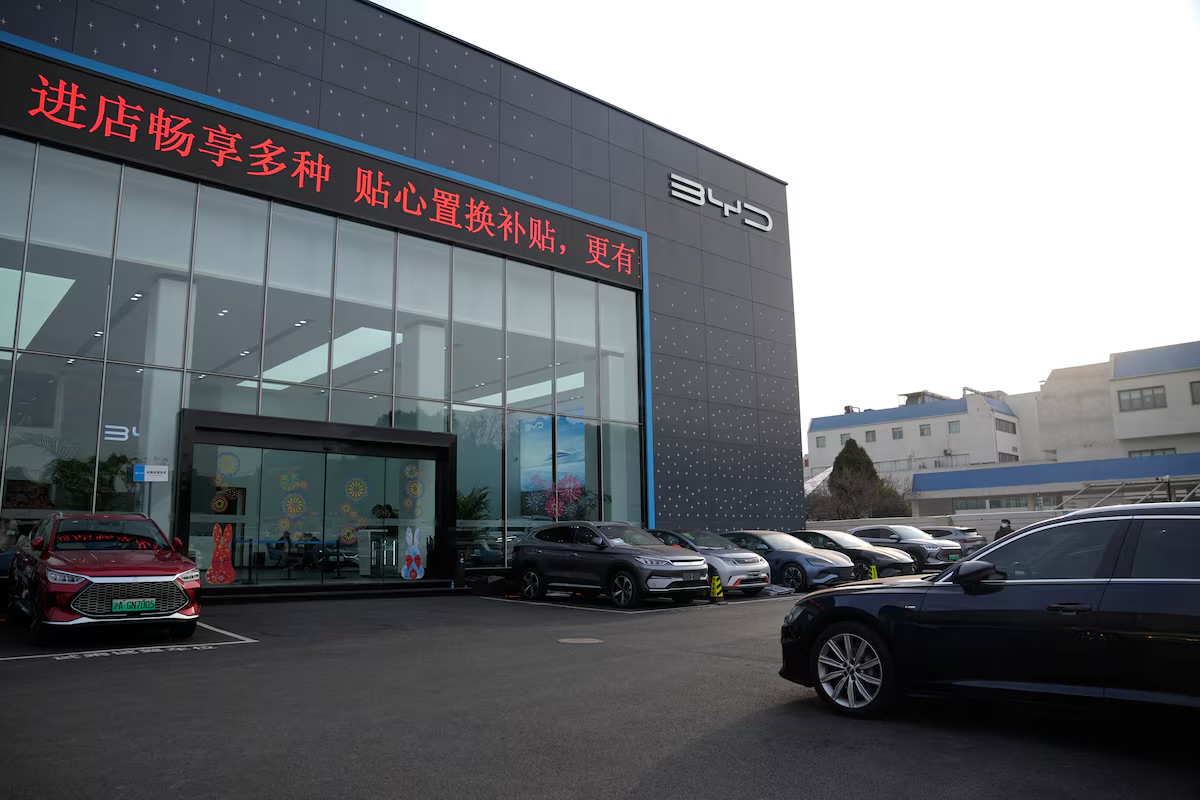
BEIJING – Chinese electric vehicle (EV) makers invested more capital abroad than in their domestic market for the first time in 2024, signaling a historic reorientation of capital flows driven by a brutal battle for profitability at home.
New data released Wednesday by U.S. think tank Rhodium Group reveals that years of government subsidies and support have led to massive overcapacity and a destructive cycle of price cutting, forcing manufacturers to aggressively seek returns outside of China.
The pivot overseas is stark: Chinese outbound foreign direct investment (FDI) in the EV value chain surged to an annual average of $30.4 billion between 2022 and 2024, up sharply from $8.5 billion in the preceding 2018-2021 period.
Meanwhile, domestic investment in the EV value chain has plummeted. After peaking at $94 billion in 2022, the value of domestic EV investment collapsed to just $15 billion last year, according to the data. Rhodium Group noted that the 2024 shift marks the first time EV investment by Chinese companies was “greater overseas than domestically,” as companies seek profitability outside a domestic market facing intense “involution.”
The Profit Crisis
The relentless price wars are deepening deflationary pressures within the world’s second-largest economy and have decimated margins across the automotive sector. Data from LSEG covering 33 listed automakers headquartered in China shows that the sector’s median net profit margin has fallen drastically, dropping from 2.7% in 2019 to just 0.83% in 2024.
With margins compressed to near zero, the largest players are accelerating their global manufacturing footprint to bypass rising trade barriers and access new consumer bases.
- BYD ($002594.SZ) is currently building an EV factory in southern Hungary, expected to start production by the end of 2025, and another facility in Turkey slated for 2026.
- Geely ($GEELY.UL) is moving forward with plans for a new plant in Vietnam.
- Chery ($9973.HK) and Great Wall Motors are expanding their presence in Russia and across Latin America.
Facing stiff tariffs and trade tensions from key partners including the European Union, the U.S., Canada, Turkey, and Brazil, Chinese automakers have focused their capital on less restrictive markets. Asia attracted 33% of new investment, while the Middle East and Africa secured 25%.
Global Headwinds Loom
The ambitious international investment strategy, however, is not without risk. Fears of a flood of cheap Chinese vehicles have sparked trade tensions, a strain the export-driven economy can ill-afford.
Even in high-priority growth regions, new headwinds are emerging. Reports suggest a China-Gulf free trade deal has stalled over concerns in Saudi Arabia that cheap Chinese imports could derail the kingdom’s own industrial ambitions, potentially squeezing future investment avenues in the Middle East.
While Chinese policymakers have pledged to address the aggressive price-cutting across multiple industries, including EVs, a concrete, clear-cut plan to enforce profitability and end the domestic “involution” has yet to be announced. This policy vacuum ensures that the trend of outward capital deployment is likely to remain the dominant investment strategy for the foreseeable future.
