
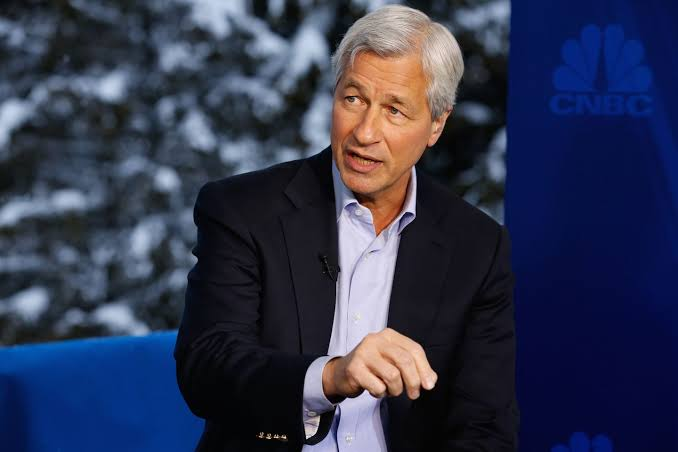
The JPMorgan chief said leverage is elevated across hedge funds, prime brokerages, ETFs and Treasury arbitrage, but stopped short of describing it as a systemic threat comparable with the 2008 financial crisis.
MARKET INSIDER — JPMorgan Chase Chief Executive Jamie Dimon has warned that record margin borrowing and less-visible forms of leverage could accelerate market selloffs when volatility rises, increasing the risk that the failure of one heavily indebted investor disrupts prices more broadly.
His comments followed the forced deleveraging of AI-focused hedge fund Situational Awareness, whose portfolio lost 67% in July. Dimon said markets absorbed that episode effectively and did not predict a financial crisis. However, record hedge-fund leverage, crowded technology positions and large leveraged trades in US Treasuries leave markets more vulnerable to margin calls and rapid liquidation.
Key Highlights
- US securities margin debt reached a record $1.50 trillion in June, almost 49% higher than a year earlier.
- Dimon said substantial additional leverage exists through hedge funds, prime brokerages, ETFs and Treasury arbitrage.
- The Federal Reserve has found hedge-fund leverage at record levels, although banks remain well capitalized and broker-dealer leverage is historically low.
- Situational Awareness’s 67% July loss demonstrates how margin calls can transform declining asset prices into forced selling.
Margin debt has reached a record $1.5 trillion
Dimon told CNBC that publicly reported margin debt represented only part of the borrowing embedded in financial markets.
“There’s a lot of margin debt you don’t see because it’s not called margin debt,” he said, referring to leverage created through prime brokerage financing, hedge funds, exchange-traded products and Treasury arbitrage strategies.
Official data support his concern about the visible portion of that borrowing.
Debit balances in US customer securities margin accounts reached a record $1.502 trillion in June, up from $1.416 trillion in May and $1.008 trillion a year earlier, according to the Financial Industry Regulatory Authority.
That represents a monthly increase of approximately 6.1% and a year-on-year rise of almost 49%, according to FINRA
Margin debt allows an investor to increase market exposure by borrowing against securities. It magnifies gains while prices are rising, but it also accelerates losses when markets turn lower.
If the value of collateral falls below a broker’s required threshold, the investor must contribute additional cash or securities. If that is impossible, the broker can liquidate positions—potentially into an already declining market.
The resulting feedback loop can be abrupt:
```mermaid
flowchart TD
    A["Asset prices fall"] --> B["Collateral value declines"]
    B --> C["Margin calls increase"]
    C --> D["Investors sell assets"]
    D --> E["Prices fall further"]
    E --> B
```
High margin debt does not necessarily predict when a correction will occur. It does, however, increase the potential speed and severity of a selloff once a catalyst appears.
Why some leverage is difficult to see
FINRA’s figures cover debit balances in customer securities margin accounts at regulated brokerage firms. They do not capture every form of financial-market borrowing.
Hedge funds can obtain financing through prime brokers, repurchase agreements, derivatives and total-return swaps. Investors can also create leveraged exposure through options and leveraged ETFs without borrowing through a conventional retail margin account.
Some strategies appear relatively low-risk because they seek to profit from small differences between closely related securities. Yet producing meaningful returns from a narrow price difference often requires substantial borrowed capital.
The Treasury cash-futures basis trade is a prominent example. A hedge fund buys a Treasury security, usually with money borrowed in the repo market, while selling a related Treasury futures contract. The expected profit from the convergence between the two prices may be small, encouraging the fund to use high leverage.
Federal Reserve researchers estimated that Treasury basis-trade positions reached approximately $830 billion in September 2025, nearly twice their early-2020 peak. Hedge funds’ gross Treasury exposure stood at about $4 trillion, supported by approximately $3 trillion of repo borrowing.
The 50 largest funds accounted for around 90% of those Treasury exposures, increasing the importance of risk management at a relatively small number of institutions, reported the Federal Reserve.
These trades provide liquidity and contribute to price discovery under normal market conditions. The vulnerability emerges when volatility rises, funding becomes more expensive or lenders demand additional collateral simultaneously.
A forced unwind could affect not only hedge-fund investors but also Treasury prices, futures markets, repo funding and dealers that intermediate between them.
Federal Reserve sees notable—but contained—vulnerabilities
Dimon’s warning is consistent with the Federal Reserve’s latest assessment of the financial system.
The Fed’s May Financial Stability Report said hedge-fund leverage remained at record-high levels for the period covered by comprehensive data. A reduction in basis-trade activity had largely been offset by other relative-value strategies, including swap-spread trades.
However, the report also contained important counterbalances. It described the banking system as sound and resilient, while broker-dealer leverage remained near historical lows and dealers retained adequate market-making capacity, according to Federal Reserve
That distinction helps explain why Dimon did not call current leverage a systemic crisis.
Leverage concentrated in hedge funds can produce significant losses and localized market dislocations without necessarily threatening the solvency of major banks. The risk becomes systemic when losses are sufficiently large, counterparties are highly interconnected and institutions lack the capital or liquidity to absorb them.
Current bank capital and risk-management standards are considerably stronger than those that prevailed before the global financial crisis. Nevertheless, exposures created through private funds, derivatives and non-bank financing can be more difficult for regulators and market participants to observe in real time.
Situational Awareness offers a recent warning
The near-collapse of Situational Awareness illustrates how quickly leveraged concentration can unravel.
The AI-focused hedge fund, founded by former OpenAI researcher Leopold Aschenbrenner, suffered a 67% decline in portfolio value during July after technology and semiconductor stocks moved sharply against it.
The firm sold the majority of its stock portfolio to Citadel and unwound most of its public-equity exposure. It also removed all leverage after margin pressure and deteriorating liquidity made its positions increasingly difficult to manage.
Despite the July collapse, the fund remained up approximately 80% for 2026 because of its extraordinary gains earlier in the year, according to an investor letter reviewed by Reuters.
JPMorgan was one of the fund’s major prime brokers. Dimon said the market had handled the liquidation well, suggesting that collateral, counterparty management and the transfer of positions prevented the failure from spreading.
Situational Awareness therefore provides two opposing lessons.
First, a leveraged fund can suffer devastating losses without destabilizing the overall financial system. This supports Dimon’s view that elevated leverage is not automatically systemic.
Second, the episode demonstrates how leverage, concentrated positions and declining liquidity reinforce one another. A fund may believe strongly in the long-term fundamentals of its holdings but still be forced to sell before that thesis can be realized.
The successful absorption of one liquidation also does not guarantee that markets could handle several large funds unwinding similar trades simultaneously.
High leverage is not the same as the 2008 crisis
Dimon distinguished current conditions from 2008, arguing that leverage was not, by itself, the fundamental cause of that crisis.
The deeper problem was the scale of actual and prospective losses on mortgages and securities backed by them. Those losses impaired bank balance sheets, undermined confidence in counterparties and threatened institutions central to the payment and credit system.
Today’s elevated leverage is distributed across equities, derivatives, hedge funds, Treasury relative-value trades and other strategies. Losses can still be large, but they do not necessarily represent the same type of common, deteriorating credit exposure that existed across the banking system before 2008.
This distinction can be summarized as follows:
| Risk factor | Current leveraged markets | Global financial crisis |
|---|---|---|
| Main vulnerability | Forced selling and liquidity shocks | Large credit losses and bank insolvency risk |
| Important participants | Hedge funds, prime brokers and non-bank investors | Banks, mortgage lenders and structured-credit investors |
| Typical trigger | Volatility, margin calls or funding withdrawal | Mortgage defaults and falling collateral values |
| Potential transmission | Crowded trades and simultaneous deleveraging | Impaired bank capital and frozen credit markets |
| Current mitigating factor | Stronger bank capital and lower dealer leverage | Capital and liquidity buffers were inadequate |
The comparison should not produce complacency. The March 2020 Treasury-market disruption showed that leveraged non-bank activity can still threaten the functioning of a market essential to global finance, even without mortgage-style credit losses.
Higher collateral demands could add pressure
Dimon said JPMorgan continually adjusts collateral requirements according to individual clients and market conditions.
When volatility rises, banks and clearing houses typically demand more collateral. This protects lenders and market infrastructure from counterparty failures, but it can intensify pressure on leveraged investors.
A hedge fund facing higher margin requirements has several options: contribute cash, reduce exposure, hedge more aggressively or sell assets. If several funds receive similar demands at the same time, the collective effort to reduce risk can deepen the market move that caused the margin calls.
Investors should therefore watch measures beyond headline margin debt, including repo rates, futures margins, option volatility, prime-broker financing conditions and liquidity in heavily owned securities.
Sharp declines accompanied by unusually high trading volume may signal forced deleveraging rather than a fundamental reassessment alone.
Inflation and long-term rates create a second risk
Dimon also warned that structural demand for capital could keep inflation and long-term borrowing costs higher than investors expect.
He pointed to government deficits, infrastructure requirements, changes in global trade and increased military spending. These forces can compete for labor, materials and financing, potentially raising both prices and the returns investors demand from long-dated bonds.
“The remilitarization of the world would be inflationary,” Dimon said in the CNBC transcript.
That matters for leverage because higher bond yields affect both sides of the equation.
They can reduce valuations for equities and other long-duration assets, particularly highly valued technology shares whose expected earnings lie far in the future. At the same time, higher financing costs make leveraged positions more expensive to maintain.
A sustained rise in long-term yields could therefore pressure collateral values while increasing borrowing costs—a difficult combination for hedge funds and other leveraged investors.
Treasury relative-value trades could also become vulnerable if interest-rate volatility increases or repo financing becomes less favorable.
Implications for Asian and emerging markets
Although Dimon was discussing US-centered financial markets, the effects of deleveraging would not remain confined to the United States.
Many global funds hold positions across US technology companies, Asian semiconductor producers, emerging-market equities, currencies and sovereign bonds. When managers receive margin calls, they may sell the most liquid assets available rather than only the positions that caused the losses.
That means fundamentally sound Asian stocks can decline because investors need cash elsewhere.
Technology supply chains are particularly exposed. Crowded investment themes around artificial intelligence connect US software and cloud companies with semiconductor manufacturers, memory-chip producers, equipment suppliers and data-center infrastructure businesses across South Korea, Taiwan, Japan and Southeast Asia.
Emerging-market currencies could also come under pressure if a volatility shock prompts investors to reduce risk and move capital into dollars or short-dated US government securities.
For Vietnam, the direct exposure of domestic financial institutions to global hedge funds is limited compared with larger developed markets. The indirect channels are more important: foreign portfolio flows, exchange-rate pressure, global risk appetite and valuations assigned to emerging-market equities.
This is especially relevant as Vietnam prepares to enter FTSE Russell’s emerging-market indices. Greater participation by international institutions should improve liquidity over time, but it will also make the domestic market more responsive to global fund flows and risk-reduction cycles.
What investors should watch next
The first indicator is the direction and pace of margin borrowing. FINRA’s June figure of $1.50 trillion is not merely a record; its near-49% year-on-year increase shows that leverage has expanded considerably faster than the underlying economy.
The second is whether weakness spreads across unrelated asset classes. A decline concentrated in overvalued technology shares is different from simultaneous stress in equities, Treasuries, credit markets and repo financing.
Third, investors should monitor changes in collateral requirements. Higher margins are prudent from the perspective of banks and clearing houses, but rapid increases can force funds to sell positions at unfavorable prices.
Fourth, attention should focus on correlations among crowded portfolios. Situational Awareness was absorbed without a broader crisis partly because other market participants were willing and able to buy its assets. That capacity could be smaller if multiple leveraged funds held similar positions and needed to sell together.
Dimon’s message is therefore more nuanced than a prediction of collapse. Record leverage does not establish that a crisis is imminent, and the financial system has so far demonstrated an ability to contain isolated failures.
It does mean that market stability depends increasingly on collateral values, liquidity and the willingness of lenders to maintain financing. When leverage is high, a relatively ordinary correction can become disorderly—not necessarily because the original losses are systemic, but because forced selling makes them larger.
