
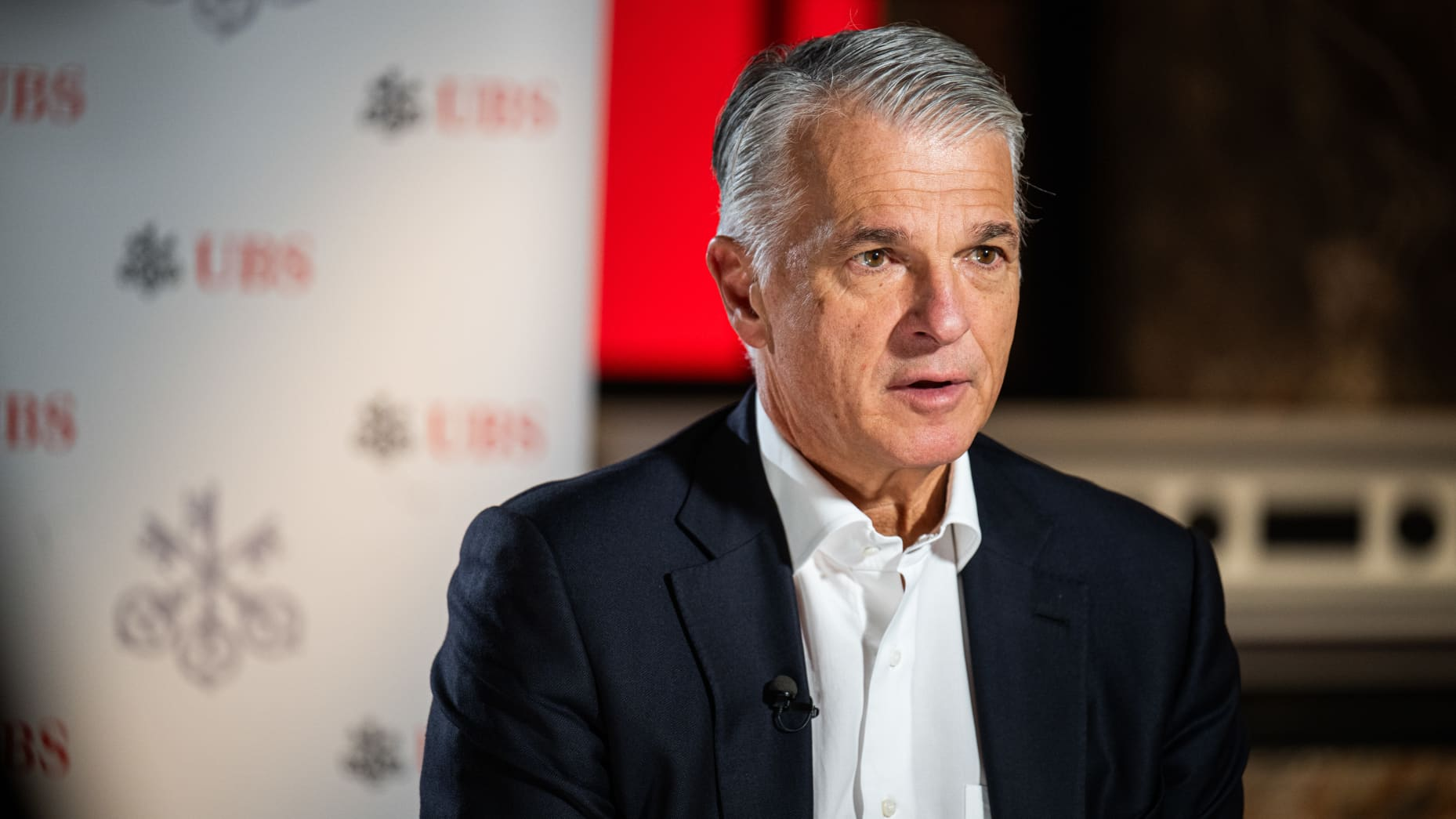
AI investment has supported growth and asset prices, but Sergio Ermotti says unresolved geopolitical and inflation risks are accumulating.
MARKET INSIDER — Financial markets are displaying too little concern about an increasingly dangerous combination of wars, disrupted energy supplies, persistent inflation and rising borrowing costs, according to UBS Chief Executive Sergio Ermotti.
Despite occasional volatility, asset prices have remained resilient as investment in artificial intelligence, data centers and other technologies supports economic growth. Ermotti warned that this strength may be encouraging complacency while new risks accumulate before earlier problems have been resolved.
UBS’s wealthiest clients are responding through broader diversification rather than abandoning U.S. assets or making aggressive directional bets—a strategy that reflects uncertainty, not an expectation of an imminent market collapse.
Key Highlights
- UBS CEO Sergio Ermotti says market volatility has been unusually subdued relative to mounting geopolitical and economic risks.
- Wealthy clients are diversifying across sectors and regions but are not making a wholesale retreat from U.S. assets or the dollar.
- Persistent inflation and the energy shock could keep interest rates elevated as the Federal Reserve, ECB and Bank of Japan consider further tightening.
Market resilience is creating complacency
“There has been a level of complacency in financial markets in the last few years,” Ermotti told CNBC, adding that the current environment would normally have produced considerably greater volatility.
The UBS chief did not argue that markets are ignoring every risk. Equities, bonds, commodities and currencies have experienced periods of turbulence as investors responded to wars, tariffs, inflation data and changes in central-bank expectations.
His concern is that these disruptions have remained relatively contained even as the number of unresolved threats has increased.
“New problems or new issues are emerging without any of the old ones being addressed or being closed,” he said.
The conflict involving Iran has disrupted energy shipping and driven Brent crude above $100 a barrel. Russia’s war in Ukraine continues to affect European security and commodity markets, while strategic rivalry between the United States and China is reshaping technology investment, trade policy and global supply chains.
At the same time, elevated government borrowing, stubborn inflation and rising bond yields are increasing the cost of capital across developed and emerging economies.
Each risk may appear manageable in isolation. Ermotti’s warning concerns their potential interaction.
AI investment has delayed the reckoning
One reason markets remain resilient is the extraordinary level of investment in artificial intelligence and supporting infrastructure.
Technology companies, utilities, semiconductor manufacturers and data-center developers continue to commit capital to computing capacity, electrical grids, advanced chips and cloud services.
That spending supports corporate earnings, construction activity and employment while creating demand across multiple supply chains.
AI enthusiasm has also increased the valuations of companies positioned to benefit from the investment cycle. Strong returns in a relatively concentrated group of technology-related stocks have helped major equity indexes absorb weakness elsewhere.
Ermotti acknowledged that investment in AI, data centers and other new technologies has been an important source of economic and market support.
The risk is not necessarily that AI spending suddenly disappears. It is that investors treat one powerful growth theme as protection against unrelated shocks.
A prolonged energy crisis could raise operating costs and interest rates at the same time. Higher discount rates would reduce the present value of future technology earnings, while more expensive electricity could weaken the economics of energy-intensive data centers.
AI investment can support growth, but it cannot eliminate geopolitical or monetary risk.
Investors are avoiding strong directional bets
“It’s quite difficult in this environment and not really advisable to have too many strong convictions,” Ermotti said.
UBS clients have broadened their investments across industries and countries while retaining exposure to technology and AI.
That does not mean they have moved entirely into cash or defensive assets. It suggests they are reducing dependence on a single market outcome.
A portfolio positioned exclusively for falling inflation, for example, would be vulnerable if oil remains above $100 and central banks raise rates. One built entirely around higher rates could suffer if geopolitical tensions ease and inflation declines more quickly than expected.
Diversification provides exposure to several possible outcomes without requiring investors to identify the exact timing of the next policy or geopolitical shift.
For UBS, the trend also reinforces the strategic importance of global wealth management. Clients navigating uncertain markets require asset allocation, hedging and access to multiple regions and product categories—areas that can generate recurring fee income for the bank.
No wholesale retreat from America or the dollar
Ermotti pushed back against claims that international investors are abandoning U.S. assets.
UBS observed some additional capital flowing toward emerging markets about a year ago, but those allocations largely involved excess cash rather than the sale of existing American investments.
“It was more how excess cash was deployed rather than people back trading from the U.S. or from the dollar,” he said.
The distinction matters.
Investing new money in Europe, Asia or emerging markets is diversification. Selling established U.S. holdings and converting dollar reserves would represent a more fundamental shift in global asset allocation.
UBS has not observed the latter on a broad scale. The dollar continues to function as the principal reference currency for international finance, trade, reserves and portfolio measurement.
U.S. markets also retain structural advantages, including deep liquidity, a large technology sector and an extensive supply of investable assets.
However, the absence of an exit from America does not mean international diversification has ended. Relative valuations, improving growth prospects and currency movements can still make selected European and emerging-market assets more attractive for incremental allocations.
Higher-for-longer rates return as the central risk
Ermotti expects inflation to keep borrowing costs elevated and anticipates further rate increases from major central banks.
“The ECB may start [the] hike process. The Fed will follow. We do expect a couple of hikes in the next few months,” he said.
The European Central Bank is expected to raise its deposit rate from 2.25% to 2.5% as the Iran conflict and higher energy prices renew inflation concerns. Eurozone economic resilience and expanding bank lending give policymakers room to tighten despite the pressure on households and businesses.
Federal Reserve expectations remain dependent on U.S. inflation data. Markets have assigned roughly a 60% probability to a September rate increase following strong employment figures, but the decision could change if consumer-price data show weaker underlying inflation.
The Bank of Japan is also approaching a policy decision amid domestic inflation, a stronger yen and rising government-bond yields.
Brent crude holding above $100 has pushed global yields higher by increasing the risk that energy costs spread into transport, food, goods and wages.
Investors who expected a rapid return to the ultra-low interest-rate environment that followed the global financial crisis may therefore need to adjust.
“Inflationary pressure is still there, and it’s not abating,” Ermotti said. “It’s reasonable to expect higher rates for the foreseeable future.”
Why low volatility can become dangerous
Calm markets are not inherently unhealthy. They can reflect stable earnings, adequate liquidity and investor confidence that policymakers will contain economic shocks.
Problems arise when low volatility encourages excessive leverage or creates the impression that downside protection is unnecessary.
If many investors hold similar positions because recent market declines have been brief, an unexpected shock can force them to reduce exposure simultaneously. That turns an ordinary correction into a liquidity event.
Higher interest rates increase this vulnerability. Leveraged strategies become more expensive to maintain, refinancing becomes harder and asset valuations face greater sensitivity to changes in bond yields.
The most exposed areas are not necessarily those receiving the most negative headlines. Risk can accumulate in crowded equity positions, long-duration assets, highly leveraged private markets or currency carry trades that appear stable until funding conditions change.
Ermotti’s message is therefore less about forecasting the next crisis than questioning whether current asset prices offer sufficient compensation for uncertainty.
Implications for Asian and emerging markets
Emerging markets could receive additional capital as wealthy investors deploy new money beyond the United States, but the benefits will be selective.
Countries with strong growth, credible monetary policy and manageable external debt may attract investment as part of broader global diversification.
Markets dependent on imported energy face a more difficult environment. Oil above $100 can raise inflation, weaken trade balances and pressure currencies, forcing central banks to maintain tighter policy even when domestic growth slows.
Asian technology and manufacturing markets can benefit from the AI capital-expenditure cycle. At the same time, they remain vulnerable to U.S.-China restrictions, supply-chain realignment and higher global bond yields.
The result is not a simple rotation from the United States into emerging markets. Investors are likely to differentiate more sharply between countries, sectors and companies based on balance-sheet quality, energy exposure and sensitivity to interest rates.
What investors should watch
The first test is whether oil remains above $100 long enough to affect broader inflation data. A brief spike would have different monetary consequences from a sustained increase that changes wages and consumer expectations.
The second is central-bank coordination. Simultaneous tightening by the Fed, ECB and Bank of Japan would reduce the policy divergence that normally supports individual currencies while tightening global financial conditions more broadly.
Investors should also monitor whether AI-related earnings continue to justify capital spending and equity valuations. Slower revenue growth combined with higher financing and electricity costs would weaken one of the principal supports for global markets.
Finally, volatility itself deserves attention. Rising equity, bond or currency volatility without an obvious deterioration in headline indexes could indicate that investors are beginning to hedge risks beneath the surface.
Ermotti is not calling for investors to exit markets. His warning is that resilience should not be mistaken for safety.
The appropriate response is to remain invested while ensuring that no single geopolitical resolution, interest-rate path or technology narrative determines the entire portfolio outcome.
