
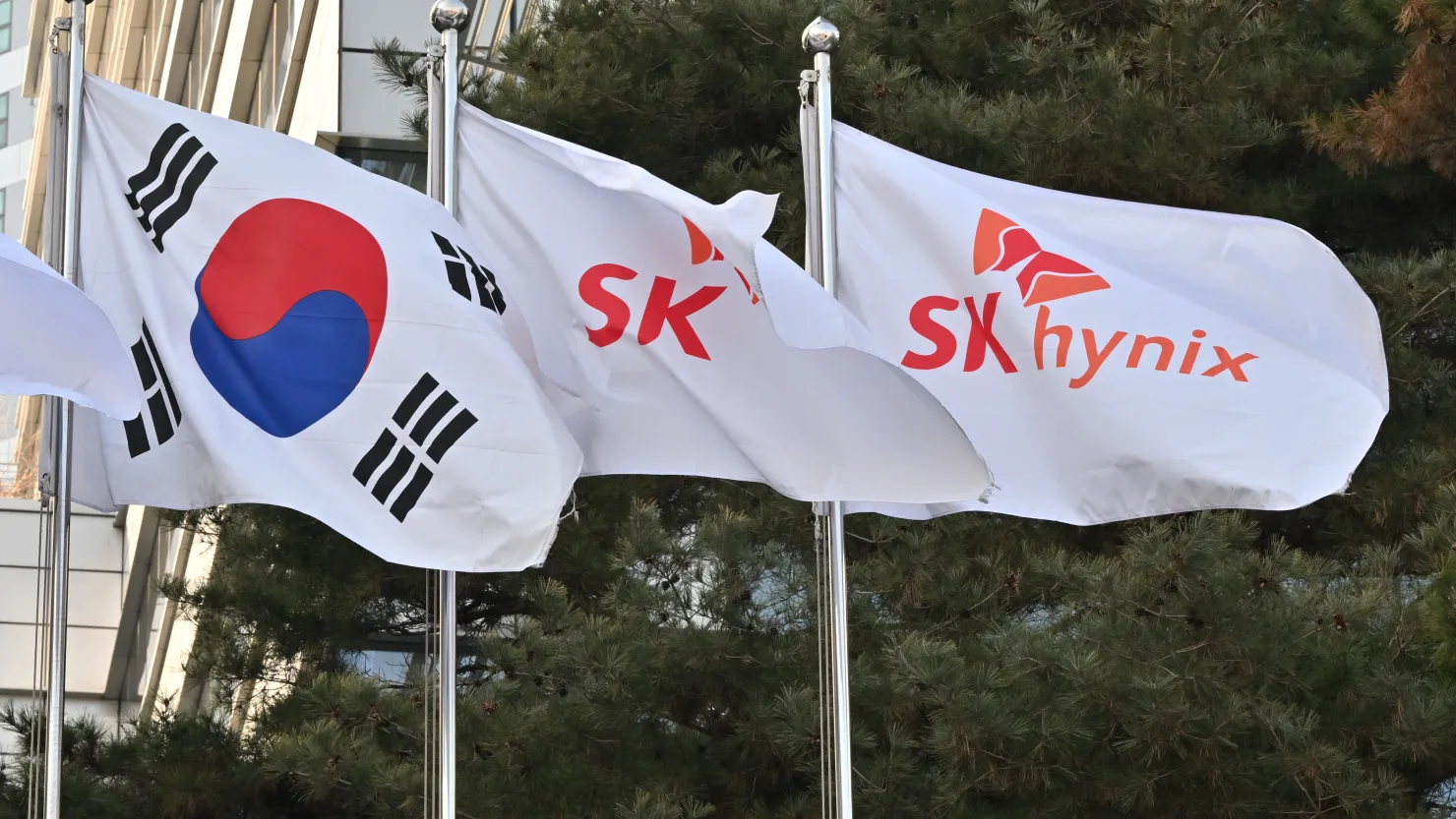
The South Korean memory giant is bringing the AI chip boom to Wall Street as investors bet the memory supercycle is only just beginning.
MARKET INSIDER – The global artificial intelligence race is creating a new class of trillion-dollar winners beyond the familiar names of Nvidia and Microsoft. This week, South Korean semiconductor powerhouse SK Hynix is making its long-awaited Nasdaq debut, giving U.S. investors direct exposure to one of the world’s most critical AI infrastructure companies—and highlighting how memory chips have become one of the most valuable assets in the AI economy.
The listing comes as governments and technology giants pour hundreds of billions of dollars into AI infrastructure, intensifying competition for advanced semiconductors. While graphics processors have dominated headlines, industry experts increasingly argue that high-bandwidth memory (HBM)—the specialized memory enabling AI models to process enormous datasets—is emerging as one of the industry’s biggest bottlenecks. That shift has propelled SK Hynix into the global spotlight.
The company, now South Korea’s second-most valuable corporation after Samsung, has seen its market capitalization approach $1 trillion following a more than sevenfold surge in its share price over the past year. Trading on Nasdaq under the ticker SKHY, the company plans to raise roughly $29 billion through American depositary receipts (ADRs), with proceeds funding an ambitious global manufacturing expansion designed to meet relentless AI demand.
SK Hynix has quietly become one of the most indispensable suppliers in the AI ecosystem. Its HBM technology powers many of Nvidia’s latest AI accelerators, making the company a critical supplier for hyperscale cloud providers racing to expand data centers worldwide. Analysts expect SK Hynix to control more than half of the global HBM market this year, reinforcing its leadership in one of the semiconductor industry’s fastest-growing segments. That strategic position was further underscored in June when Nvidia CEO Jensen Huang visited Seoul to announce a multi-year partnership with the company.
The AI boom is also reshaping industrial policy. Beyond expanding massive fabrication clusters across South Korea, SK Hynix is investing heavily in the United States, including a $4 billion advanced packaging facility in Indiana scheduled to begin operations in 2028. The project aligns with Washington’s broader effort to rebuild domestic semiconductor manufacturing under the CHIPS and Science Act, which could provide SK Hynix with up to $458 million in grants and $570 million in government-backed loans.
Financially, the transformation has been extraordinary. Revenue nearly tripled between 2023 and 2025 to approximately $65 billion, while Wall Street analysts expect sales to climb toward $235 billion in 2026 as AI infrastructure spending accelerates. More than three-quarters of the company’s revenue comes from DRAM memory—including HBM—while it also holds a leading position in NAND flash storage through Solidigm, the former Intel NAND business acquired in 2021.
Yet history offers a cautionary note. Memory chips have long been among the semiconductor industry’s most cyclical products, with previous technology booms—from personal computers to smartphones—eventually giving way to oversupply and steep price declines. To reduce that volatility, SK Hynix, Samsung, and Micron are increasingly locking customers into multi-year supply agreements, providing greater visibility for both manufacturers and hyperscale AI customers that cannot afford shortages.
The company is backing its confidence with unprecedented capital spending. In South Korea alone, SK Hynix plans investments reaching $720 billion to expand AI memory production, while simultaneously purchasing billions of dollars’ worth of cutting-edge extreme ultraviolet (EUV) lithography systems from Dutch equipment maker ASML. These machines, among the most sophisticated manufacturing tools ever built, are essential for producing the next generation of advanced AI memory.
Whether today’s AI-driven memory boom becomes another painful semiconductor cycle—or the beginning of a structurally larger computing era—remains one of the biggest debates in global markets. For now, SK Hynix’s Nasdaq debut sends a powerful signal: in the race to build artificial intelligence, the companies supplying memory may prove just as strategically important as those designing the AI chips themselves.
