
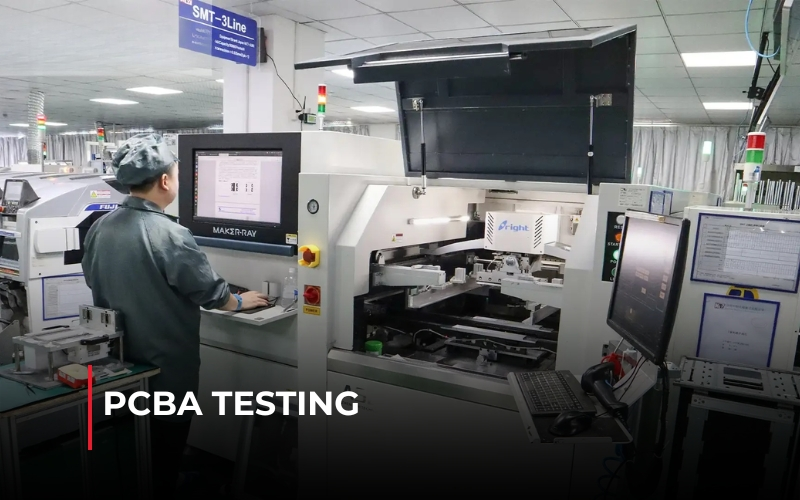
A printed circuit board assembly (PCBA) may appear complete once every component has been mounted and soldered onto the board. However, a finished appearance alone does not guarantee that the assembly will operate as designed. Hidden defects such as poor solder joints, incorrect component placement, electrical faults, or firmware issues can remain undetected until the product is powered on or deployed in the field.
As electronic products become increasingly compact, intelligent, and interconnected, ensuring performance requires far more than a visual inspection. Manufacturers must verify that every assembled board functions correctly, complies with design specifications, and delivers consistent long-term performance.
For companies producing consumer electronics, industrial equipment, automotive systems, medical devices, and telecommunications hardware, comprehensive PCBA testing has become an integral part of the manufacturing process rather than simply a final quality control step. Effective verification not only reduces production defects and warranty claims but also improves manufacturing yield, supports compliance with international standards, and strengthens customer confidence.
This article explores why PCBA testing is indispensable in modern electronics manufacturing, examines the most widely used inspection and validation methods, and explains how a structured quality assurance strategy contributes to product reliability and long-term business success.
Why PCBA Testing Matters More Than Ever
The electronics industry continues to evolve at an unprecedented pace. Products are becoming smaller, faster, and more sophisticated while integrating increasingly dense component layouts, multilayer circuit boards, embedded software, and high-speed communication interfaces.
This growing complexity also increases the risk of manufacturing defects. A single solder bridge, an incorrectly installed component, an inaccurate component value, or improperly programmed firmware can prevent an entire assembly from functioning correctly.
For this reason, verifying every assembled board has become an essential stage of production rather than an optional quality check.
Unlike visual inspection, comprehensive verification confirms not only that components are correctly installed but also that they operate together as intended. Electrical integrity, firmware functionality, communication interfaces, and overall system behavior must all perform according to the original design requirements before a product can be released.
Beyond technical performance, rigorous quality verification also delivers significant commercial benefits. Detecting defects early in production minimizes rework, reduces scrap, lowers warranty costs, and prevents expensive field failures. According to the American Society for Quality (ASQ), the cost of correcting defects increases dramatically as products move further through manufacturing, distribution, and customer deployment.
These principles are also reflected in IPC manufacturing standards, which emphasize that reducing defects throughout production improves product quality, operational efficiency, and customer satisfaction.
Industries such as automotive, aerospace, industrial automation, telecommunications, and medical technology rely particularly heavily on comprehensive validation processes because product failures can have significant financial, operational, or even safety consequences.
Ultimately, manufacturers are not simply looking for defects, they are building confidence that every product leaving the factory will perform consistently throughout its intended service life.
Quality assurance is a critical part of modern PCBA manufacturing, but the process is often easier to understand through real production examples. Before exploring the different inspection methods in detail, watch the short video below to see how manufacturers verify assembly quality and detect defects throughout the production process.
Watch: How PCBA Testing Works in Electronics Manufacturing
As the video demonstrates, no single inspection method can identify every possible defect. Depending on the product and customer requirements, manufacturers typically combine multiple verification techniques to ensure both assembly quality and functional performance.
Common PCBA Testing Methods in Vietnam’s Electronics Manufacturing
No single inspection method can identify every manufacturing defect. Depending on the product’s complexity, production volume, and customer requirements, electronics manufacturers in Vietnam typically combine several quality verification methods throughout the assembly process.
Factories serving consumer electronics may only require basic inspection and functional verification, while suppliers producing automotive, industrial, medical, or telecommunications products often implement more comprehensive quality control procedures to meet international standards and customer specifications.
Understanding these methods helps buyers evaluate a supplier’s manufacturing capabilities and quality management system before placing an order.
Automated Optical Inspection (AOI)
Automated Optical Inspection (AOI) is one of the most widely used inspection methods in Vietnam’s PCBA industry. After surface-mount components are placed and soldered, high-resolution cameras automatically compare the assembled board against the original design data.
AOI quickly identifies common assembly defects, including missing components, incorrect orientation, polarity errors, solder bridges, insufficient solder, and component placement issues.
Because the process is fast and highly automated, AOI allows manufacturers to detect assembly problems early, reducing rework and improving production efficiency before boards move to electrical verification.
However, AOI only evaluates the physical quality of the assembly. It cannot confirm whether the circuit operates correctly once power is applied.
In-Circuit Testing (ICT)
Many medium- and large-scale PCBA manufacturers in Vietnam use In-Circuit Testing (ICT) for products that require higher quality assurance or larger production volumes.
ICT verifies the electrical integrity of individual components and circuit connections using dedicated test fixtures designed specifically for each product.
This process helps identify electrical defects such as open circuits, short circuits, faulty solder joints, damaged components, and incorrect component values before final assembly.
Although ICT offers fast and accurate diagnostics for mass production, developing custom fixtures requires additional engineering effort. For this reason, it is generally more suitable for stable, high-volume manufacturing programs.
Flying Probe Testing
For prototypes, low-volume production, or products that are still undergoing design revisions, many Vietnamese manufacturers use flying probe systems instead of ICT.
Unlike ICT, flying probe equipment does not require dedicated fixtures. Computer-controlled probes move across the PCB and make direct contact with predefined test points to verify electrical connections.
This flexibility reduces setup costs and shortens product development time, making flying probe inspection particularly valuable during new product introduction (NPI) or engineering validation.
Once production reaches higher volumes, manufacturers often transition to ICT to improve throughput and reduce cycle time.
Functional Circuit Testing (FCT)
While electrical verification confirms that circuits have been assembled correctly, Functional Circuit Testing (FCT) evaluates whether the completed PCBA performs as intended under real operating conditions.
During this stage, the board is powered on and operated within a simulated application environment. Engineers verify communication interfaces, embedded software, input and output signals, sensor responses, and overall system behavior.
For example, a board may successfully pass AOI and ICT but still fail because of incorrect firmware configuration or software integration issues. Functional verification helps identify these problems before products leave the factory.
The specific FCT procedure varies depending on the customer’s application, making it one of the most customized stages of the quality assurance process.
Burn-In and Reliability Testing
Not every product requires burn-in testing. However, manufacturers producing PCBAs for automotive, industrial automation, aerospace, medical devices, or other mission-critical applications often perform additional reliability verification before shipment.
During burn-in, assembled boards operate continuously under elevated temperatures and electrical loads to expose latent defects that may not appear during normal inspection.
Although this process increases production time, it significantly improves confidence in long-term product reliability and reduces the risk of failures after deployment.
Whether burn-in is required usually depends on the customer’s specifications, industry standards, and the product’s intended operating environment.
Choosing the Right Verification Process
There is no universal inspection strategy for every PCBA. The appropriate combination of AOI, ICT, flying probe testing, FCT, and reliability validation depends on the product, production volume, target industry, and customer requirements.
For buyers sourcing PCBAs in Vietnam, understanding which verification methods a supplier offers is just as important as evaluating production capacity or pricing. A manufacturer that can provide documented quality control procedures, traceability, and appropriate inspection capabilities is generally better positioned to deliver consistent product quality over the long term.

Troubleshooting and Functional Verification
Even with modern manufacturing equipment and automated inspection systems, no production process is entirely free from defects. What differentiates a reliable PCBA manufacturer is not whether issues occur, but how quickly they are identified, analyzed, and resolved before products reach the customer.
Quality verification plays an important role in uncovering defects that are difficult, or impossible, to detect through visual inspection alone. Common issues include solder bridges, open circuits, damaged components, incorrect polarity, firmware errors, and communication failures between hardware and software.
When a defect is identified, engineers perform root cause analysis to determine why it occurred rather than simply replacing the faulty component. The investigation may examine PCB design, component quality, soldering parameters, firmware configuration, or even material variations from suppliers.
For example, if the same component repeatedly fails during electrical verification, engineers may evaluate supplier consistency, soldering temperatures, PCB layout, or firmware compatibility instead of treating each failure as an isolated incident. Resolving the underlying cause helps prevent similar defects from recurring during mass production.
This continuous improvement process directly contributes to higher production yield, lower rework costs, and more stable manufacturing performance.
One of the most closely monitored manufacturing indicators is First Pass Yield (FPY), the percentage of assemblies that successfully pass production without requiring rework or repair. A high FPY generally reflects a well-controlled manufacturing process, while a low FPY often indicates opportunities for process improvement.
For buyers evaluating PCBA suppliers in Vietnam, consistent production yield is often a stronger indicator of manufacturing capability than production capacity alone.
Why Functional Verification Matters
Passing visual inspection or electrical verification does not necessarily mean that a product will function correctly in real-world applications.
Functional verification evaluates the complete assembled board under operating conditions similar to its intended use. Depending on the application, this process may verify:
- Power management performance
- Signal processing accuracy
- Embedded firmware operation
- Communication interfaces and protocols
- Sensor functionality
- User interface response
This step has become increasingly important as modern electronic products integrate hardware, embedded software, wireless communication, and intelligent control systems into a single assembly.
For example, a board may successfully pass AOI and ICT but still fail because firmware cannot communicate with external devices or software does not respond correctly under operating conditions. Functional verification helps identify these issues before products are shipped to customers.
For manufacturers, this reduces warranty claims, technical support costs, and product recalls. For customers, it provides greater confidence that products will perform reliably once deployed in the field.
As product complexity continues to increase, functional verification is no longer viewed solely as a technical requirement—it has become an important contributor to customer satisfaction and long-term product reliability.
From Compliance to Reliability
Quality assurance in electronics manufacturing is evolving beyond traditional defect detection. Today, customers expect suppliers not only to meet specifications but also to demonstrate consistent manufacturing performance, complete production traceability, and continuous process improvement.
This shift is particularly evident in industries such as automotive, medical devices, industrial automation, and telecommunications, where product failures can lead to significant operational, financial, or safety consequences.
As a result, manufacturers are increasingly investing in advanced inspection technologies and data-driven quality management systems.
One of the most significant developments is the adoption of AI-assisted inspection. Machine learning algorithms can recognize defect patterns, improve inspection accuracy, and identify process variations before they develop into larger quality issues. Rather than simply detecting failures, modern systems increasingly support predictive quality management by analyzing production data to identify potential risks earlier in the manufacturing process.
At the same time, Industry 4.0 technologies are transforming electronics manufacturing. Many advanced factories in Vietnam now integrate inspection equipment with Manufacturing Execution Systems (MES), enabling real-time production monitoring, digital traceability, and centralized quality data management.
These capabilities allow engineers to monitor production performance, identify trends, and implement process improvements based on data rather than reactive problem-solving.
For international buyers, quality documentation has become just as important as production capacity. OEMs increasingly expect suppliers to provide evidence of compliance with IPC standards, ISO 9001 quality management systems, traceability records, and documented quality control procedures throughout the manufacturing process.
As Vietnam continues to strengthen its position as a global electronics manufacturing hub, suppliers that combine advanced quality assurance practices with transparent production processes will be better positioned to serve international customers and participate in higher-value manufacturing programs.
Conclusion
A completed PCBA is not necessarily a reliable one. Only a structured combination of inspection, electrical verification, functional validation, and continuous quality improvement can confirm that an assembled board will perform as intended throughout its service life.
Throughout the manufacturing process, electronics manufacturers use multiple quality assurance methods to identify defects, improve production yield, and ensure compliance with customer requirements. These practices reduce rework, minimize warranty claims, and increase confidence in the final product.
As electronic products become more sophisticated, quality verification will continue to play an increasingly important role. Technologies such as AI-assisted inspection, digital traceability, predictive analytics, and Industry 4.0 are reshaping how manufacturers validate product reliability and optimize production performance.
For companies sourcing PCBAs in Vietnam, evaluating a supplier’s quality assurance capabilities is just as important as assessing production capacity or pricing. A manufacturer with robust inspection procedures, documented quality systems, and comprehensive verification processes is better equipped to deliver consistent product quality and support long-term business success.
