
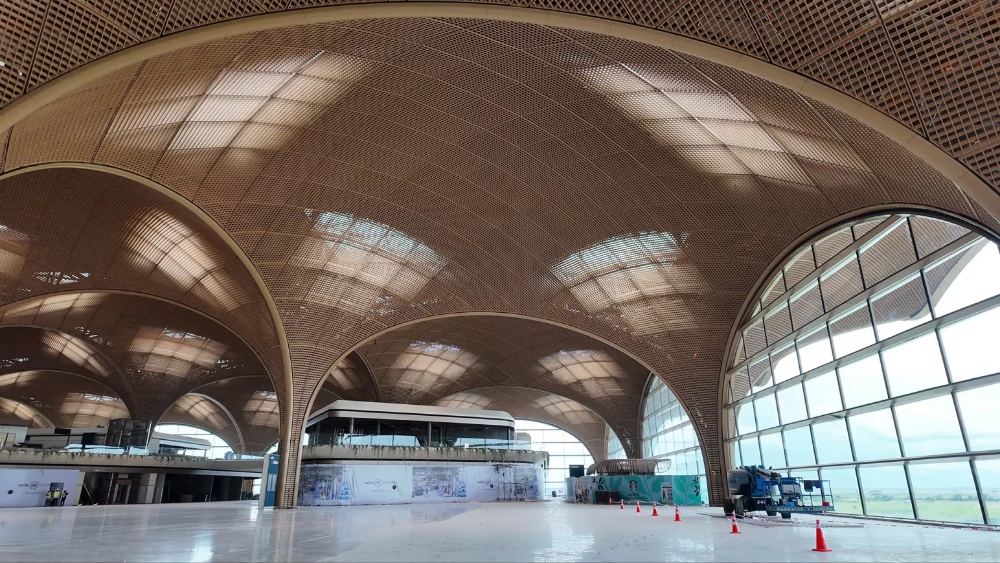
A mega-project meant to power Cambodia’s economic rise instead exposes deepening investor risks as travelers flee scam fears, border conflict and political instability.
MARKET INSIDER – Cambodia’s new $2 billion Techo International Airport was supposed to be a defining symbol of the country’s emergence as Southeast Asia’s next tourism and investment powerhouse. Instead, the nation’s most ambitious infrastructure project is opening into a near-vacuum. With international arrivals plunging and global travelers alarmed by escalating scam-center violence and border tensions, the airport—designed by Foster + Partners and backed heavily by Chinese capital—now risks becoming a cautionary tale for foreign investors assessing political risk in the region.
The numbers reveal a stark mismatch between vision and reality. Cambodia aimed for 7.5 million international visitors in 2025, yet only 4.05 million arrived in the first eight months—a 5.6% decline year-on-year. The situation unraveled further after a border clash with Thailand in July, triggering a 38.4% collapse in August arrivals. For a country where tourism contributes nearly 10% of GDP, the slump threatens to destabilize economic projections and undercut the very rationale for the mega-airport’s construction.
But the sharpest blow to Cambodia’s travel sector is not the border closure—it is fear. The proliferation of online scam compounds and human-trafficking networks, some linked by U.S. and U.K. sanctions to politically connected tycoons such as Ly Yong Phat and Chen Zhi of Prince Group, has fueled unprecedented safety concerns. “The threat of scam centers and the risk of being kidnapped to work there is the biggest obstacle for international travelers,” warned Touch Kosal, president of the Cambodia Tourism Workers’ Union. The alarm has gone global: South Korea has issued a “black code” travel advisory on high-risk zones, while India has formally warned its citizens to reconsider travel.
The geopolitical fallout is similarly severe. Thai visitors—Cambodia’s largest tourist group—have dropped by 28.2% this year, falling from 1.34 million to under one million. Although authorities insist they are cracking down—reporting 2,722 foreign nationals deported for online fraud and more than 200 human-trafficking arrests this year—critics argue the operations sidestep powerful actors believed to be shielding the most profitable scam networks.
Tourism Deputy Minister Kuch Pannhasa maintains the downturn is merely a logistical issue tied to border closures, but the data tells a different story. Travelers are not avoiding Cambodia because of convenience—they are avoiding it because of fear, uncertainty and eroding trust. Meanwhile, the nation’s flagship airport, built to quadruple passenger capacity, sits underused as airlines quietly scale back confidence.
Techo International Airport was meant to signal Cambodia’s arrival on the global stage. Instead, it has become a real-time stress test of whether governments can meaningfully confront illicit economies, protect foreign visitors and reassure investors.
With global capital increasingly sensitive to political instability, Cambodia now faces a defining question: can it restore safety and credibility fast enough to justify the scale of its ambitions—or will its new airport stand as a monument to the cost of ignoring systemic risks?
