
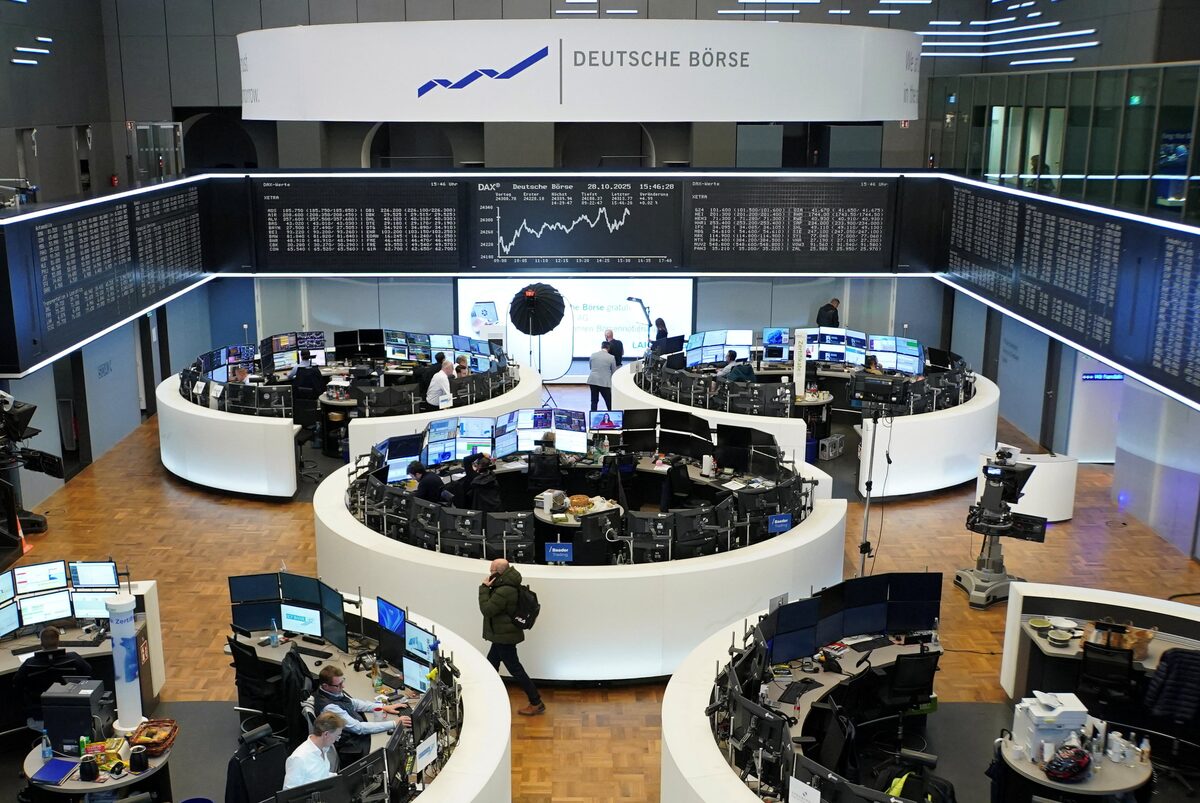
Markets weigh Davos warnings, U.S. power plays, and oil risks as investors rotate into earnings winners
MARKET INSIDER – European equities edged lower on Friday as investors absorbed a volatile mix of geopolitics, energy risk, and corporate earnings, underscoring how fragile sentiment remains across global markets. While defense, oil, and select technology names found support, broader indices struggled to hold gains amid sharp warnings from world leaders and renewed uncertainty over U.S. foreign policy.
The pan-European Stoxx 600 slipped into the red in late-morning trade, reflecting a cautious mood after a turbulent week at the World Economic Forum in Davos. Ukrainian President Volodymyr Zelenskyy delivered a blunt critique of Europe’s security posture, arguing the continent risks strategic irrelevance if it continues to rely on persuasion rather than collective defense. His remarks landed just as talks involving Ukraine, Russia, and the U.S. were confirmed in the United Arab Emirates—raising hopes of diplomacy, but also highlighting how much geopolitical risk remains unresolved.
Markets are also recalibrating to the expanding scope of U.S. influence under President Donald Trump. After easing trade tensions with Europe earlier in the week, Trump unsettled allies again by suggesting a “Board of Peace” that could rival the United Nations, while simultaneously warning of U.S. naval deployments near Iran. Energy markets reacted swiftly, with Brent crude futures jumping, lifting oil and gas stocks and reinforcing inflation and supply-risk concerns for Europe.
Against this uneasy backdrop, company-specific news drove sharp divergences. Swedish telecoms group Ericsson surged after beating fourth-quarter profit expectations and announcing a 15 billion-krona share buyback. Investors welcomed the resilience of its margins and management’s commitment to defense and enterprise networks, even as the broader radio access market is expected to stagnate next year. The rally stood in contrast to continued turbulence in Europe’s gaming sector, where Ubisoft remains under pressure following deep restructuring and heavy write-downs.
Global market signals were mixed but stabilizing. Asian equities advanced as Japan held rates steady, and U.S. futures pointed higher after Wall Street gains, with attention turning to the independence of the Federal Reserve ahead of a Supreme Court ruling tied to Trump’s attempt to remove a sitting governor. Together, these cross-currents underline a central theme for investors in 2026: returns are becoming increasingly selective, driven less by broad risk appetite and more by earnings credibility, balance-sheet strength, and exposure to geopolitically resilient sectors.
The bigger question now is whether Europe can convert geopolitical pressure into strategic clarity. If not, capital may continue to bypass the region’s indices in favor of individual global champions—making stock-picking, not macro bets, the defining strategy of the year ahead.
