
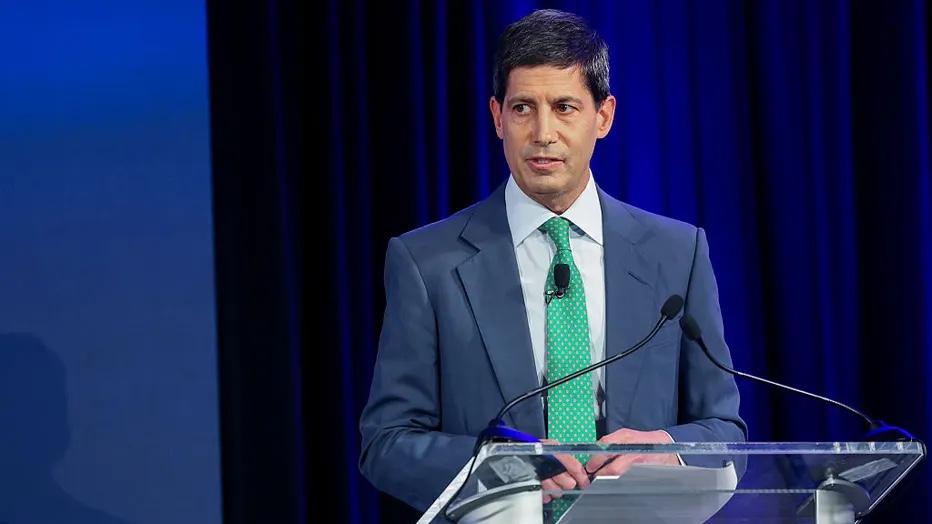
The nomination signals a potential shift in U.S. monetary power at a moment of fragile inflation, political pressure, and global market anxiety.
President Donald Trump has nominated Kevin Warsh to succeed Jerome Powell as chair of the Federal Reserve, setting the stage for one of the most consequential leadership changes at the U.S. central bank in decades. While markets showed only muted initial reaction, the decision lands at a sensitive global moment—when inflation remains sticky, government borrowing is swelling, and the political insulation of central banks is under unprecedented strain.
Warsh, 55, is no stranger to monetary policy or Wall Street. A former Fed governor with deep ties to financial markets, he is widely viewed as credible and independent-minded—someone unlikely to act as a rubber stamp for the White House. That perception has helped steady investor nerves, even as Trump praised Warsh in characteristically superlative terms and framed the appointment as a corrective to what he sees as years of policy failure under Powell.
Yet the symbolism is hard to ignore. Trump has spent years publicly attacking the Powell-led Fed for keeping interest rates too high, even after multiple rate cuts in 2025. Warsh himself has fueled expectations of change, previously calling for a “regime change” at the central bank and arguing that its current leadership suffers from a credibility deficit. In an institution built on consensus and continuity, that language suggests a more confrontational posture—and raises questions about how policy debates inside the Fed could evolve.
The timing amplifies the stakes. Inflation has eased from its peak but remains above the Fed’s 2% target, while the U.S. labor market shows signs of cooling without collapsing. Globally, investors are watching the Fed as the anchor of dollar liquidity, benchmark rates, and cross-border capital flows. Any perception that U.S. monetary policy is bending to political pressure could ripple far beyond American markets, affecting currencies, emerging-market debt, and risk appetite worldwide.
Politically, Warsh’s path to confirmation is far from smooth. Some lawmakers have vowed to block any Fed nominations until a Justice Department investigation involving Powell is resolved, while others argue that restoring “accountability” at the Fed is overdue. The process also reopens a deeper constitutional debate: how much authority a U.S. president should have over an institution designed to operate independently of short-term politics.
For now, traders expect little immediate change, pricing in only limited additional rate cuts before policy settles near what officials see as a neutral level. The larger question is structural, not tactical. If Powell remains on the Fed’s board after stepping down as chair, and if courts weigh in on presidential powers over governors, the Warsh nomination could mark the beginning of a prolonged test of central bank independence.
In a world where markets increasingly trade on trust as much as data, Trump’s choice may matter less for the next rate decision—and far more for whether the Federal Reserve can continue to act as the world’s most influential, and most independent, central bank.
