
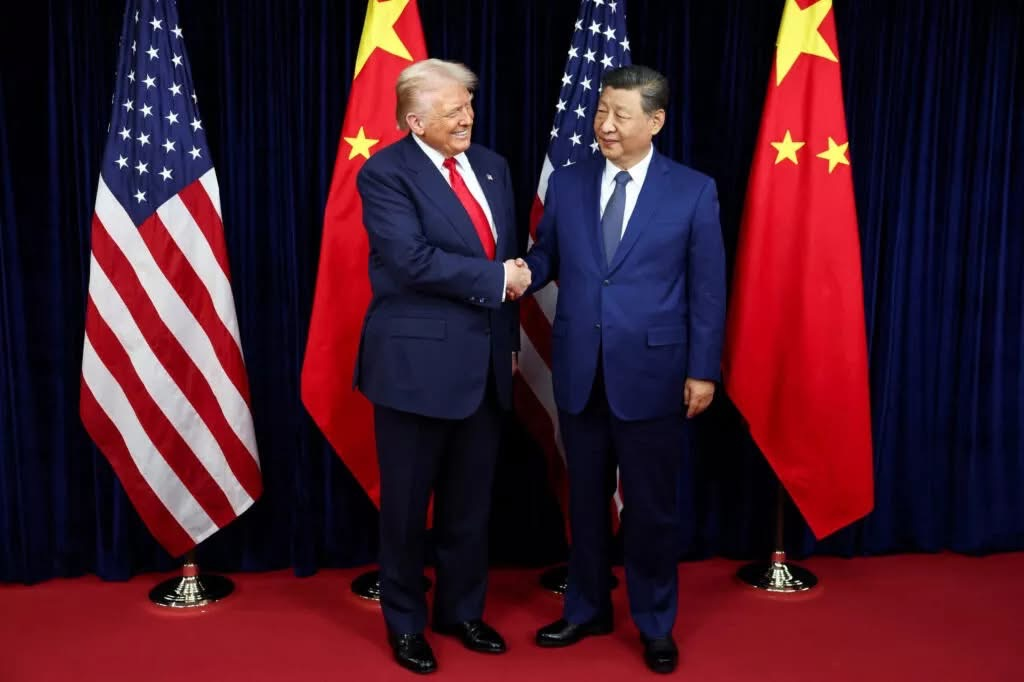
From Tesla to BlackRock, America’s corporate giants seek deals, approvals, and leverage in a tense U.S.-China reset.
MARKET INSIDER – As Washington and Beijing struggle to stabilize one of the world’s most consequential economic relationships, some of America’s biggest companies are quietly betting that access to China still matters more than geopolitics. During President Donald Trump’s May 14–15 visit to China, a select group of U.S. corporate leaders joined the delegation—not for symbolic diplomacy, but to secure regulatory approvals, supply chain guarantees, and market access in the world’s second-largest economy.
Unlike Trump’s blockbuster 2017 China trip, which produced headline-grabbing purchase agreements, this year’s delegation is smaller and far more strategic. The companies attending—including Tesla, Meta, BlackRock, Visa, Mastercard, Goldman Sachs and Citigroup—arrived with highly specific objectives tied to policy barriers that increasingly define global business strategy.
For aerospace giant Boeing and agricultural heavyweight Cargill, the trip could still produce traditional purchase agreements involving aircraft, meat, and grain exports. But for most executives, the real agenda revolves around regulation and survival inside an increasingly controlled Chinese market.
Meta is reportedly seeking clarity after Chinese regulators pushed back against its proposed acquisition of AI startup Manus in a deal valued at more than $2 billion. Beijing has recently tightened oversight of American investments into Chinese technology firms, particularly in artificial intelligence and strategic sectors. The dispute highlights a growing paradox: while the U.S. and China compete aggressively over AI supremacy, Silicon Valley still sees China as too important to ignore.
Meanwhile, Tesla faces mounting pressure over its dependence on Chinese clean-energy supply chains. Beijing is considering restrictions on exports of solar battery manufacturing equipment to the United States, a move that could disrupt Tesla’s factory expansion plans. Earlier this year, Tesla reportedly sought to purchase nearly $3 billion worth of battery-related equipment from Chinese suppliers, while also lobbying regulators to approve its Full Self-Driving technology in China—the world’s largest electric vehicle market.
Finance is another major battleground. Larry Fink traveled to Beijing as a BlackRock-led consortium faces regulatory scrutiny over a $23 billion port acquisition from Hong Kong conglomerate CK Hutchison, including strategic ports near the Panama Canal. Chinese authorities have publicly criticized the deal, underscoring how infrastructure, logistics, and capital markets are increasingly viewed through a geopolitical lens rather than a purely commercial one.
Payment giants Visa and Mastercard are also hoping the summit opens doors in China’s tightly controlled financial system. Mastercard wants greater ownership in its local joint venture, while Visa is still seeking approval to process domestic card payments independently in China—a privilege already granted to some competitors. At the same time, Wall Street firms such as Goldman Sachs and Citigroup continue pressing for broader access to China’s capital markets despite slowing economic growth and rising political tensions.
The deeper message behind Trump’s business delegation is that even amid tariffs, export controls, and strategic rivalry, corporate America is not decoupling from China—it is renegotiating its terms of engagement. That may frustrate political hardliners on both sides, but it also reflects a reality investors increasingly understand: in sectors from AI and EVs to finance and agriculture, the U.S.-China relationship remains too interconnected to unwind cleanly. The real question now is not whether globalization survives, but who gets to shape its next rules.
