
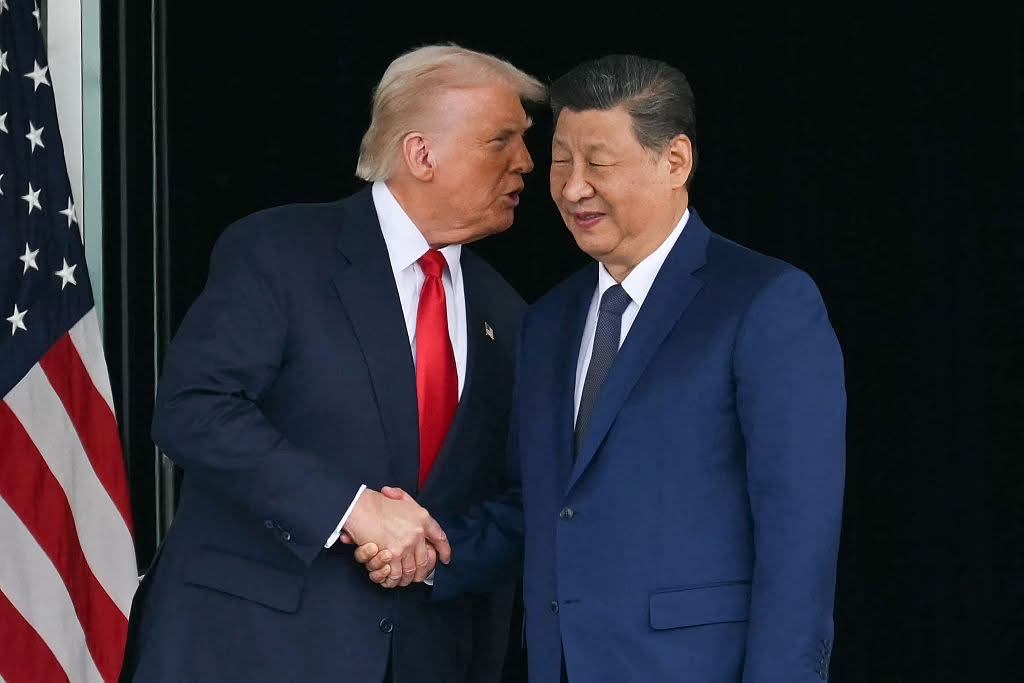
Markets are watching whether Washington and Beijing can manage rivalry before it disrupts trade, inflation, and supply chains again.
MARKET INSIDER – The next phase of the U.S.-China relationship is no longer about friendship, normalization, or even strategic trust. It is about whether the world’s two largest economies can prevent a fragile rivalry from spiraling into a shock powerful enough to destabilize global markets, supply chains, inflation, and investment flows.
A high-level summit between Washington and Beijing would once have symbolized diplomatic progress. Today, it represents something more urgent: crisis management between two deeply interconnected powers that are simultaneously competing, decoupling, and weaponizing economic leverage. The last U.S. presidential visit to China took place in 2017. Since then, relations between United States and China have deteriorated into a cycle of tariffs, technology restrictions, supply-chain realignment, and geopolitical confrontation stretching from Taiwan to the Middle East.
Despite the sharp decline in trade dependence, neither side has truly replaced the other. U.S. goods exports to China fell 25.8% in 2025, while imports from China dropped nearly 30%. Yet bilateral goods trade still totaled more than $414 billion last year, underscoring how deeply the two economies remain intertwined. Much of the apparent “decoupling” may actually be rerouting through third countries, particularly across Southeast Asia, Mexico, and broader emerging markets. For investors, this matters because fragmentation is increasing costs globally rather than eliminating interdependence.
Tariffs remain the most visible pressure point, but the real battleground has expanded far beyond customs duties. Washington has increasingly leveraged dollar-based financial systems, semiconductor export controls, and outbound investment restrictions to contain China’s technological rise. Beijing, meanwhile, retains powerful counterweights through manufacturing dominance, market access, and critical mineral supply chains. Rare earths have become especially strategic. China controls roughly 70% of global rare-earth mining, 90% of refining capacity, and over 90% of magnet production used in electric vehicles, wind turbines, advanced defense systems, and data centers. What was once a niche supply-chain issue has evolved into a macroeconomic and national-security risk with global implications.
Taiwan remains the structural fault line at the center of the relationship. The island sits at the intersection of military strategy, semiconductor production, and global technology infrastructure. Any escalation would likely trigger consequences far beyond Asia. Estimates from Bloomberg Economics suggest a Taiwan blockade scenario could cut U.S. GDP by roughly 5% and China’s GDP by nearly 9%, highlighting why both powers remain incentivized to avoid uncontrolled confrontation despite increasingly aggressive rhetoric.
The geopolitical picture is becoming even more complex as energy security enters the equation. China currently purchases more than 80% of Iran’s seaborne oil exports, making Tehran strategically important for Beijing while simultaneously turning Middle East instability into a global inflation risk. Rising oil prices have already contributed to renewed volatility in energy markets and consumer inflation expectations worldwide. In this environment, even limited diplomatic stabilization between Washington and Beijing could have outsized effects on commodities, emerging markets, and investor confidence.
What makes the new U.S.-China dynamic especially consequential is that it is no longer merely bilateral. China’s Belt and Road Initiative now spans roughly 150 countries, with record construction contracts and investments in 2025 alone. Meanwhile, the U.S. is increasingly competing through strategic infrastructure partnerships, technology alliances, and supply-chain blocs. Countries across Asia, Africa, Latin America, and Europe are finding themselves caught between two competing systems of trade, finance, and geopolitical influence. The challenge for most nations is no longer choosing sides outright, but managing the costs of operating inside a fragmented global economy.
For markets, the real signal from any future summit is not reconciliation — it is predictability. Investors are less concerned about whether the U.S. and China become strategic partners again and more focused on whether both sides can establish mechanisms to reduce the risk of sudden policy shocks, tariff escalations, export bans, or financial disruptions. In a world increasingly shaped by AI competition, supply-chain nationalism, and geopolitical fragmentation, stability itself has become a premium asset.
That may ultimately define the next era of U.S.-China relations: not a reset, but a managed rivalry where both powers recognize that the economic cost of chaos has become too large for either side — or the world — to absorb.
