
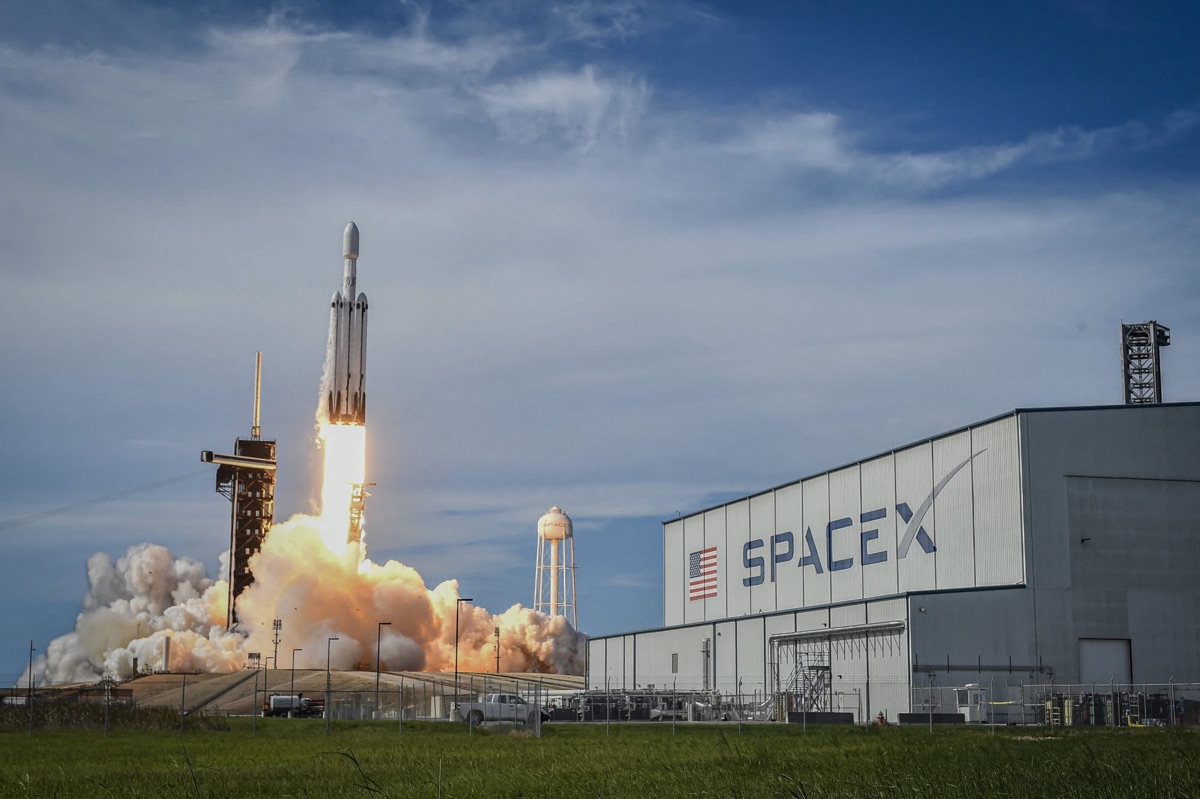
BlackRock may invest up to $10 billion as investors bet on Starlink—not rockets—as SpaceX targets a record Nasdaq debut.
MARKET INSIDER – SpaceX is reportedly preparing for a blockbuster Nasdaq debut on June 12 that could value the company at an astonishing $1.75 trillion, making it the largest IPO in global capital markets history. The offering is expected to raise roughly $75 billion—more than 2.5 times the size of Saudi Aramco’s record-breaking 2019 listing—and institutional giant BlackRock is said to be considering a $5–10 billion allocation.
But Wall Street’s appetite is not really about rockets.
Behind the eye-watering valuation lies Starlink, the satellite internet business that has quietly evolved into one of the world’s fastest-growing telecom infrastructure platforms. Starlink generated an estimated $11.4 billion in revenue in 2025, nearly tripling from $3.9 billion in 2023. EBITDA reportedly reached $7.2 billion, implying a stunning 63% adjusted margin—closer to elite software companies than traditional telecom operators.
That profitability is what has transformed investor perception of SpaceX from a capital-intensive aerospace company into a recurring-revenue infrastructure powerhouse. By February 2026, Starlink had surpassed 10 million active users across more than 160 countries, expanding aggressively into underserved regions where terrestrial broadband remains unreliable or economically unviable. Rural Africa, remote parts of Latin America, maritime shipping lanes, commercial aviation, and offshore industries have become lucrative frontier markets with limited competition.
The strategic implications extend far beyond Silicon Valley. Governments increasingly view low-earth orbit satellite networks as critical infrastructure with geopolitical importance comparable to energy pipelines or semiconductor supply chains. Starlink’s role in conflict zones, disaster recovery, and remote connectivity has already demonstrated how satellite internet can shape military logistics, communications resilience, and digital sovereignty. For institutional investors like BlackRock, the attraction is not launch frequency—it is the prospect of owning a subscription-based global telecom utility with near-monopolistic reach in difficult geographies.
The IPO is expected to trade under the ticker “SPCX,” with underwriting led by JPMorgan Chase, Goldman Sachs, Morgan Stanley, Bank of America, and Citigroup. If completed at the rumored valuation, SpaceX would immediately rank among the world’s most valuable publicly traded companies, rivaling the scale of tech titans that dominate the NASDAQ Composite and S&P 500.
For Vietnamese investors, direct exposure remains challenging. Vietnam currently lacks locally listed ETFs tracking major US indices, meaning investors seeking access to SpaceX may need international brokerage accounts through platforms such as Interactive Brokers or Charles Schwab. Some Vietnamese mutual funds retain flexibility to invest overseas, but any future allocation to SPCX would depend entirely on fund managers’ mandates and risk appetite. Regulatory ambiguity around overseas capital transfers and currency exposure also remains a hurdle for retail participation.
Still, the valuation debate is far from settled. Much of the $1.75 trillion thesis depends on Starlink maintaining its extraordinary 63% margin while scaling globally—a challenge few telecom businesses in history have achieved sustainably. Investors will be closely watching SpaceX’s first post-listing earnings reports, alongside progress on the long-delayed Starship program, which remains central to Elon Musk’s broader interplanetary ambitions.
The real question for markets is no longer whether SpaceX can launch rockets. It is whether Starlink can become the world’s first truly global telecom monopoly—and whether investors are pricing in the next generation of infrastructure or simply another tech narrative fueled by Elon Musk’s gravitational pull.
