
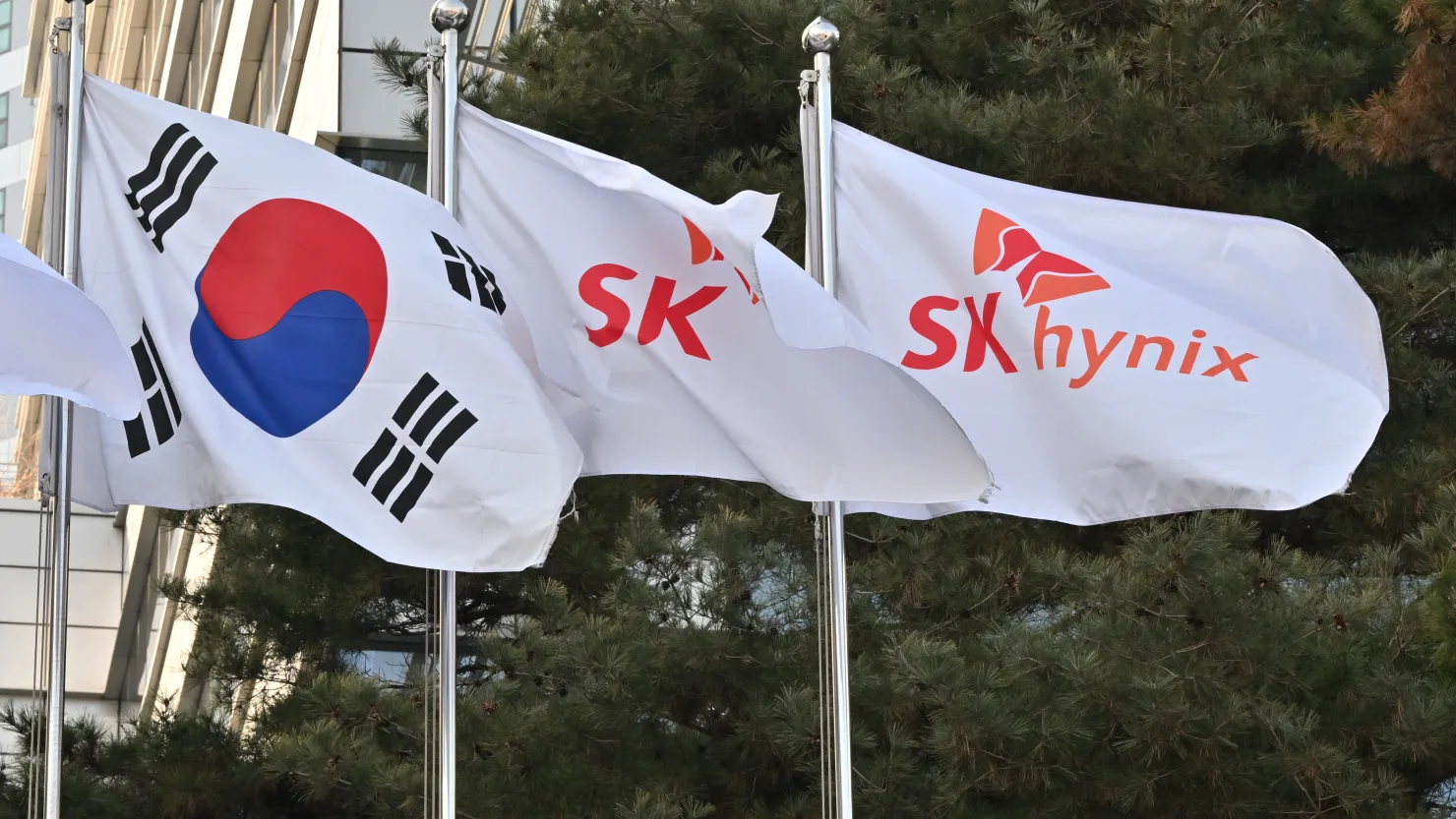
Second-quarter GDP expanded 3.7% from a year earlier, but weak consumption and construction suggest the benefits of the semiconductor boom remain uneven.
MARKET INSIDER — South Korea’s economy grew faster than expected in the second quarter as booming semiconductor exports offset weak domestic demand and declining construction investment.
Gross domestic product expanded 0.6% from the previous quarter and 3.7% from a year earlier, preliminary Bank of Korea data showed on July 23. Both readings exceeded economists’ forecasts, reinforcing expectations that the central bank will raise its full-year growth projection in August.
The figures confirm South Korea as one of the biggest economic beneficiaries of the global artificial-intelligence investment cycle. They also expose a growing policy challenge: the export boom is strengthening growth and wages while elevated inflation is pushing interest rates higher.
Key highlights
- South Korean GDP grew 0.6% quarter on quarter and 3.7% year on year. Exports increased 1.4%, led by semiconductors, machinery and equipment.
- Private consumption rose just 0.4%, while construction investment declined 0.2%. The Bank of Korea’s existing 2.6% annual growth forecast is likely to be revised in August.
- South Korea’s government is targeting 3% growth for 2026. The central bank raised its policy rate to 2.75% in July and is expected to tighten further.
- Stronger chip-sector wages and bonuses may spread inflationary pressure to the wider economy.
How fast did South Korea’s economy grow?
South Korea’s GDP expanded 0.6% in the three months through June from the first quarter, exceeding the 0.4% increase expected in a Reuters survey of economists.
Year-on-year growth reached 3.7%, also beating the median forecast of 3.5%. The economy nevertheless slowed from a revised quarterly expansion of 1.8% in the first three months of the year.
The second-quarter result was driven primarily by external demand. Exports rose 1.4% from the previous quarter as shipments of semiconductors, machinery and equipment increased. Imports grew more slowly, allowing net trade to make an important contribution to GDP.
Private consumption increased 0.4%, helped by spending on goods including passenger vehicles. Construction investment fell 0.2%, however, underscoring the continued weakness in parts of the domestic economy.
The result shows that South Korea is growing rapidly by recent standards, but the expansion remains concentrated in technology exports rather than broadly distributed across household consumption, real estate and construction.
Why are semiconductor exports booming?
South Korea occupies a central position in the supply chain for memory chips used in AI servers, data centres, smartphones and other electronic devices.
The global race to develop generative AI has encouraged major technology companies to spend heavily on computing infrastructure. That has sharply increased demand for conventional memory and high-bandwidth memory, or HBM, which is essential for moving large volumes of data between processors.
SK Hynix has established a leading position in advanced HBM products, while Samsung Electronics produces memory, logic chips, smartphones, displays and consumer electronics. Their scale allows South Korea to benefit when global cloud-computing companies increase capital expenditure.
The strength extended beyond the GDP reporting period. South Korean exports increased 52.3% year on year during the first 20 days of July, while semiconductor shipments surged 180.6%, according to preliminary customs data reported by Reuters.
June exports had already posted their fastest annual growth since 1978, rising more than 60% as semiconductor shipments nearly tripled to a record $44.8 billion.
Those figures suggest chip demand may continue supporting growth during the third quarter, although exceptionally high annual comparisons will eventually make the pace difficult to sustain.
Can South Korea achieve 3% growth this year?
The Bank of Korea forecast in May that the economy would expand 2.6% in 2026. The stronger second-quarter result makes an upgrade increasingly likely when the central bank publishes its revised outlook in August.
A Bank of Korea official said annual growth could reach 3% even if the economy recorded an average quarterly contraction of as much as 0.1% during the second half.
That calculation indicates much of the growth required to achieve a 3% annual rate has already been secured. However, it does not mean South Korea can enter a technical recession without consequences. Two weak quarters would raise concerns about the durability of domestic demand and the economy’s dependence on chip exports.
The government has already raised its own 2026 growth forecast from 2% to 3%, the strongest anticipated expansion since 2021. It is seeking to accelerate AI-related investment and other technology projects to reinforce the export cycle, according to Reuters.
The outlook will depend heavily on continued spending by global technology companies, semiconductor prices, energy costs and demand from major trading partners, particularly China and the United States.
Why is the Bank of Korea raising interest rates?
Strong growth has given the Bank of Korea greater room to address inflation, currency weakness, household debt and financial-stability risks.
On July 16, the central bank unanimously raised its policy rate by 25 basis points, from 2.50% to 2.75%. It was the first increase in three and a half years—not an increase to a 3.5-year high, as the original Vietnamese source could be read to suggest.
The Bank of Korea said economic growth had strengthened, led by exports and investment, while inflation was expected to remain above its target for a considerable period. The decision and its reasoning are set out in the bank’s official monetary-policy statement.
Consumer inflation accelerated in June to its highest level in two and a half years. The conflict in the Middle East, higher energy prices and pressure on the Korean won have increased import costs, while strong economic activity is creating more domestically generated inflation.
A Reuters poll conducted before the July decision found that 28 of 31 economists expected another increase by the end of 2026, taking the policy rate to 3%. The median forecast anticipated a further rise to 3.25% in the first quarter of 2027, followed by rates remaining at that level through at least the end of the year.
That path is not guaranteed. A sharp decline in oil prices, weaker chip demand or a slowdown in household spending could reduce the need for further tightening. Continued inflation and currency pressure would strengthen the case for additional increases.
Could technology-sector bonuses fuel inflation?
The extraordinary profitability of South Korea’s chip industry is beginning to affect employee compensation.
Samsung reached a wage and profit-sharing agreement under which qualifying semiconductor employees may receive substantial performance awards linked to the chip division’s earnings. A memory-chip employee earning a basic annual salary of approximately 80 million won could receive total bonuses estimated at around 626 million won, or about $410,000, if profit expectations are met.
SK Hynix employees could receive more than 700 million won under its profit-sharing arrangements if the company achieves the earnings levels expected by analysts.
These estimates are not fixed or guaranteed payments for every employee. Actual compensation will depend on corporate profits, business unit, individual eligibility and the final terms of the respective schemes.
The scale nevertheless matters for monetary policy. Large payments to technology employees can increase spending on housing, consumer goods, services and financial assets. Workers in other industries may then demand higher compensation when negotiating wages, creating a broader spillover from the semiconductor boom.
The Bank of Korea has warned that such effects could cause wage growth and inflation to become more persistent, even if Middle East tensions ease and energy prices eventually decline.
This is an unusual feature of the current cycle: the same AI boom supporting exports and GDP could also complicate inflation control by raising corporate profits, employee income and asset prices.
How significant is the AI boom for Korean markets?
The chip rally has transformed South Korea’s equity market and the valuations of its largest companies.
Samsung Electronics crossed $1 trillion in market value before SK Hynix reached the threshold in May. SK Hynix subsequently overtook Samsung in terms of the market value of ordinary shares, although Samsung remains larger when its preferred shares are included.
SK Hynix’s market capitalisation reached approximately 2,080 trillion won, or $1.35 trillion, in June, compared with about 2,067 trillion won for Samsung’s ordinary shares. Including preferred stock, Samsung was valued at roughly 2,246 trillion won, according to Reuters.
The revaluation reflects the rising strategic importance of memory technology. AI processors receive much of the attention, but their performance depends on rapid access to very large amounts of memory. That has turned HBM from a specialised component into a critical part of global AI infrastructure.
Investors should not assume that rapid export growth guarantees continuously rising chip shares. Semiconductor production is highly cyclical, and current valuations incorporate expectations of sustained AI spending, limited supply and strong pricing.
Any evidence that cloud companies are reducing data-centre investment, that HBM supply is expanding too quickly or that customers are designing around existing products could cause earnings expectations and share prices to reverse.
Is South Korea’s growth becoming too dependent on chips?
The second-quarter data present a clear contrast: exports increased strongly, while construction investment contracted and household consumption rose only modestly.
That imbalance creates several vulnerabilities. A downturn in the semiconductor cycle would have an outsized effect on exports, business investment, tax revenue and financial markets. High interest rates could further weaken property, construction and household spending, making the economy even more reliant on technology.
The concentration is also visible at the corporate level. Samsung and SK Hynix have become extraordinarily important to the KOSPI, meaning movements in two chipmakers can dominate the performance of the broader South Korean stock market.
The most sustainable scenario would involve export income gradually spreading into household consumption, business investment and employment without triggering excessive wage and asset-price inflation.
If that transmission remains weak, headline GDP may look strong while many households and domestically focused businesses continue to experience difficult conditions.
What it means for Asia and emerging markets
South Korea’s performance is an encouraging indicator for other Asian economies integrated into the electronics supply chain.
Strong Korean semiconductor exports may support demand for equipment, components, materials, packaging and logistics services across Taiwan, Japan, China, Malaysia, Singapore and Vietnam. Vietnamese manufacturers could benefit through electronics assembly and supporting industries, particularly where they supply Korean multinational groups.
However, stronger Korean growth and higher interest rates also carry cross-market implications. A more hawkish Bank of Korea could support the won and make Korean assets more attractive relative to lower-yielding emerging markets.
If the regional tightening cycle spreads while oil prices remain elevated, Asian economies may face a difficult combination of higher import costs and tighter financial conditions. Countries with energy-import dependence, currency pressure or high private debt would be particularly exposed.
For Vietnam, continued Korean technology investment would be constructive for manufacturing and exports. But the longer-term opportunity depends on moving beyond labour-intensive assembly into components, semiconductor services, research and higher-value supply-chain activities.
Outlook
South Korea’s better-than-expected second-quarter growth confirms that the country is one of the clearest macroeconomic winners from the global AI infrastructure boom.
The 3.7% annual expansion and continued surge in semiconductor shipments make a full-year growth rate near 3% increasingly achievable. Yet the economy’s underlying composition remains less robust than the headline suggests, with private consumption subdued and construction investment declining.
The principal question for investors is no longer whether chip exports are strong. It is whether that strength can broaden into a more balanced expansion before higher interest rates begin to restrain domestic demand.
South Korea currently has the rare advantage of strong exports during a global period of geopolitical and inflationary uncertainty. Managing the resulting currency, wage, housing and price pressures will determine whether the semiconductor boom produces durable national growth or another highly concentrated technology cycle.
