
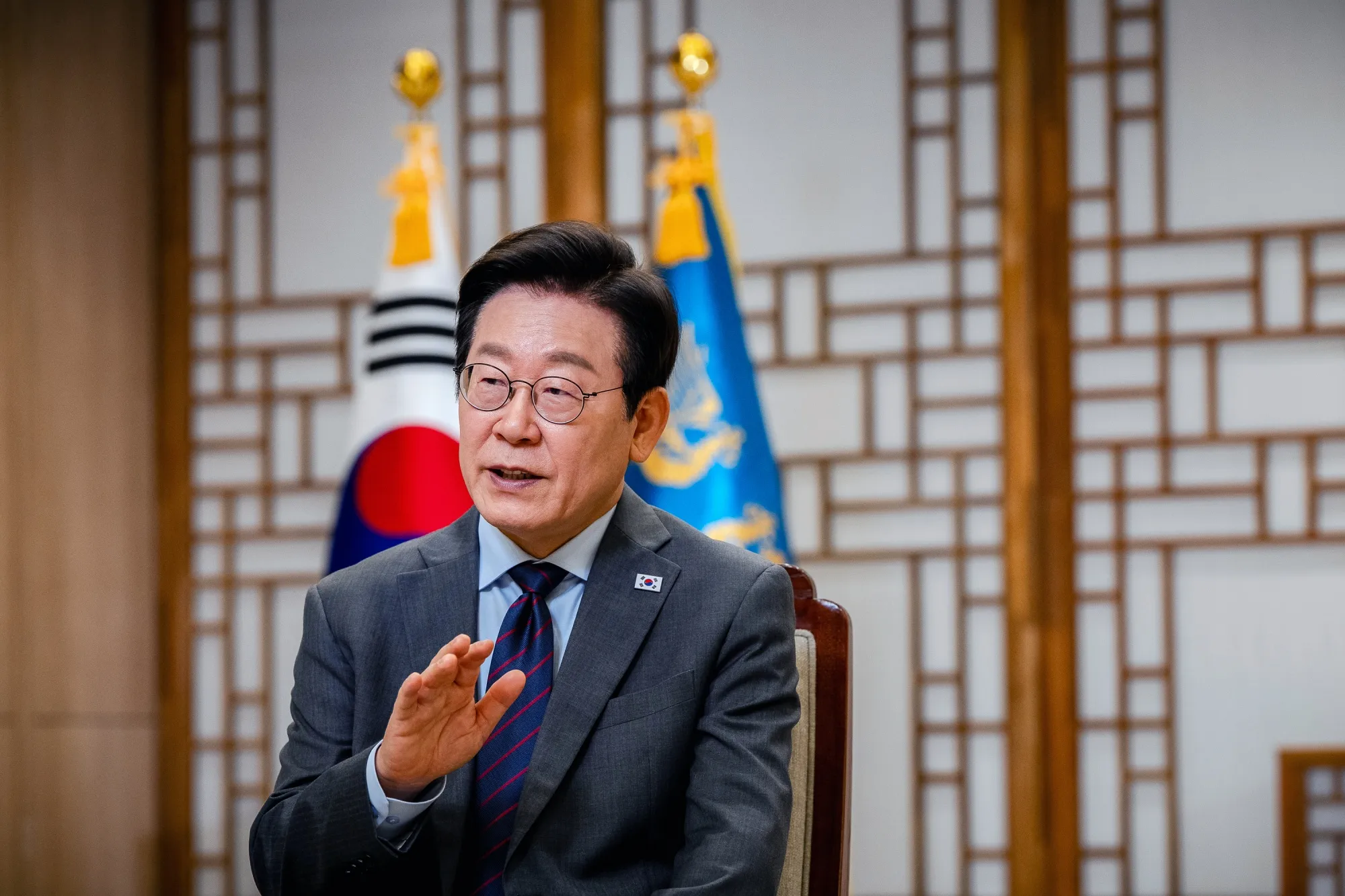
President Lee Jae Myung’s clarification highlights the financial conditions behind a proposed $200 billion U.S. energy investment program touted by Donald Trump.
MARKET INSIDER — South Korean President Lee Jae Myung has emphasized that participation in Alaska’s proposed liquefied natural gas project depends on commercial viability and legal compliance, tempering President Donald Trump’s presentation of Seoul’s involvement as an agreed investment.
The clarification exposes an important distinction within the countries’ $200 billion strategic investment program: selecting projects for cooperation does not mean every financing decision, construction contract or investment term has been finalized.
The package also covers a major gas-fired power development in Texas and plans for eight U.S. nuclear reactors. Lee said nuclear investments would require commercial assessment on a plant-by-plant basis.
Key Highlights
- Seoul says Alaska LNG participation remains conditional on financial viability and legal requirements.
- The package includes a $22.3 billion Texas power project and a $120 billion nuclear development framework.
- Korean companies could gain equipment and construction opportunities, but returns depend on negotiated contracts, financing and execution.
Political agreement leaves commercial questions open
Trump said late Wednesday, September 30, that the countries had agreed to work on Alaska LNG, describing its value as approximately $50 billion.
Lee’s response on Thursday underscored conditions already reflected in the joint statement, which made cooperation dependent on commercial reasonableness.
The difference is consequential. A government-backed framework can create momentum and establish priorities, while leaving unresolved how much individual participants invest, what risks they assume and how they earn a return.
Reporting on the announcement also contains different Alaska project values. Reuters described development estimates ranging from $44.5 billion to $54.5 billion. These estimates should not be treated as a finalized Korean equity contribution. reuters.com reported.
For investors, the decisive documents will be the agreements allocating capital, responsibilities and financial risk.
Why Alaska LNG faces a demanding economic test
Alaska LNG would transport natural gas approximately 1,300 kilometers from the state’s North Slope to a southern liquefaction terminal for export.
Its attraction for South Korea is partly geographical. A Pacific supply route could diversify LNG procurement and reduce exposure to some maritime chokepoints affecting other suppliers.
That strategic value must be weighed against the substantial cost of developing the pipeline, gas-processing infrastructure and export facilities.
South Korean Industry Minister Kim Jung-kwan previously characterized the project as high-risk, arguing that participation would be difficult without sufficient cash generation.
The central commercial question is whether the delivered cost of Alaskan LNG can compete with alternative supplies while providing adequate returns on the infrastructure investment.
Long-term purchase agreements could support financing by improving revenue visibility. Their value would depend on buyer credit quality, pricing terms, volume commitments and provisions governing delays or non-delivery.
An agreement to consider buying LNG is also different from an equity investment. Seoul’s participation could involve several types of exposure, which should be assessed separately.
Texas links energy investment to data-center demand
The Texas component is more specifically defined in the announcement.
The proposed development in Encinal carries an estimated cost of $22.3 billion and planned generating capacity of 6,472 megawatts. Related Companies and NextEra Energy would lead the project, supplying electricity to co-located data centers.
Initial commercial operations are targeted for 2029, with full capacity scheduled to arrive in stages by 2032. Yonhap’s account of the Commerce Department announcement identifies the development as Project Star, Yonhap News Agency mentioned.
The two governments intend to expand Korean participation in equipment supply, engineering, construction and long-term operations.
For Korean businesses, those opportunities could generate revenue independently of any return on invested capital. However, participation in a government framework does not itself establish that a company has won an order.
The project’s economics will depend on construction costs, fuel arrangements, customer contracts and the timing of data-center demand. Building generation capacity ahead of customer requirements could delay revenue, while late delivery could constrain customers’ expansion.
Nuclear plans require individual project assessments
The nuclear framework allocates $120 billion toward eight large reactors, comprising $100 billion for construction and $20 billion in contingency reserves.
Yonhap reported that the proposed mix includes two Korean-designed APR1400 reactors and six U.S.-designed AP1000 units, according to Yonhap News Agency
The agreement involves both governments, Westinghouse Electric, Korea Electric Power Corp. and Korea Hydro & Nuclear Power. It also envisages a potentially significant minority investment in Westinghouse by Korean companies, subject to commercial negotiations.
Lee’s insistence on plant-level reviews matters because nuclear projects can differ substantially in site conditions, permitting, construction schedules and customer arrangements.
A contingency reserve provides a cushion against unexpected costs. It does not establish who bears expenses beyond that reserve, or whether financing costs and other expenditures are included in the headline amount.
Similarly, an investment in Westinghouse would require its own assessment of valuation, governance rights and expected returns.
What the package means for investors
The program could deepen Korean companies’ role in U.S. energy supply chains, extending from major equipment and construction to maintenance and operating services.
Its scale also makes execution and capital allocation central to the investment case.
Equipment suppliers, contractors and equity investors face different risks. A supplier may earn revenue upon delivery; a project shareholder may wait years for distributions. A contractor’s exposure depends heavily on whether its agreement fixes the price and transfers cost-overrun risk.
Investors should therefore watch for final investment decisions, binding purchase agreements, financing commitments and named contract awards.
Seoul’s clarification does not amount to withdrawing from cooperation. It establishes that strategic support must still translate into commercially acceptable projects—an important qualification when headline investment figures are much larger than the commitments individual companies have publicly finalized.
