
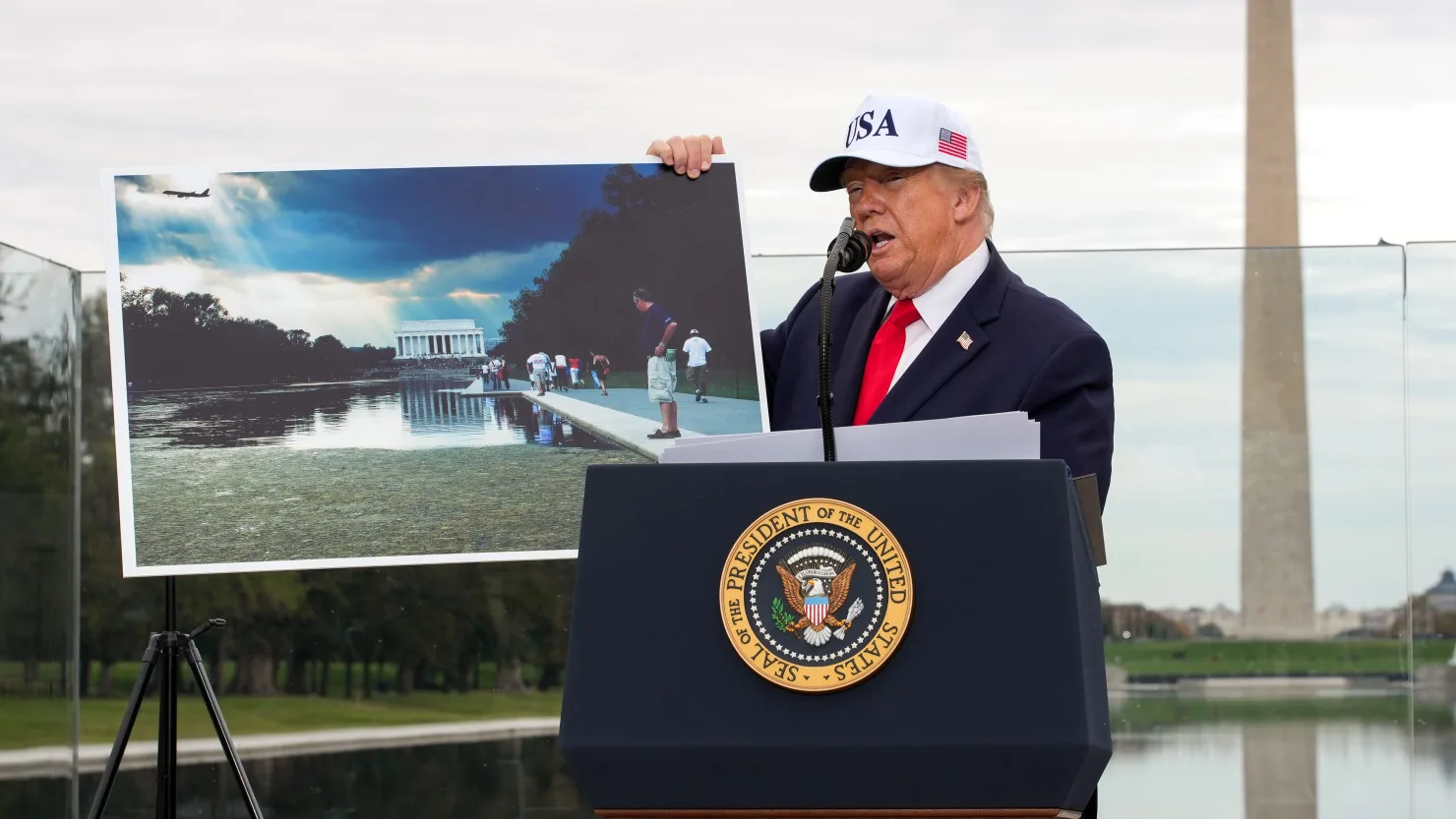
The president combined an extended account of Washington building projects with attacks on Democrats and a renewed $5,000 payment pledge.
MARKET INSIDER — U.S President Donald Trump devoted the opening portion of his final scheduled in-person speech before Tuesday’s U.S. midterm elections to the renovated Lincoln Memorial Reflecting Pool, before turning to congressional races and his administration’s record. Speaking in Washington on Monday, he urged voters to support Republicans and repeated a promise that people would receive $5,000 if the party won. The speech offered limited detail on how that payment would work. For investors and businesses, the election’s significance lies in how control of Congress will shape the administration’s ability to advance spending, tax and other legislative priorities.
Key Highlights
- Trump spent more than 20 minutes discussing the Reflecting Pool and other Washington projects before explicitly addressing the midterms.
- He repeated an unsupported claim that vandals caused damage previously attributed to faulty contractor work.
- His renewed $5,000 payment pledge did not establish eligibility, funding or an implementation timetable.
A renovation announcement becomes an election appeal
Trump opened his nearly hour-long address by announcing the reopening of the Lincoln Memorial Reflecting Pool, which had been fenced off for months during a troubled renovation ordered by his administration.
He praised the completed work and discussed other monument refurbishments and efforts to reduce crime in Washington. His first explicit reference to the midterm elections came approximately 23 minutes into the speech, according to CNBC.
The lengthy opening placed a local construction project at the center of an appearance expected to deliver his final public case for retaining Republican control of Congress. Other reporting also described an extended discussion of the pool before Trump shifted to Tuesday’s vote.
Once he turned to the election, Trump portrayed Democratic candidates as extreme, promoted his administration’s achievements and criticized individual opponents, including Michigan Senate nominee Abdul El-Sayed.
Those descriptions were campaign attacks, rather than independent assessments of the candidates.
Vandalism claim conflicts with the reported court account
Trump again blamed vandals for damaging the Reflecting Pool and delaying repairs.
That assertion conflicts with the explanation his administration previously provided in court. According to CNBC’s reporting, U.S. Attorney for the District of Columbia Jeanine Pirro told a court on July 31 that the damage resulted from a contractor’s faulty installation.
Trump criticized Pirro over that admission and continued to repeat the vandalism allegation during Monday’s remarks.
The distinction matters because the renovation served as an example of the administration’s performance. Responsibility for the setbacks remains part of the public record surrounding the project, rather than a detail that can be resolved by repeating the president’s account.
The $5,000 promise remains a campaign pledge
Trump also reiterated that people would receive $5,000 if Republicans won the election.
The remarks described in the report did not provide the details necessary to evaluate such a program: who would qualify, how payments would be financed, when they would be distributed or what approvals would be required.
An election result would not itself create a payment entitlement. The statement should therefore be understood as a political promise, rather than evidence that an operational distribution program is in place.
For economic analysis, the missing design details are substantial. The cost and potential effects of direct payments depend on eligibility, scale, timing and whether they are financed through borrowing, new revenue or reductions in other spending.
Without that information, assigning a precise fiscal cost or inflation impact would go beyond what the speech established.
Trump acknowledges the historical midterm challenge
Trump also referred to the difficulties presidents commonly face in midterm elections, saying his party had made a strong effort despite the historical pattern.
His comments acknowledged an electoral challenge, but did not amount to a concession or establish the likely outcome of Tuesday’s races.
Voters will determine control of the House and Senate in the next Congress. Those results will influence the administration’s legislative room to maneuver, while also shaping congressional oversight and negotiations over federal spending.
For markets, party control is one input into the policy outlook. The size of congressional majorities, differences within each party and the specific proposals brought forward will also matter.
Other Washington projects remain on the agenda
Later in the address, Trump returned to his plans for Washington, discussing a large triumphal arch and a promenade along the Potomac River.
He also described a proposed National Garden of American Heroes featuring between 250 and 500 statues and discussed work on a public golf course that faces legal challenges.
These remarks presented a range of presidential priorities, but did not establish that every project had secured funding, approvals or a definitive construction schedule.
The immediate political test comes with Tuesday’s vote. The subsequent policy test will be whether the administration can translate its campaign promises—including the proposed payments—into detailed measures capable of implementation.
