
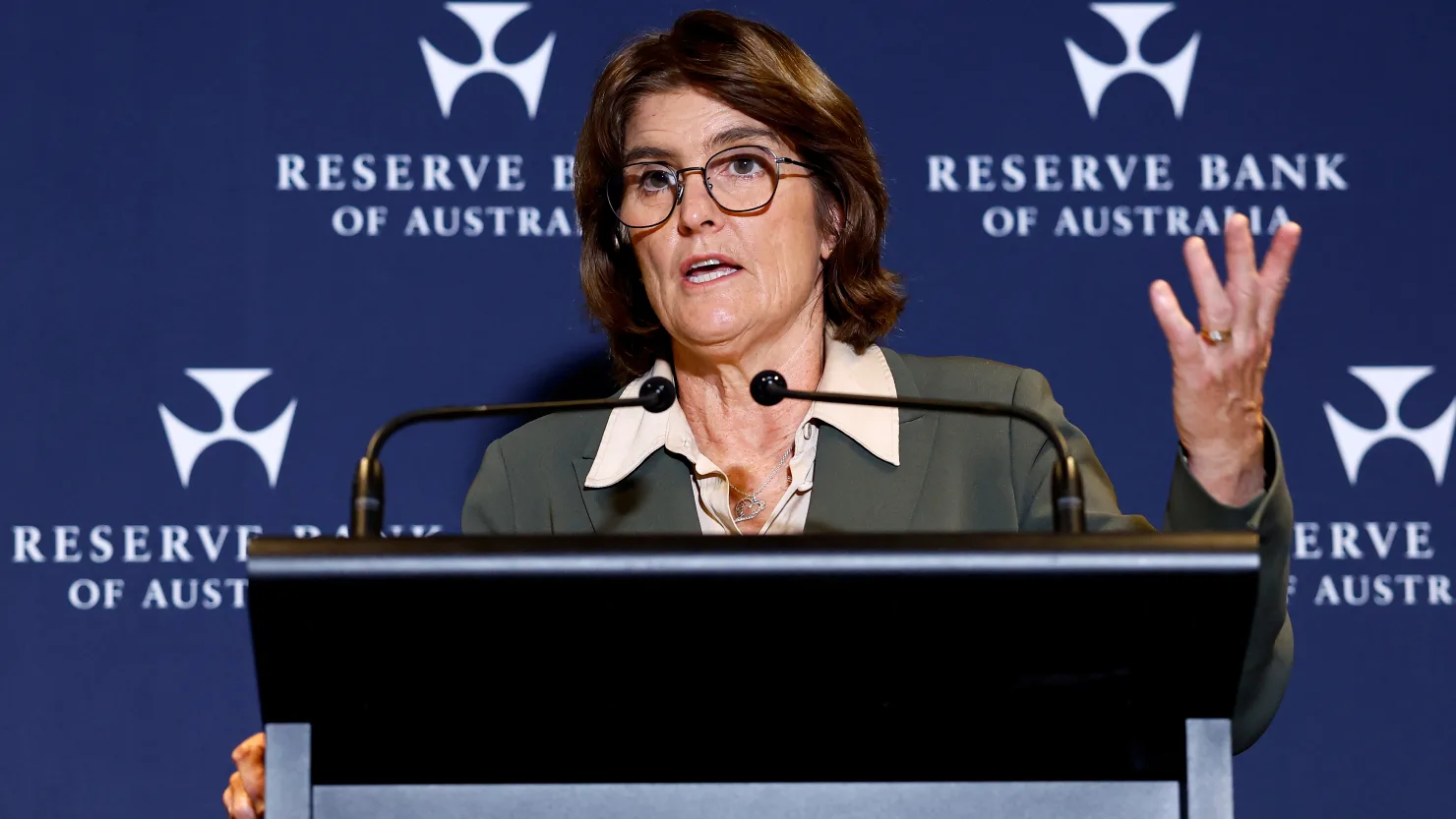
The Reserve Bank of Australia lifts its cash rate to 4.85% after September inflation reaches 4.3%, putting further pressure on borrowers and highlighting diverging monetary-policy conditions.
MARKET INSIDER — Australia’s central bank raised its benchmark interest rate by 25 basis points to 4.85% on Tuesday, November 3, 2026, the highest level since November 2008, as persistent inflation forced policymakers to tighten monetary policy despite slowing economic growth. The Reserve Bank of Australia (RBA) approved its fifth rate increase of the year in a 6–3 vote, following a rise in annual consumer price inflation to 4.3% in September. The decision underscores Australia’s struggle to contain price pressures and highlights the risk that higher energy costs and resilient domestic demand could keep interest rates elevated for longer.
Key takeaways
- The RBA increased its cash rate to 4.85%, its highest level in 18 years, with six board members supporting the increase and three voting to hold.
- Australia’s annual inflation accelerated to 4.3% in September from 4.0% in August, prompting the central bank to push back its expected return to the 2%–3% inflation target until late 2027.
- Higher fuel and commodity prices, stronger domestic spending and technology-related investment are complicating monetary policy as economic growth slows.
Why Did Australia Raise Interest Rates Again?
The Reserve Bank of Australia has intensified its efforts to control inflation after price pressures proved more persistent than previously expected.
The November increase was broadly anticipated by economists surveyed by Reuters, but the divided board vote reflected the difficult balance between restoring price stability and avoiding excessive damage to economic activity.
According to the RBA’s November policy statement, six members supported raising the cash rate by 25 basis points, while three preferred to leave it unchanged.
The decision marked the fifth rate increase in 2026, reinforcing the central bank’s increasingly restrictive policy stance.
Australia’s annual consumer price inflation reached 4.3% in September, up from 4.0% in August and its highest reading since March.
That places inflation well above the RBA’s medium-term target range of 2%–3%.
The central bank now expects inflation to remain elevated through much of 2027, with a return to the target range delayed until late next year.
That is three quarters later than previously projected, suggesting the inflation problem has become more persistent than policymakers anticipated.
What Is Driving Australia’s Inflation Problem?
Australia’s inflation pressures reflect a combination of international supply shocks and domestic demand.
Higher fuel and commodity prices have increased costs across transportation, manufacturing and household consumption.
The war involving Iran has contributed to energy-market volatility, raising concerns about the inflationary consequences of prolonged disruption to oil supplies and international shipping.
For an economy exposed to global commodity markets, rising energy costs can spread through business operating expenses and consumer prices.
Domestic spending has also remained sufficiently resilient to complicate the central bank’s efforts to slow inflation.
RBA Governor Michele Bullock warned in September that inflation was still too high and that stronger-than-expected spending was contributing to persistent price pressures.
“We’re seeing signs that upside risks to inflation are materializing,” Bullock said, indicating that further tightening could be necessary if inflation failed to moderate.
The RBA has also identified investment associated with artificial intelligence as one factor contributing to higher prices for technology-related goods.
Rapid expansion in AI infrastructure can increase demand for computing equipment, electronic components and other specialized inputs, adding to existing supply constraints.
However, the central bank’s assessment does not establish AI investment as the dominant cause of Australia’s inflation. Energy costs and broader domestic economic conditions remain important contributors.
Is Australia’s Economy Slowing Under Higher Borrowing Costs?
The latest interest-rate increase comes as Australia’s economic expansion loses momentum.
Gross domestic product grew 2.1% year on year in the June quarter of 2026, compared with 2.5% in the March quarter.
Although the economy continued to expand, the slowdown illustrates the challenge facing policymakers as tighter financial conditions affect households and businesses.
Higher interest rates increase borrowing costs for mortgage holders, property investors and companies relying on bank financing.
For households, larger mortgage repayments can reduce disposable income and limit spending on discretionary goods and services.
Businesses may also postpone investment projects when financing costs rise or demand becomes less predictable.
These effects are part of the monetary-policy transmission mechanism through which central banks seek to reduce inflation.
However, excessive tightening can also weaken employment, business confidence and economic activity.
Asked whether Australia was heading toward a recession, Bullock said that was not the central bank’s baseline expectation.
The RBA therefore faces a difficult policy trade-off: maintaining sufficient restraint to bring inflation under control without unnecessarily undermining economic growth.
Why Is Australia Moving Differently From Other Central Banks?
Australia’s latest decision highlights how monetary-policy cycles can diverge across major economies.
Central banks respond primarily to domestic inflation, employment and financial conditions, even when they face common global pressures.
For Australia, persistent inflation has made additional tightening necessary despite weaker growth.
The divergence matters because interest-rate differentials influence international investment decisions, currency valuations and capital flows.
Higher Australian interest rates can increase the relative yield available on Australian-dollar assets, potentially supporting demand for the currency.
However, the Australian dollar also responds to commodity prices, Chinese economic activity, global risk appetite and expectations for U.S. monetary policy.
Higher interest rates therefore do not guarantee currency appreciation.
For bond investors, the decision reinforces the importance of monitoring the RBA’s inflation forecasts and the likelihood that borrowing costs will remain restrictive.
For equity investors, the implications differ across sectors.
Banks may benefit from higher lending rates, but funding costs, credit demand and borrower repayment capacity can offset those advantages.
Real estate and other interest-rate-sensitive industries face more direct pressure from higher financing costs.
What Does the RBA Decision Mean for Asian Markets?
Australia’s monetary-policy outlook has implications for Asian economies through trade, commodities, currencies and investment flows.
Australia is a major supplier of commodities to Asian markets, including China, Japan and South Korea.
Changes in Australian domestic demand and global commodity prices can therefore influence regional trade and business expectations.
For emerging-market investors, a prolonged period of relatively high Australian interest rates could also affect the attractiveness of Australian-dollar bonds and other yield-sensitive investments.
Currency movements are particularly relevant for businesses with cross-border revenues, imports or Australian-dollar liabilities.
For Vietnam, the direct effect of the RBA’s decision is likely to be limited compared with developments in U.S. monetary policy, global energy prices and Chinese demand.
Nevertheless, the decision provides another indication that inflation risks remain uneven across the Asia-Pacific region.
It also highlights how energy-market disruptions can complicate monetary policy even when domestic economic growth is slowing.
Why It Matters
Australia’s fifth rate increase of 2026 illustrates a broader challenge for global financial markets: inflation can remain persistent even after central banks have significantly tightened financial conditions.
For households and businesses, the immediate consequence is a longer period of elevated borrowing costs.
For investors, the decision affects expectations for Australian government bond yields, bank profitability, property valuations and the Australian dollar.
The more important question is whether the RBA can restore inflation to its target without triggering a sharper economic slowdown.
The central bank’s revised forecast suggests that price stability will take longer to achieve than previously expected, increasing the importance of incoming inflation and activity data.
Outlook: What Investors Should Watch Next
Investors should focus on three indicators following the November decision.
The first is Australia’s monthly consumer price inflation, particularly whether fuel costs and domestic services inflation begin to moderate.
The second is household spending and labor-market resilience, which will help determine whether higher interest rates are reducing demand without causing a significant deterioration in economic conditions.
The third is the RBA’s evolving inflation forecast and the tone of Governor Bullock’s subsequent communications.
With inflation expected to remain above target for much of 2027, the central bank has limited room to signal an early return to lower borrowing costs.
Australia’s policy outlook will depend on whether inflation eases faster than expected or renewed price pressures force policymakers to maintain restrictive settings for longer.
