
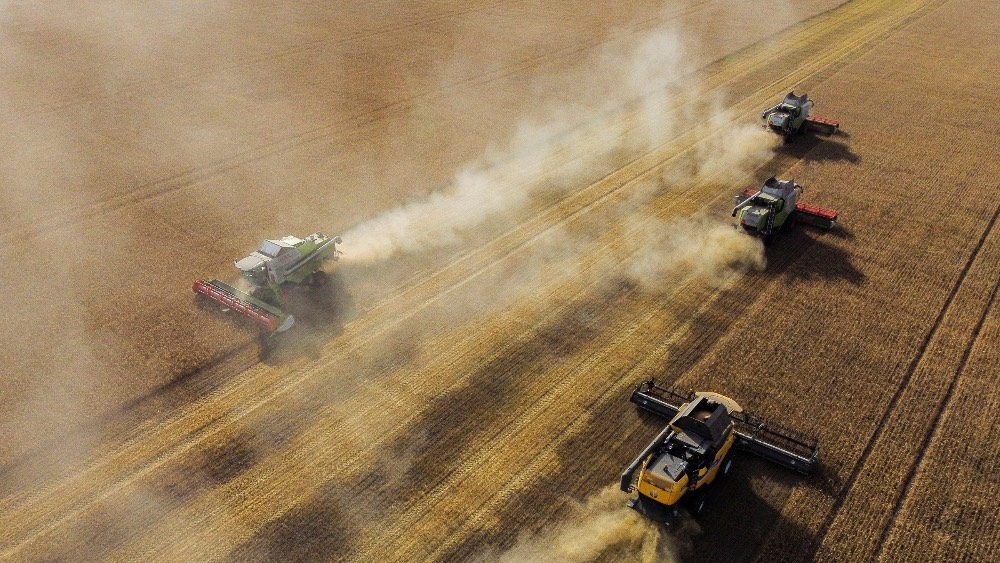
Market Insider – Russian traders are increasingly engaging in barter deals with Chinese partners — swapping wheat for cars or flax for building materials — as financial sanctions and payment restrictions make traditional transactions difficult.
According to Reuters, this marks the first resurgence of large-scale barter trade between Russia and China since the 1990s. Sources familiar with the matter said at least eight such transactions have been recorded so far, covering goods ranging from agricultural products to household appliances. While exact volumes and values remain unclear, barter arrangements are reportedly gaining traction.
“Barter trade is a clear sign of de-dollarization, sanctions pressure, and liquidity challenges between partners,” said Maxim Spassky, Secretary of the General Council of the Russia-Asia Union of Industrialists and Entrepreneurs. He added that volumes are likely to increase further.
Sanctions force new channels
Since 2022, Western sanctions have cut many Russian banks off from the SWIFT international payment system. More recently, Washington warned Chinese banks over dealings with Russia, raising fears of secondary sanctions. As a result, many Chinese lenders have been reluctant to process payments from Russian entities.
At the Kazan Expo business forum last month, Chinese companies acknowledged that payments remain a key obstacle to bilateral trade. Xu Xinjing, Chairman of Hainan Longpan Oilfield Technology, said barter could be a workable alternative, creating new opportunities for Russian and Asian firms under current restrictions.
In 2024, Russia’s Ministry of Economy issued a 14-page “Guidelines on Foreign Barter Trade,” advising companies on how to use such mechanisms to bypass sanctions and even proposing the creation of a barter exchange platform. The Federal Customs Service confirmed barter operations are taking place with several countries, though it described their scale as “insignificant” compared to overall foreign trade.
Economic backdrop
Russia’s trade surplus dropped 14% year-on-year in the first seven months of 2025 to $77.2 billion. Exports fell by $11.5 billion to $232.6 billion, while imports rose $1.2 billion to $155.4 billion.
Beyond barter, Russian businesses have been experimenting with other workarounds:
- Payment agents: intermediaries routing money through complex channels.
- VTB Bank Shanghai: settlement via the Russian state-owned lender’s Chinese branch.
- Stablecoins and crypto: increasingly used by smaller firms to bypass restrictions.
“Small businesses are actively using multiple methods — crypto, clearing systems, or opening accounts across several banks. There is no ready-made solution, so companies often rely on 10–15 different payment schemes at once,” said Sergey Putyatinsky, Deputy Head of Operations and IT at Russian financial firm BCS.
Sanctions bite, economy adapts
Since the annexation of Crimea in 2014 and the Ukraine war in 2022, Russia has faced more than 25,000 sanctions from the U.S., EU, and their allies. Despite this, President Vladimir Putin insists Russia’s growth has outpaced G7 economies over the past two years. The central bank, however, warns the country is technically in recession and grappling with high inflation.
