
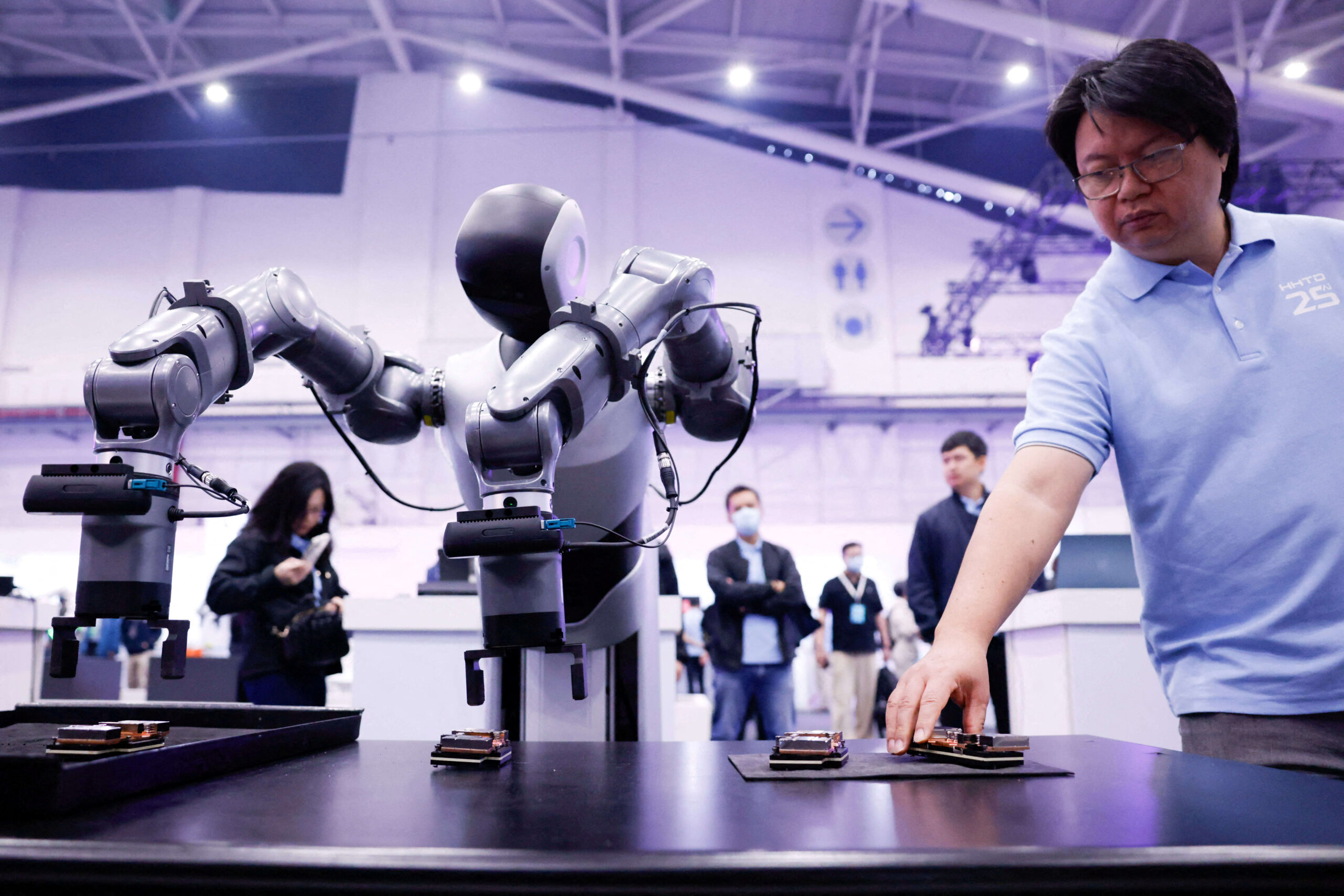
The Taiwanese manufacturer beat second-quarter earnings forecasts as AI servers became its largest business. Nvidia’s Vera Rubin platform offers another growth catalyst, although advanced-chip packaging remains a critical constraint.
MARKET INSIDER — Foxconn reported a better-than-expected 35% increase in second-quarter profit as surging demand for artificial-intelligence infrastructure accelerated its transformation from an iPhone-focused assembler into a major supplier of AI servers and networking equipment.
Net profit rose to NT$59.97 billion ($1.86 billion) from NT$44.4 billion a year earlier, exceeding the NT$58.8 billion analyst consensus. Revenue increased 41% to a second-quarter record of NT$2.53 trillion, with cloud and networking products contributing more than half of sales for the first time.
Foxconn maintained its forecast for strong full-year growth and said Nvidia’s next-generation Vera Rubin server racks would begin contributing as production ramps.
Key Highlights
- Second-quarter net profit increased 35% to NT$59.97 billion, beating the NT$58.8 billion analyst consensus. Revenue rose 41% to NT$2.53 trillion, setting a record for the April-to-June period.
- Cloud and networking products, including AI servers, generated 51% of revenue, compared with 29% from smart consumer electronics. Operating profit climbed 68% to NT$94.8 billion, significantly faster than revenue.
- Foxconn expects AI server-rack shipments to more than double in 2026. Nvidia’s Vera Rubin racks are moving toward production, with initial shipments expected in the fourth quarter.
- The company plans to increase 2026 capital expenditure by approximately 30%. CoWoS advanced-packaging capacity remains a potential constraint on next year’s AI-server growth.
Foxconn delivers record second-quarter results
Hon Hai Precision Industry, better known internationally as Foxconn, reported records for second-quarter revenue, operating profit and net income.
Revenue reached NT$2.53 trillion, rising 41% from the corresponding period of 2025. Gross profit increased 36% to NT$154.5 billion, while operating profit jumped 68% to NT$94.8 billion.
Net profit attributable to shareholders rose 35% to approximately NT$60 billion. Earnings per share increased to NT$4.27 from NT$3.19 a year earlier.
Foxconn reported a gross margin of 6.12%, an operating margin of 3.75% and a net margin of 2.37%. The sharp increase in operating profit indicates that higher production volumes, cost control and a shift toward higher-value AI systems are improving operating leverage, even though contract manufacturing remains a relatively low-margin business.
For the first half, revenue climbed 35% to NT$4.65 trillion, while operating profit increased 65% to NT$170.5 billion. Net profit rose 27% to NT$109.9 billion, giving Foxconn first-half earnings per share of NT$7.84, according to Foxconn second-quarter results
The second-quarter profit exceeded the LSEG consensus forecast by about NT$1.2 billion, or approximately 2%. The result therefore represents a solid rather than dramatic earnings beat, but the changing composition of revenue is potentially more important for the company’s longer-term valuation.
AI servers have become Foxconn’s largest business
Cloud and networking products accounted for 51% of second-quarter revenue, exceeding half of group sales for the first time. Smart consumer electronics, which include Apple’s iPhone, contributed 29%.
That reversal demonstrates how rapidly AI infrastructure is changing Foxconn’s business model.
The company remains Apple’s largest iPhone assembler, but it is increasingly important to Nvidia and major cloud-service providers as a manufacturer of complete AI server systems. These products can include graphics-processing units, networking equipment, cooling systems, power components, enclosures and fully assembled server racks.
Producing an integrated rack is more complex than assembling an individual server or consumer device. AI systems must accommodate extremely high power consumption, dense computing configurations and advanced thermal-management requirements.
Foxconn argues that its competitive advantage comes from supplying complete systems rather than isolated components. Its scale, component-manufacturing capabilities and global production network allow it to coordinate more of the server-rack supply chain internally.
Rotating CEO Michael Chiang said the company’s automation rates for computer numerical control and surface-mount technology processes were approaching 100%. Foxconn operates more than 240 sites across 24 countries, giving it the capacity to manufacture products closer to customers while managing large-volume production.
The transition does not mean smartphones have become unimportant. Apple-related orders remain substantial, and the second half traditionally brings seasonal strength as manufacturers prepare new consumer devices for year-end sales. The difference is that Foxconn is no longer dependent on smartphones as its primary growth engine.
Vera Rubin provides the next potential catalyst
Foxconn is preparing to manufacture server racks based on Nvidia’s Vera Rubin architecture, the successor to the Blackwell generation of AI computing systems.
The company’s official earnings release said Vera Rubin racks would enter mass production during the third quarter. On the earnings call, Chiang indicated that production preparations would take place in the quarter, with shipments expected to begin in the fourth quarter.
Volumes are then expected to increase over several quarters, with Vera Rubin becoming a major Foxconn product in 2027.
The timing matters because Nvidia’s product transitions create large manufacturing opportunities but also introduce execution risks. New systems require manufacturers to redesign rack architecture, cooling, networking and power distribution around increasingly powerful chips.
Foxconn expects its total AI server-rack shipments—not only Vera Rubin products—to increase by a high double-digit percentage sequentially in the third quarter and more than double over the full year.
Its high-performance networking business is also expanding. Full-year revenue from switches operating at 800 gigabits per second or above is expected to double, while co-packaged optics switches are scheduled to enter mass production and begin shipping in the third quarter.
This gives Foxconn exposure to more than AI processors. As computing clusters become larger, the ability to transfer data rapidly between processors and servers becomes increasingly important. Networking, optical connections, power systems and cooling may therefore represent additional sources of growth alongside server assembly.
CoWoS capacity could limit the upside
Customer demand appears strong, but Foxconn cannot manufacture completed server racks without sufficient supplies of advanced AI processors.
Chiang identified CoWoS capacity as a key determinant of the AI server market’s growth in 2027. CoWoS, short for Chip on Wafer on Substrate, is an advanced packaging technology developed by Taiwan Semiconductor Manufacturing Co. It allows processors and high-bandwidth memory to be integrated into the high-performance packages used in AI systems.
Nvidia and other AI-chip designers depend heavily on TSMC for manufacturing and advanced packaging. Capacity has been expanding, but demand from AI customers has remained exceptionally strong.
Market expectations indicate that CoWoS capacity could increase by more than 50% next year, according to Chiang. However, the number of next-generation server racks that Foxconn can deliver will depend on how much chip and packaging capacity its customers secure, the Reuters reported.
This distinction is important for investors. Demand for AI infrastructure can remain strong while realized revenue falls below expectations if chips, memory, cooling components or power equipment are unavailable.
CoWoS therefore represents both a constraint and a potential confirmation signal. Continued packaging expansion would support Foxconn’s order conversion and revenue growth. Delays or insufficient capacity could push some server shipments into later periods without necessarily indicating weaker end demand.
Profit growth shows improving operating leverage
Foxconn’s revenue rose 41% during the quarter, but operating profit increased 68%. That gap suggests the company is capturing better economics from its growing production base.
The operating margin increased as Foxconn benefited from higher volumes, a more favorable product mix and cost control. First-half adjusted earnings before interest, tax, depreciation and amortization rose 52% to NT$227.7 billion.
That increase outpaced the financial cost of expanding the business. First-half capital expenditure rose 5% to NT$80.9 billion, while net interest expense increased by NT$6.6 billion from a year earlier.
Foxconn’s first-half return on equity reached 6.21%, an improvement of 0.73 percentage point. Its operating margin of 3.67% exceeded the company’s 3% objective and was above the 3.2% recorded for full-year 2025.
Nevertheless, investors should keep Foxconn’s margin structure in perspective. The company remains a contract manufacturer operating with a net margin below 2.5%. Even small changes in component costs, currency movements, utilization rates or customer pricing can materially affect earnings.
AI servers may raise the value of each system Foxconn manufactures, but high revenue per rack does not automatically translate into proportionately high profit. Sustainable value creation will depend on whether Foxconn can maintain operating-margin improvement as competition and production volumes increase.
Third-quarter outlook points to further acceleration
Foxconn expects significant revenue growth from the second quarter and strong year-on-year expansion during the July-to-September period.
Cloud and networking products are projected to achieve high double-digit growth both sequentially and from a year earlier. Smart consumer electronics should also expand as the industry enters its traditional peak season.
Recent monthly revenue supports that outlook. Foxconn’s July revenue rose 54.2% from a year earlier to a record NT$946.5 billion, exceeding NT$900 billion for the first time. The company attributed the increase to strong AI-product demand and growth in smart consumer electronics, according to Reuters
Foxconn maintained its forecast for strong full-year revenue growth but did not provide a numerical target.
The combination of seasonal smartphone production and continued AI-server expansion should make the second half stronger than the first. The principal questions are how quickly Vera Rubin systems can enter commercial production and whether component availability allows orders to be converted into shipments on schedule.
Capital expenditure is rising with AI demand
Foxconn expects its 2026 capital expenditure to increase about 30% from the previous year as it expands production capacity and develops new manufacturing sites.
Investment is expected to grow in Taiwan, the United States, Mexico and Vietnam. Within the US, Foxconn plans to strengthen research, development and manufacturing capabilities in Texas, Wisconsin, Ohio and California.
The expansion reflects demand for geographically diversified technology supply chains. AI-server customers increasingly want manufacturing capacity near large data-center markets, particularly as governments introduce tariffs, incentives and local-production requirements.
Mexico offers proximity to US customers and integration with North American supply chains. Texas provides direct access to one of the country’s fastest-growing data-center and technology markets.
Vietnam also remains relevant to Foxconn’s diversification strategy. The country has attracted electronics manufacturing investment because of its established supplier base, competitive production costs and access to Asian and global markets.
For Vietnam, further Foxconn investment could deepen participation in the AI hardware supply chain. However, the economic value will depend on whether local operations expand beyond assembly into components, engineering, research and higher-value manufacturing services.
Apple production continues shifting toward India
Foxconn still assembles most iPhones in China, but it now produces the majority of devices exported to the United States from India.
The shift forms part of Apple’s effort to reduce its manufacturing concentration in China and manage tariff and geopolitical risks. It also illustrates how Foxconn’s global network is becoming central to its competitive position across both consumer electronics and AI infrastructure.
This diversification may reduce dependence on any single production location, but it requires substantial capital and can initially create inefficiencies. New plants need trained workers, qualified suppliers, logistics infrastructure and stable production yields before they can match established facilities.
Foxconn must therefore manage two large transitions simultaneously: the geographic redistribution of consumer-electronics production and the rapid expansion of its AI-server business.
Electric vehicles remain a longer-term option
Foxconn continues to develop electric-vehicle and mobility businesses, although AI currently provides the clearest near-term growth catalyst.
The company highlighted projects involving Mitsubishi Motors in New Zealand, ElectroMobility Poland and an electric-vehicle charging joint venture in Saudi Arabia. It has also begun deliveries and production of additional vehicle and electric-bus products in Taiwan.
The EV strategy is based on applying Foxconn’s contract-manufacturing model to automobiles. Progress has been slower than in AI servers, and the business has not yet become a comparable earnings contributor.
For investors, EV operations should therefore be treated as a longer-term option rather than the principal explanation for current financial performance.
Why Foxconn shares are trailing Taiwan’s market
Foxconn shares gained 17% from the beginning of 2026 through Wednesday’s close and rose 2.7% before the earnings announcement. However, Taiwan’s benchmark index advanced approximately 57% over the same period.
The underperformance suggests investors have placed higher valuations on companies with more direct exposure to advanced semiconductors and AI components.
Foxconn is essential to AI infrastructure, but its contract-manufacturing model generally produces lower margins than chip design, semiconductor fabrication or proprietary hardware. The market may therefore require evidence that record AI-server revenue can translate into sustained margin and return-on-equity improvement.
Its exposure to smartphones, geopolitical risk and large capital requirements may also contribute to the valuation discount.
The earnings release offers evidence that the mix is improving: cloud and networking products have become the largest revenue source, operating profit is rising faster than sales and full-year AI rack shipments are expected to more than double.
Whether that is sufficient to close the performance gap will depend on execution during the second half and the profitability of the Vera Rubin production cycle.
Implications for Nvidia, TSMC and the Asian technology supply chain
Foxconn’s results provide another indicator that spending on AI infrastructure remains strong.
For Nvidia, the production outlook suggests that customers continue preparing for large deployments of new AI systems. For TSMC, it reinforces the strategic importance of advanced packaging alongside leading-edge semiconductor manufacturing.
The report also shows that the AI investment cycle reaches well beyond chip designers. Server assemblers, networking suppliers, optical-component manufacturers, cooling-system providers and power-equipment companies all participate in the build-out.
Taiwan remains central to this ecosystem through Foxconn, TSMC and a broad network of component suppliers. At the same time, manufacturing is spreading into the United States, Mexico, India and Vietnam as companies seek additional capacity and more resilient supply chains.
This creates opportunities across emerging Asia, but local economies will capture greater value only if they develop engineering capabilities and domestic suppliers rather than remaining limited to final assembly.
What investors should watch next
The immediate indicator will be Foxconn’s monthly revenue, which can show whether AI-server shipments and seasonal consumer-electronics production continue accelerating through the third quarter.
Vera Rubin’s production schedule will be equally important. Confirmation of fourth-quarter shipments would reduce execution uncertainty and provide better visibility into 2027 revenue.
Investors should also follow TSMC’s advanced-packaging expansion. Strong server demand cannot translate fully into Foxconn revenue without adequate supplies of packaged AI processors.
Margins deserve close attention. Revenue growth alone will be less important if the cost of capacity expansion, financing or production complexity absorbs the additional gross profit. Continued operating-margin improvement would strengthen the argument that Foxconn’s AI transition is creating economic value rather than simply increasing sales volume.
Capital expenditure will provide another signal. Foxconn’s planned 30% increase shows confidence in customer demand, but it also raises the consequences of any slowdown. New facilities need sufficient utilization to earn acceptable returns.
Foxconn’s second-quarter results confirm that AI servers are no longer a supplementary business. They have become the company’s largest revenue source and the central driver of its growth outlook.
The next phase will test whether Foxconn can convert that scale into stronger profitability while navigating chip constraints, product transitions and a more geographically distributed manufacturing network.
