
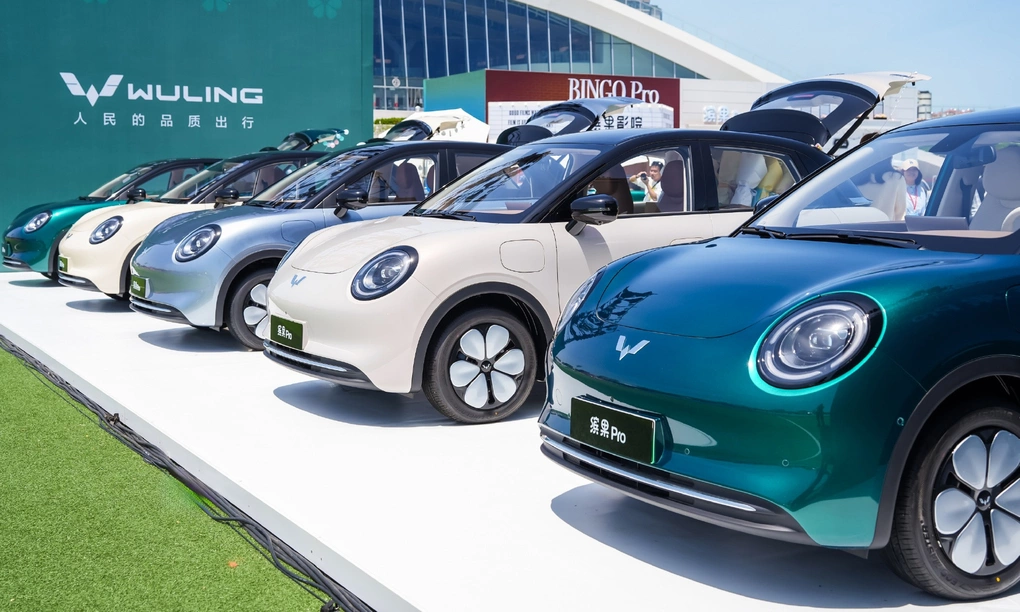
The proposed rebadging could give Chevrolet a lower-cost electric hatchback for emerging markets, but General Motors has not confirmed production, launch markets, pricing or timing.
MARKET INSIDER — General Motors is considering selling the Wuling Bingo Pro as an entry-level Chevrolet electric vehicle in selected emerging markets, according to a July 7, 2026 report by GM Authority. The China-market hatchback starts at 56,800 yuan, or about $8,400, and offers up to 403 kilometres of range under China’s testing standard. However, neither GM nor its SAIC-GM-Wuling joint venture has publicly confirmed the proposed Chevrolet model, its production arrangements or possible launches in markets including Brazil and Mexico.
Key takeaways
- The Wuling Bingo Pro reportedly costs between 56,800 and 70,800 yuan in China and offers rated ranges of 330 km or 403 km.
- GM Authority says GM is evaluating a Chevrolet version, but no official launch decision, name, export price or market list has been announced.
- The strategy would extend GM’s use of vehicles developed by SAIC-GM-Wuling, following the Chevrolet Spark EUV and Captiva EV.
Is GM preparing a Chevrolet Wuling Bingo Pro?
GM is assessing whether to use the Wuling Bingo Pro as the basis for a low-cost Chevrolet electric vehicle outside China, GM Authority reported.
The publication said the model could target international markets where demand for affordable urban electric vehicles is growing. Brazil and Mexico were identified as possible destinations, while Southeast Asia and Africa could fit the broader commercial logic because compact vehicles play a significant role in many densely populated cities.
Those possible markets should not be treated as a confirmed rollout plan. As of July 20, 2026, Market Insider found no corresponding GM or SAIC-GM-Wuling announcement confirming that the project had received final approval.
A Chevrolet derivative would probably receive the brand’s bowtie badge, a different name and limited exterior changes, following GM’s approach with other models originating from its Chinese joint venture. Final specifications could also differ by country because of local safety rules, charging standards, consumer preferences and homologation requirements.
What does the Wuling Bingo Pro offer?
The Bingo family entered the Chinese market in March 2023 as an affordable battery-electric range. The Bingo Pro went on sale in China in May 2026, priced between 56,800 and 70,800 yuan, equivalent to approximately $8,390–$10,450 at the exchange rates cited in the source material.
The front-wheel-drive hatchback uses an 87-horsepower electric motor and a lithium iron phosphate, or LFP, battery. Buyers can choose between versions rated for 330 km and 403 km under the China Light-Duty Vehicle Test Cycle (CLTC).
CLTC figures are not directly comparable with estimates produced under the US Environmental Protection Agency or Europe’s Worldwide Harmonised Light Vehicles Test Procedure. Real-world range and any official overseas rating would probably be lower, depending on speed, weather, traffic and equipment.
China Passenger Car Association data cited in the original material put Bingo Pro sales at 21,085 units in June 2026. That figure requires confirmation against the association’s underlying model-level dataset before publication as an independently verified number.
| Indicator | Reported China-market specification |
|---|---|
| Starting price | 56,800 yuan |
| Highest listed price | 70,800 yuan |
| Rated range | 330 km or 403 km, CLTC |
| Motor output | 87 horsepower |
| Battery chemistry | Lithium iron phosphate |
| June 2026 sales | 21,085 units, according to CPCA data cited by the source |
Why would GM use a Chinese-developed electric vehicle?
Developing an entry-level electric car from the ground up requires substantial spending on engineering, batteries, software, tooling and regulatory approval. Adapting a vehicle already developed by SAIC-GM-Wuling could shorten the route to market and give Chevrolet access to a cost structure shaped by China’s highly competitive electric-vehicle supply chain.
SAIC-GM-Wuling is a joint venture involving GM, SAIC Motor and Guangxi Automobile Group. Its portfolio gives GM access to small, relatively inexpensive electric vehicles that differ sharply from the larger and more costly EVs typically sold under US brands.
GM has already applied a related product strategy internationally. The Chevrolet Spark EUV is based on the Baojun Yep Plus, while the Captiva EV is derived from the Wuling Starlight S. In June 2026, GM said production of the Captiva EV had begun in Brazil, where the Spark EUV was already being assembled at the same partner facility, according to a GM Authority report citing GM South America.
That precedent makes a Chevrolet-badged Bingo Pro commercially plausible, but it does not prove that GM has approved the model.
What could the strategy mean for emerging EV markets?
A Chevrolet version of the Bingo Pro could expand the limited selection of relatively affordable electric hatchbacks in Latin America and other emerging regions. Chevrolet would contribute an established dealer and service network, while SAIC-GM-Wuling would provide a vehicle platform developed for price-sensitive buyers.
The China price, however, should not be interpreted as a likely overseas retail price. Freight, tariffs, taxes, distributor margins, certification costs and local equipment requirements can substantially raise the final figure.
Manufacturing location would therefore be important. Local or regional assembly can help an automaker manage import costs and increase supply, but it requires production agreements, sufficient sales volume and reliable access to components.
The plan could also expose the tension within GM’s emerging-market strategy. Chinese engineering and supply chains may improve affordability, while rising trade barriers and political scrutiny of China-linked automotive products can complicate market entry.
What are the implications for Southeast Asia and Vietnam?
For Southeast Asian investors, the report points to intensifying competition in the region’s small-EV segment. Chinese manufacturers have used lower production costs, LFP batteries and compact designs to address urban customers who find larger electric sport utility vehicles unaffordable or impractical.
A Chevrolet-badged model could combine Chinese vehicle economics with a familiar international brand and established after-sales infrastructure. That combination may pressure incumbent automakers to reduce prices or introduce smaller EVs.
Wuling vehicles are already present in Vietnam through local distributor and assembler TMT Motors. However, there is no verified announcement that the Bingo Pro—or a Chevrolet derivative—will be offered in Vietnam. Any local impact therefore remains a competitive scenario rather than a confirmed product development.
Why it matters
The proposal illustrates how multinational automakers may compete in lower-income EV markets without relying exclusively on vehicles designed for North America or Europe. Platform sharing and rebadging can reduce development time, broaden product ranges and support lower entry prices.
For investors, the more important question is not the badge itself but whether GM can translate China-based vehicle economics into profitable international sales after tariffs, localisation expenses and dealer costs. The model’s export price, production base and geographic scope will determine whether it becomes a material expansion of Chevrolet’s EV business or a limited regional product.
Outlook: What should investors watch next?
The next signals to monitor are an official statement from GM or SAIC-GM-Wuling, regulatory filings or dealer communications identifying a launch market, and any decision on local assembly. Investors should also watch the vehicle’s overseas safety and range certifications, final retail price and initial sales performance. Until those details emerge, the Chevrolet Bingo Pro should be described as a model under consideration, not a confirmed launch.
