
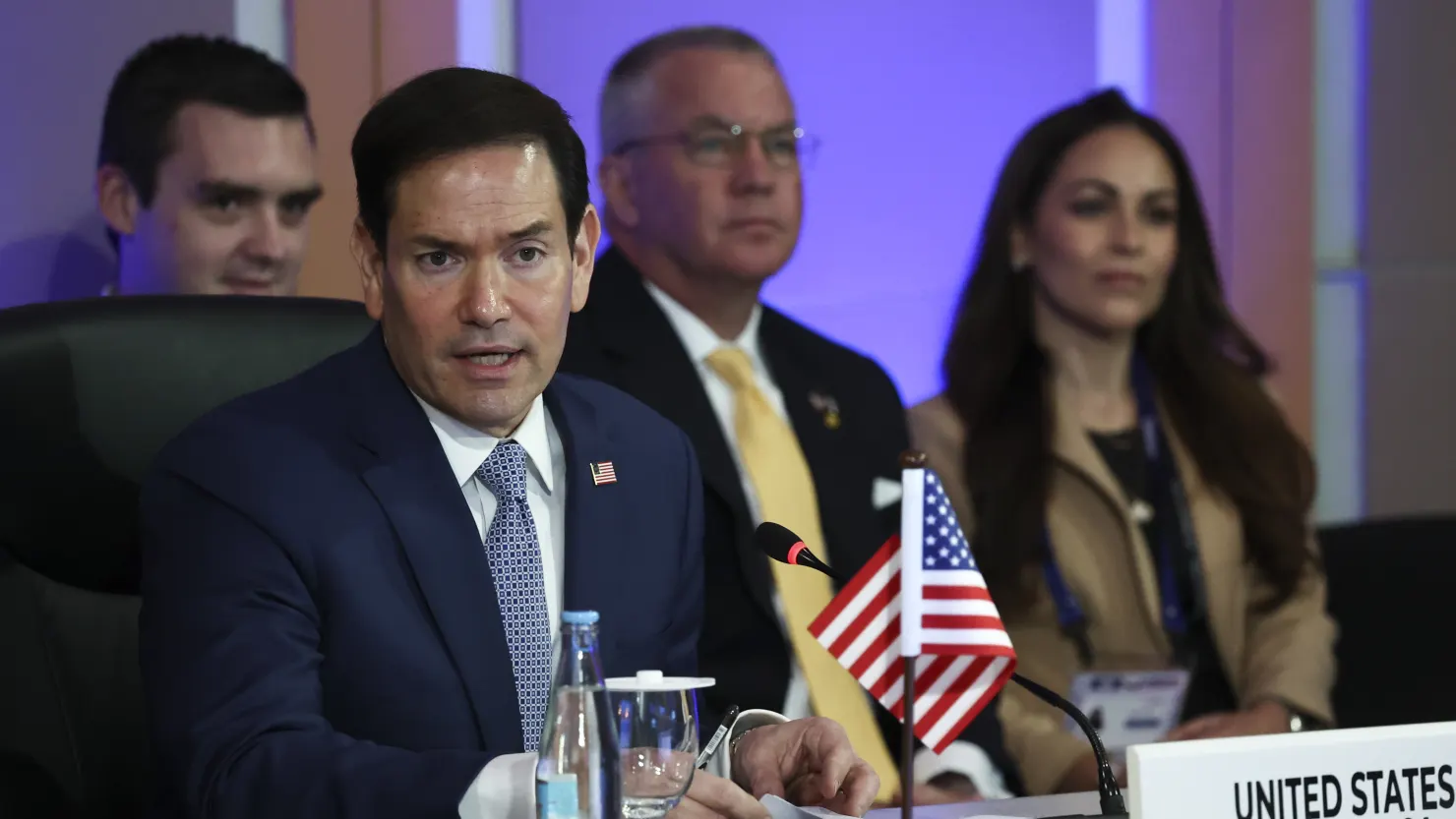
Washington says it remains open to negotiations, but the dispute over control and possible fees in the Strait of Hormuz threatens the June ceasefire framework and energy supplies to Asia.
MARKET INSIDER — U.S. Secretary of State Marco Rubio accused Iran of failing to honour its commitments under a June ceasefire framework as American forces struck Iranian targets for an 11th consecutive night. Speaking at an ASEAN meeting in Manila on July 22, Rubio said Washington remained open to negotiations but would not accept Tehran controlling or charging compulsory fees for passage through the Strait of Hormuz. The dispute has implications far beyond the Middle East: it threatens a critical energy corridor, tests international navigation rules and raises concerns for Asian economies already exposed to rising oil and shipping costs.
Key takeaways
- Rubio said Iran was not taking negotiations seriously but maintained that Washington remained committed to diplomacy.
- U.S. forces attacked Iranian military operations, drone-storage and logistics facilities for an 11th consecutive night.
- The June 17 memorandum guaranteed toll-free passage through Hormuz for only 60 days, leaving its longer-term administration unresolved.
- International law gives ships a right of transit passage through straits used for international navigation, although coastal states retain limited regulatory powers.
- Brent crude traded above $91 a barrel as threats expanded from Hormuz to the Red Sea.
- Asia is particularly vulnerable because China, India, Japan, South Korea and Southeast Asian economies depend heavily on Middle Eastern energy.
What did Rubio say about Iran?
Rubio told ASEAN foreign ministers that the United States remained willing to negotiate, but questioned whether Tehran was equally committed.
“The problem we’re having right now is that they’re not serious about talks,” he said. “If they’re serious, we’re serious. If they’re not, then we will do what is necessary to protect our interests, and also the interests of our allies.”
The secretary of state identified the future of the Strait of Hormuz as a central obstacle. According to Rubio, Iran was demanding a right to control traffic through the waterway and potentially impose fees—a position Washington rejects.
He warned that accepting such an arrangement could establish a precedent under which a coastal state uses control of an international waterway to extract payments or threaten commercial vessels.
Rubio’s statements represent the U.S. position and should not be treated as an independent determination that Iran has breached international law or the ceasefire framework. Tehran argues that Iran and Oman, as the two coastal states bordering Hormuz, possess sovereign rights that must be respected in any future management system.
What did the United States strike?
U.S. Central Command said American forces targeted military operations centres, drone-storage sites and logistics infrastructure in Iran.
The attacks marked the 11th consecutive night of renewed U.S. strikes, which Washington says are intended to weaken Iran’s ability to threaten commercial shipping in Hormuz.
Explosions were reported in Tehran and the southeastern coastal cities of Chabahar and Konarak. Blasts were also reported in Bushehr, where Iran’s only operating nuclear power plant is located. The available reports did not indicate that the nuclear facility itself had been targeted.
Iran had previously attacked U.S. military sites in Bahrain, Kuwait and Jordan, while a tanker was struck in the Strait of Hormuz. Tehran also claimed it had hit infrastructure belonging to Amazon in Bahrain, but Reuters could not independently verify that assertion and Amazon did not comment.
The continuing attacks demonstrate how far the June arrangement has deteriorated. Although diplomatic channels remain open through Pakistan and other mediators, military operations are now proceeding alongside—rather than being suspended for—negotiations.
What did the June memorandum say about Hormuz?
The United States and Iran signed the Islamabad Memorandum of Understanding on June 17, establishing an interim framework intended to end military operations and begin negotiations on a permanent agreement.
The document provided for immediate termination of military operations, gradual removal of the U.S. naval blockade, restoration of commercial shipping, a maximum 60-day negotiating period, temporary preservation of Iran’s nuclear status quo, discussions on sanctions, frozen Iranian assets and reconstruction, a future compliance-monitoring mechanism
On Hormuz, Iran agreed to use its “best efforts” to ensure safe passage for commercial vessels without charge—but explicitly for only 60 days.
The memorandum also said Iran would consult Oman over the future administration of the strait and possible maritime services, in discussion with other Gulf coastal states and in accordance with international law.
That wording deferred the most contentious issue. Tehran interpreted it as opening the way for an Iranian role in managing traffic and potentially charging for services after the initial period. Washington maintains that commercial transit must remain open without compulsory Iranian tolls or restrictions.
Iran and Oman reinforced their position in a June 23 joint statement, saying all arrangements concerning Hormuz must respect the sovereignty and sovereign rights of its two coastal states.
The disagreement is therefore not simply about reopening the waterway. It concerns who has authority to regulate passage, which services may legitimately be charged for and what international guarantees should apply.
Does international law allow Iran to control the strait?
The legal position is more nuanced than Rubio’s political formulation suggests.
Under Part III of the United Nations Convention on the Law of the Sea, ships and aircraft enjoy a right of transit passage through straits used for international navigation. That passage “shall not be impeded,” according to the convention’s Article 38.
Coastal states may adopt laws governing navigation safety, pollution, fishing and customs matters. However, those rules must not discriminate against foreign vessels or have the practical effect of denying or obstructing transit passage.
Iran therefore has coastal-state regulatory rights, but those rights do not amount to an unrestricted authority to close Hormuz, selectively deny passage or impose conditions that effectively obstruct international navigation.
The legal picture is complicated because Iran has signed but not ratified UNCLOS, while the United States has not ratified it. Washington nevertheless recognises many navigation provisions as reflecting customary international law. Iran has historically disputed whether every aspect of the convention’s transit regime applies in the same way to states that have not joined it.
A fee for a genuine optional maritime service would not necessarily be unlawful. A compulsory toll imposed merely for exercising transit passage—and enforced through threats against ships—would be much more difficult to reconcile with the established navigation regime.
Why did Rubio connect Hormuz with the South China Sea?
Rubio delivered his warning to an audience that is highly sensitive to maritime sovereignty and freedom of navigation.
China claims most of the South China Sea through a line that overlaps the exclusive economic zones of Vietnam, the Philippines, Malaysia, Brunei and Indonesia. A 2016 arbitral tribunal rejected the legal basis for key elements of Beijing’s expansive claims, although China refused to recognise the ruling.
Rubio did not name China in the quoted remarks, but said Southeast Asia required no lesson about the importance of free navigation through international waterways. The comparison was unmistakable.
His wider argument is that allowing one state to use a strategically important strait as economic leverage could weaken rules governing other contested maritime areas.
The comparison nevertheless has limits. Hormuz is a narrow international strait bordered by Iran and Oman, while the South China Sea involves overlapping maritime entitlements, disputed features and much broader sovereignty claims. The legal and geographic situations are not identical.
Washington is also vulnerable to accusations of inconsistency because it insists that other countries comply with UNCLOS navigation principles despite not having ratified the convention itself.
Even so, ASEAN states have a strong economic interest in opposing any precedent that permits a country to obstruct established commercial shipping routes.
Why does Hormuz matter to global markets?
The Strait of Hormuz connects Gulf producers with the Arabian Sea and remains one of the world’s most important energy chokepoints.
Roughly one-fifth of global petroleum liquids consumption historically moves through the strait, although the precise share changes with production, demand and the extent of current shipping disruption. Rubio’s reference to 20% of global “energy supply” should therefore be understood as political shorthand; it does not mean that one-fifth of all global energy from every source necessarily passes through Hormuz.
Saudi Arabia and the United Arab Emirates have pipelines that can bypass part of the strait, but available capacity is insufficient to replace all seaborne Gulf exports.
The risk has also expanded beyond Hormuz. Yemen’s Iran-aligned Houthi movement announced restrictions on Saudi oil shipping near the Bab el-Mandeb Strait, threatening the Red Sea route that Saudi Arabia has used to bypass Gulf disruptions.
Three tankers carrying Saudi crude for China and India reversed course in the Red Sea on July 21 following the Houthi warning, according to Reuters.
Brent crude subsequently traded above $91 a barrel. If both Hormuz and the Red Sea routes become severely constrained, markets would face a much larger physical supply risk rather than merely a geopolitical risk premium.
What are the implications for Asia?
Asia is the principal destination for a large share of Gulf oil and liquefied natural gas exports.
China and India are major crude buyers, while Japan and South Korea depend heavily on imported Middle Eastern energy. Several Southeast Asian economies are also vulnerable through direct imports, refined-fuel prices and shipping costs.
Extended disruption could produce higher crude oil and LNG prices more expensive tanker insurance and freight, longer voyages and reduced vessel availability, greater demand for U.S. dollars from oil importers, pressure on Asian currencies and trade balances, higher inflation in transport, manufacturing and food distribution, reduced flexibility for central banks to support economic growth
Airlines, shipping companies, chemicals producers and other energy-intensive industries would face rising costs. Upstream producers and some oil-service companies could benefit from higher prices, although market volatility and physical disruption would create separate operational risks.
The situation is particularly difficult for governments that subsidise domestic fuel. Higher international prices can either increase public expenditure or force politically sensitive retail-price adjustments.
Can diplomacy still prevent wider escalation?
Diplomatic channels have not closed completely.
Iran has received a mediated proposal for a 10-day ceasefire aimed at reviving the June memorandum. Iranian Interior Minister Eskandar Momeni has also visited Pakistan and asked Islamabad to continue mediation.
Rubio’s statement that the United States remains prepared to negotiate leaves room for renewed talks. However, Washington’s continuing strikes and Iran’s insistence on coastal-state authority make an immediate settlement difficult.
A workable interim arrangement would probably need to specify a verified halt to U.S. and Iranian attacks whether Israel and Iran-aligned groups are covered, guaranteed passage for commercial vessels, responsibility for demining and traffic safety, the difference between optional services and compulsory fees, a procedure for investigating maritime incidents, limits or notification requirements for military deployments, a timetable for the remaining nuclear and sanctions negotiations
Without those provisions, another tanker incident or disagreement over passage could quickly restart military operations.
Why it matters for investors
The Hormuz dispute has evolved from a regional military issue into a test of two systems on which global markets depend: secure energy flows and predictable navigation rules.
Rubio’s warning is especially relevant to Asia because the region combines high dependence on Gulf energy with unresolved maritime disputes of its own. Any precedent suggesting that a state can unilaterally restrict an international route could raise the perceived risk around other strategic waterways.
Yet investors should distinguish political rhetoric from confirmed legal findings. Iran possesses legitimate coastal-state rights, while commercial vessels possess transit rights. The central question is whether those interests can be reconciled without allowing regulatory authority to become coercive control.
Markets are unlikely to respond sustainably to diplomatic statements alone. They will look for evidence that attacks are stopping, vessel traffic is recovering and insurance and freight costs are declining.
Outlook: What should investors watch next?
The immediate test is whether Iran and the United States accept the proposed 10-day ceasefire and publish compatible terms.
Investors should monitor U.S. and Iranian military operations, daily vessel crossings through Hormuz, tanker diversions and maritime insurance premiums, Houthi activity near Bab el-Mandeb, brent crude and Asian LNG prices, any agreement between Iran and Oman on maritime administration, whether proposed charges are optional service fees or compulsory tolls, progress during the memorandum’s 60-day negotiating window and currency and inflation pressure in Asian energy-importing economies
A verified ceasefire combined with rising commercial traffic could remove part of the geopolitical premium from oil. Further attacks on tankers—or an effective disruption of both Hormuz and the Red Sea—would create a more serious supply shock with consequences for inflation, currencies and global equities.
