
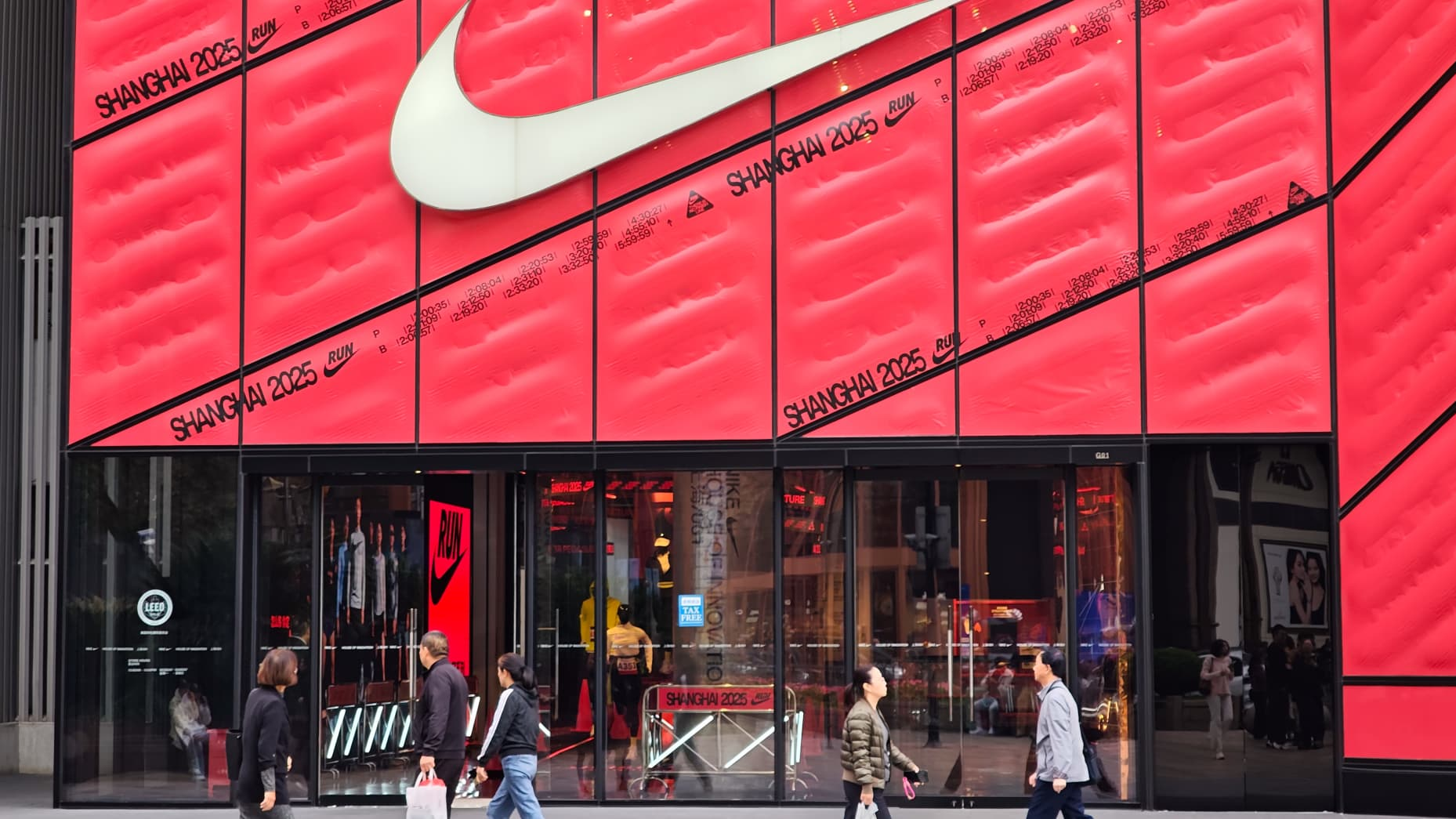
The sportswear group wants to restore pricing discipline and brand consistency, but withdrawing partners from e-commerce could sacrifice reach while local and international rivals gain ground.
MARKET INSIDER — Nike will sharply restrict distributors from selling its products online in mainland China from January 2027, concentrating digital sales in Nike-controlled storefronts on Tmall, JD.com and Douyin, alongside its website and app. The company says the overhaul will reduce inconsistent pricing, excessive discounting and fragmented brand presentation. Yet the strategy carries substantial execution risk: Greater China sales fell 17% in the latest quarter, competitors are gaining share, and affected retailers could redirect customers and digital resources toward rival brands.
Key takeaways
- Most of Nike’s 16 major Chinese retail partners will stop selling Nike products online from January 2027.
- Digital sales will concentrate in Nike-operated channels and branded storefronts on Tmall, JD.com and Douyin.
- The policy affects partners that collectively operate thousands of physical stores; available information does not establish that Nike is terminating “thousands of online distributors.”
- Greater China sales declined 17% on a currency-neutral basis in Nike’s latest quarter.
- Topsports generates 22% of its revenue from online Nike sales and expects a significant near-term impact.
- The central investor question is whether greater control over price and presentation can offset the loss of distributors’ traffic, customer data and selling capacity.
What is Nike changing in China?
Starting in January 2027, most of Nike’s major retail partners in mainland China will no longer be permitted to sell Nike footwear and apparel through their own online stores.
Consumers will instead be directed primarily to Nike’s official website and mobile app, Nike-branded storefronts on Alibaba’s Tmall, Nike’s official presence on JD.com, Nike-controlled sales channels on Douyin
Retail partners will continue operating physical stores, meaning Nike is restructuring its digital distribution rather than ending its broader wholesale relationships in China.
Cathy Sparks, Nike’s vice president and general manager for Greater China, said the objective was to create a more consistent, premium and trustworthy customer experience across online and offline channels.
The company believes its existing digital network has become too fragmented. Numerous storefronts may display products differently, apply different discounts and present inconsistent brand messages, making it difficult for Nike to maintain premium positioning.
According to Reuters, most of Nike’s 16 Chinese store partners—which collectively manage thousands of physical locations—will cease online Nike sales.
This distinction makes the original headline potentially misleading. Nike is restricting the online activities of major distributors with extensive store networks; it has not confirmed that it is directly terminating thousands of individual online distributors.
Why is Nike taking greater control of online sales?
The immediate commercial objective is to regain control over pricing, inventory and brand presentation.
When the same product appears across numerous online stores at different prices, consumers learn to search for the deepest discount rather than purchase from the brand’s preferred channel. That can increase sales volume temporarily but weaken full-price demand and reduce the perception of exclusivity.
Fragmentation also makes it harder for Nike to coordinate product launches, explain technical features, distinguish performance products from lifestyle ranges and connect customer activity between digital platforms and physical stores.
A more concentrated structure could provide several benefits more consistent pricing and fewer uncontrolled promotions, better coordination of new-product releases, clearer visibility into consumer behaviour, stronger control over online inventory, improved protection against counterfeit or unauthorised products and a more coherent connection between Nike’s app, digital membership and stores
Sparks said the restructuring was intended to reduce fragmentation rather than consumer access. Because Tmall, JD.com and Douyin are already among China’s dominant digital platforms, Nike believes customers will still be able to find its products easily.
The important question, however, is whether theoretical access translates into comparable sales. Distributor-operated stores bring their own followers, promotional capabilities, livestreaming operations and customer databases. Removing Nike products from those channels could reduce the number of occasions on which consumers encounter the brand.
How serious is Nike’s China slowdown?
The change comes as Nike’s performance in China continues to deteriorate.
Greater China sales fell 17% on a currency-neutral basis in the fiscal fourth quarter, accelerating from a 10% decline in the preceding quarter. China remains Nike’s third-largest geographic market and accounts for roughly 15% of group revenue.
For fiscal 2026, Nike reported companywide revenue of $46.4 billion, broadly unchanged on a reported basis but down 2% after adjusting for currency movements. Nike Direct revenue decreased 8% for the full year, including a 12% fall in Nike Brand Digital, while wholesale revenue increased 4%, according to the company’s fiscal 2026 results.
Those figures highlight the tension in Nike’s China strategy. Globally, wholesale has recently performed better than the company’s direct business. In North America, chief executive Elliott Hill has been rebuilding relationships with wholesale partners after Nike’s previous leadership reduced their role too aggressively.
China is now moving in the opposite direction online, although distributors will retain their physical-store operations.
Nike may therefore be trying to pursue a hybrid model: controlled digital commerce combined with partner-operated brick-and-mortar distribution. Whether that balance works will depend on how sales, inventory and customer data are shared between Nike and its retailers.
Does Nike have a distribution problem or a product problem?
BNP Paribas analyst Laurent Vasilescu argues that the company is addressing the wrong issue.
He described the China policy as a potential strategic mistake and said Nike’s principal problem was product weakness rather than distribution. BNP maintained its underperform rating on the stock.
That criticism is supported by the competitive environment. Domestic companies such as Anta and Li Ning have expanded through faster supply chains, extensive store networks and products calibrated to local price points and consumer preferences.
Specialist international brands including On and Hoka have also benefited from growing Chinese participation in running and other performance sports.
Adidas offers a particularly relevant comparison. After its own prolonged decline in China, the German company accelerated local product development and shortened decision-making cycles. Locally designed products now represent about 60% of Adidas’ China range, up from roughly 10% previously, Reuters reported.
Nike has acknowledged the need for greater localisation and appointed a vice president of local product creation in Greater China. This may prove as important as the e-commerce restructuring.
Controlling distribution can reduce discounting and improve presentation, but it cannot create demand for products that consumers do not find sufficiently innovative, relevant or competitively priced.
Could Nike repeat its North American wholesale mistake?
The concern is not that the two strategies are identical, but that they share a similar risk.
Under its earlier direct-to-consumer strategy, Nike reduced supply to several wholesale partners in North America in an effort to capture more sales directly. The policy weakened Nike’s presence in multi-brand retail environments and created shelf space that competitors could occupy.
Hill has since moved to repair those relationships, recognising that distributors provide more than transaction processing. They offer consumer reach, local market knowledge, inventory capacity and visibility alongside competing products.
In China, Nike is not withdrawing from its partners’ physical stores. It is nevertheless removing Nike products from their online channels, potentially giving competitors greater exposure to millions of digitally active customers.
The policy could therefore succeed in improving Nike’s online presentation while simultaneously weakening its share of broader e-commerce traffic.
Much will depend on whether Nike’s official storefronts can replace the sales generated by distributor channels without resorting to the same heavy discounting the restructuring is designed to reduce.
What does the change mean for Topsports?
Topsports, Nike’s largest distributor in mainland China, is among the companies most exposed to the change.
Online Nike sales account for approximately 22% of Topsports’ revenue, according to Reuters. Its board expects the adjustment to have a significant negative effect in the short term.
Topsports operates an extensive physical retail network and describes itself as an omnichannel sportswear retailer with more than 90 million cumulative users. Its online capabilities include storefronts, livestreaming and social-commerce accounts across major Chinese platforms. Topsports’ corporate website says the company works with more than 20 sports brands.
Chief executive Yu Wu said the distributor supports Nike’s decision despite the expected near-term pressure. Topsports expects to continue working with Nike through physical retail, local consumer services and new store concepts.
For Topsports, the strategic issue will be how it replaces the lost online revenue. The company could attempt to convert more digital customers into store visits, but it may also allocate additional online promotion to other brands.
That creates a potential unintended consequence for Nike: the distributors most capable of selling its products may use their digital networks to strengthen competing labels instead.
Will the policy damage Nike’s revenue?
A short-term decline is a material possibility.
The strategy could reduce revenue through three mechanisms:
- Lost digital traffic: Consumers who previously encountered Nike products through distributor stores may not automatically migrate to Nike’s official storefronts.
- Reduced promotional intensity: Tighter pricing control should support brand equity, but fewer discounts may initially lower unit sales among price-conscious shoppers.
- Distributor substitution: Retailers prevented from selling Nike online may promote Anta, Li Ning, Adidas, Hoka, On or other available brands more aggressively.
Against those risks, Nike could improve gross margins if a greater proportion of sales occurs at full price and fewer goods require clearance.
The outcome should therefore not be judged solely by revenue in the first quarter after implementation. Investors will need to assess sales alongside full-price sell-through, digital traffic, inventory levels and margin performance.
A controlled reduction in low-margin or heavily discounted sales could strengthen the business over time. A sharp revenue decline without better margins or stronger consumer engagement would indicate that the strategy had sacrificed distribution without solving Nike’s underlying product problem.
What does this mean for China’s digital retail market?
Nike’s decision illustrates a broader strategic dilemma facing international consumer brands in China.
Large digital platforms provide extraordinary reach, but distribution across many merchants can weaken control over pricing, authenticity and brand presentation. Concentrating sales in official flagship stores allows tighter governance but increases dependence on platform algorithms and the brand’s own marketing capability.
Douyin adds another complication. Chinese e-commerce increasingly depends on short video, influencers and livestreaming rather than conventional product searches. Distributors often possess specialised teams and established audiences in these formats.
Nike will need to reproduce those capabilities inside its official channels. Simply consolidating storefronts will not guarantee that consumers discover or engage with the products.
The strategy is therefore not a pure direct-to-consumer shift. Nike remains dependent on Tmall, JD.com and Douyin for digital traffic, even if it takes greater control of the stores operating within those ecosystems.
Why it matters for investors
China is too important for Nike’s global turnaround to succeed without meaningful improvement in the region.
The restructuring addresses real problems: fragmented presentation, inconsistent prices, excessive promotions and limited control over customer journeys. Greater discipline could help rebuild premium positioning and improve profitability.
But distribution reform is not a substitute for product innovation.
Nike must simultaneously deliver footwear and apparel that reflect Chinese consumer preferences, compete effectively in performance categories and justify premium prices. It also needs to preserve productive relationships with retailers whose store networks and local knowledge remain essential.
The most favourable outcome would combine stronger official digital channels, healthier pricing, improved local products and continued partner support in physical retail.
The adverse scenario would involve an immediate loss of online revenue, partners shifting attention toward competitors and consumers finding little reason to move to Nike’s official stores.
Outlook: What should investors watch next?
The first measurable test will come after the policy takes effect in January 2027.
Investors should monitor Greater China revenue and currency-neutral growth, traffic and conversion rates at Nike’s official digital stores, full-price sales and promotional activity, inventory held by Nike and its retail partners, gross-margin changes in Greater China, Nike’s share of major online shopping festivals, new locally designed product launches, store productivity at Topsports and other distributors, and whether affected partners increase promotion of competing brands
Topsports’ earnings will provide an early indication of how much revenue disappears from distributor channels and whether it is redirected to Nike’s own stores.
Ultimately, the success of Nike’s China reset will not be determined by having fewer online storefronts. It will depend on whether consumers who reach those stores find products they want to buy at prices that restore both growth and brand value.
