
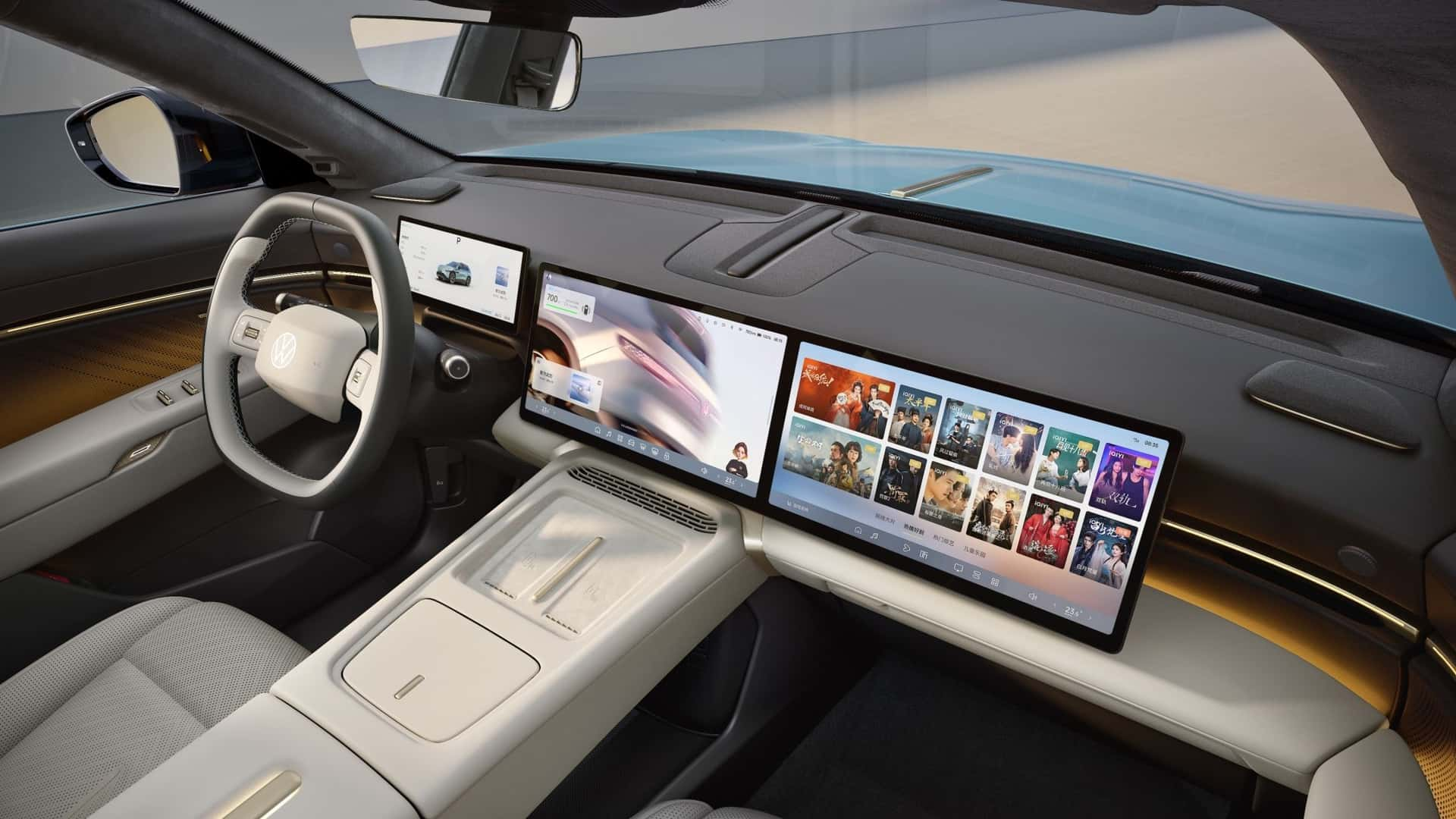
The ID. Era 5S illustrates how Chinese engineering partnerships are reshaping Volkswagen’s products, development methods and international ambitions.
MARKET INSIDER — Volkswagen is increasingly using China as a center for automotive innovation, drawing on local software expertise and technology partnerships to strengthen its competitiveness. Its ID. Era 5S plug-in hybrid sedan combines a German brand with substantial development work undertaken in China, including advanced driver-assistance technology. The shift reflects pressure from Chinese manufacturers that compete aggressively on price, software and product speed. It also has implications beyond the domestic market: Volkswagen plans to bring China-developed vehicles and technology to other regions, potentially changing how established global automakers design, price and deliver their products.
An affordable sedan highlights the shift
The ID. Era 5S carries an official starting price of 119,900 yuan—approximately $18,000—before promotional offers. SAIC Volkswagen’s website also lists a limited-time entry price of 89,900 yuan, underscoring the intense competition in China’s passenger-car market.
Reported demonstrations described the vehicle navigating complex urban conditions, including crowded intersections, narrow roads and parking facilities, without driver intervention during portions of the journey.
Those demonstrations should not be confused with unrestricted autonomous driving. Volkswagen describes its latest China-developed systems as advanced driver assistance, using the designation “L2++.” Such capabilities do not establish that a vehicle can operate safely without driver supervision in all conditions.
CARIAD, Volkswagen’s software subsidiary, identifies urban navigation assistance as part of its China rollout.
Local partnerships accelerate development
Volkswagen’s relationships with Horizon Robotics and Xpeng are central to its effort to develop vehicles more closely aligned with Chinese customers’ expectations.
Carizon, the joint venture between CARIAD and Horizon Robotics, develops driver-assistance technology for the group. The partnership combines Volkswagen’s vehicle engineering with local capabilities in computing hardware, software and AI.
Volkswagen has also announced deeper collaboration with Horizon on AI foundation models, intended to support more advanced automated-driving systems. Its roadmap targets initial Level 3 capabilities from the second half of 2027, distinguishing future ambitions from the assistance systems already entering production.
The commercial rationale is clear: software features increasingly influence purchasing decisions, alongside range, comfort, safety and price.
AI changes the engineering process
The transformation extends to how Volkswagen develops and tests software.
The company says its C-Brain AI tools have reduced some software feature-testing tasks from as long as three days to two or three hours. It also reports that certain software diagnosis, correction and release workflows previously requiring roughly two weeks can now be completed in about 20 minutes, according to volkswagengroupchina.com.cn
These are company-reported improvements in specific workflows. They do not mean an entire vehicle can be developed, validated and brought to market within that timeframe.
For manufacturers, faster software work could reduce development costs and allow more frequent improvements. The financial benefit ultimately depends on whether those efficiencies translate into competitive products, reliable performance and profitable sales.
China becomes an export and technology base
Volkswagen’s strategy is expanding from “In China, for China” to “In China, Beyond China.”
At its October technology event, the group outlined plans to export more China-built vehicles and introduce locally developed platforms and electronic architecture in other markets. South America is intended to be the first region to incorporate those technologies into locally produced models before the end of the decade.
Volkswagen also identified Vietnam, Mexico and Egypt among markets scheduled to receive China-produced vehicles by the end of 2026. That is a company plan, rather than confirmation that every launch has already occurred.
For buyers in emerging markets, this approach could broaden access to competitively priced electrified vehicles. However, equipment, software availability and pricing will depend on local regulations and product decisions.
Technology progress must deliver commercial results
Volkswagen’s technical advances come amid substantial competitive pressure in China.
The supplied reporting describes falling deliveries during the first nine months of 2026, followed by a sharp October increase in sales of electrified models, supported by the ID. Era 5S and ID. Aura T6.
An improvement in one month does not establish a sustained turnaround. The more meaningful tests will be whether new products generate repeat demand, protect margins and reduce development costs across a wider portfolio.
The strategic shift also goes beyond a simple comparison of German and Chinese engineering. Volkswagen is reorganizing where innovation happens and how it accesses specialist capabilities. China’s importance now extends from manufacturing and sales to software development and technologies that could shape vehicles sold elsewhere.
For investors, the question is whether this closer integration can restore competitiveness while preserving profitability and control over the technologies that differentiate the brand.
