
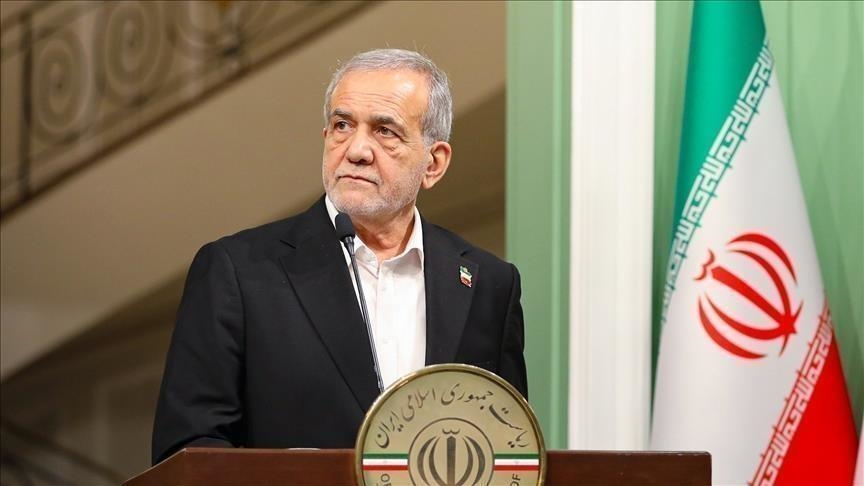
Masoud Pezeshkian said Mojtaba Khamenei was in good health and urged national unity, but the supreme leader’s continued absence from public view leaves questions over Iran’s leadership and policy direction.
MARKET INSIDER — Iranian President Masoud Pezeshkian said he held a nearly seven-hour meeting with Supreme Leader Ayatollah Mojtaba Khamenei, offering rare insight into contacts with Iran’s most powerful—and increasingly enigmatic—official.
Pezeshkian said the talks covered sanctions, household finances, employment, housing, currency management and the country’s response to the five-month conflict with the United States. He also said Khamenei was in “perfect health” and had made national unity his central message. However, no images of the meeting were released, and Khamenei has not appeared publicly since succeeding his father in March.
Key Highlights
- Pezeshkian said his meeting with Mojtaba Khamenei lasted almost seven hours.
- Discussions included sanctions, markets, jobs, housing, energy and Iran’s foreign economic relations.
- Khamenei reportedly warned that Iran’s adversaries were seeking to exploit internal divisions.
- The absence of photographs or video leaves unresolved questions about the supreme leader’s health and control over decision-making.
Pezeshkian says unity was Khamenei’s central message
Pezeshkian disclosed details of the meeting in an interview with Iran’s state-run IRIB television, describing the discussion as extensive and productive.
The president said Khamenei placed particular emphasis on preserving “unity and cohesion” as Iran confronts military pressure, tighter US sanctions and worsening domestic economic conditions.
“The enemy’s entire strategy today is focused on creating division,” Pezeshkian said. He argued that political disagreements could continue internally but should not weaken Iran’s position when dealing with foreign powers.
According to the president, the meeting also addressed “people’s livelihoods, the state of the market, employment, people’s housing” and difficulties created by US sanctions.
Pezeshkian did not initially say precisely when or where the meeting took place. Iranian state media had earlier reported that the two leaders met in late July, around the beginning of the president’s third year in office, according to Associated Press.
State media said the discussions covered military affairs, access to financial resources, foreign-exchange management, energy consumption and economic relations with other countries.
Why a seven-hour meeting is politically significant
Iran’s president manages the government and much of its domestic economic program, but ultimate authority rests with the supreme leader.
Khamenei has the final say over the armed forces, national security, the nuclear program and the broad direction of foreign policy. He also appoints or influences senior officials across the military, judiciary, state broadcasting system and powerful religious institutions.
The length and breadth of the reported meeting therefore suggest that Pezeshkian was seeking guidance—or approval—on issues extending well beyond routine economic administration.
It may also reflect an effort to demonstrate that Iran’s divided political institutions are functioning under a unified command structure.
Pezeshkian is generally associated with the relatively pragmatic side of Iran’s political system and has supported negotiations capable of easing sanctions. The Revolutionary Guard and other hardline institutions have demanded stronger guarantees before accepting concessions to Washington.
Those differences have become increasingly important as negotiations over the Strait of Hormuz, sanctions relief, war compensation and Iran’s nuclear activities remain unresolved.
No images were released from the meeting
The announcement did not end speculation surrounding Mojtaba Khamenei because Iranian authorities released no photograph, video or audio recording of the encounter.
Khamenei has not made a verified public appearance since he was selected as supreme leader on March 8, approximately one week after his father, Ayatollah Ali Khamenei, was killed in the opening US-Israeli strikes against Iran on February 28.
Mojtaba Khamenei was reportedly injured in the same attack. Iranian officials initially described his injuries as limited, while senior sources subsequently told Reuters that he suffered more serious injuries, including facial disfigurement.
Pezeshkian said in May that Khamenei’s condition was improving. He has now gone further by saying the supreme leader is in full physical health, but that assessment has not been independently confirmed.
The president has also offered seemingly inconsistent accounts of his access to Khamenei. On July 21, he said their interactions were increasing “day by day,” but in early August he described communication with the leader as “very difficult.”
The Basij paramilitary organization has promised that footage showing Khamenei meeting military commanders and appearing among the public will eventually be released. It has not provided a timetable, Reuters reported.
Until such evidence emerges, Pezeshkian’s account is likely to reassure government supporters without fully resolving uncertainty over Khamenei’s health, mobility or role in daily decision-making.
Khamenei’s absence has become a political vulnerability
Security concerns offer a plausible explanation for Khamenei’s low profile. His predecessor and several senior officials were killed in surprise strikes, giving Iran’s leadership a strong incentive to conceal locations, movements and communication arrangements.
Yet remaining out of public view carries political costs.
The supreme leader is not merely an administrator. He serves as Iran’s highest religious, political and military authority and is expected to represent continuity during a national crisis.
His absence from his father’s principal funeral and burial ceremonies was particularly conspicuous. No live speech or recent video message was released to mark those events.
Iranian officials maintain that Khamenei continues to make key decisions. Nevertheless, the lack of visible leadership has encouraged speculation that military and security officials—particularly the Revolutionary Guard—may have acquired greater influence over government policy.
Reuters reported in July that senior Iranian sources attributed Khamenei’s absence to both his injuries and security concerns. The sources said he remained involved in decisions but had not recovered sufficiently to appear publicly.
Pezeshkian’s detailed description of the meeting appears partly intended to counter that narrative by presenting Khamenei as healthy, engaged and capable of conducting prolonged discussions.
Hardline security appointments complicate the unity message
The call for cohesion comes as Khamenei reshapes Iran’s security establishment around figures with strong links to the Revolutionary Guard.
Iran recently appointed former Revolutionary Guard commander Mohsen Rezaei as secretary of the Supreme National Security Council. The council coordinates national security and foreign policy and is formally chaired by Pezeshkian.
Rezaei, 71, is a close Khamenei ally and has repeatedly expressed skepticism about negotiations with Washington. He also opposed extending earlier ceasefire arrangements and has advocated a confrontational response to US pressure.
Khamenei separately named Rezaei as his personal representative on the security council, giving the former commander an additional source of authority within a body nominally led by the president.
The appointment does not prove that Iran has abandoned diplomacy. It does, however, suggest that any agreement promoted by Pezeshkian will be closely supervised by hardliners who distrust Washington and oppose concessions without enforceable guarantees.
The reshuffle may also be intended to centralize decision-making after months of war, leadership losses and disagreement over how Iran should respond to sanctions and military pressure, according to Reuters
Economic pressure is becoming inseparable from war policy
The topics Pezeshkian listed reveal how closely Iran’s domestic economic problems are now tied to national-security decisions.
Sanctions and restrictions on ports, banking channels and oil exports have reduced Iran’s access to foreign currency. War damage, energy shortages and disruptions to transport through the Strait of Hormuz have added further pressure on production and trade.
For ordinary Iranians, these pressures appear through rising food and housing costs, diminished purchasing power, job insecurity and a weakening currency.
Iran’s government therefore faces a difficult balance. Maintaining a hard line may preserve negotiating leverage over Hormuz and the nuclear program, but continued confrontation prolongs the conditions damaging household finances and commercial activity.
A diplomatic settlement could release frozen revenues, allow more oil exports and improve access to international trade. Yet accepting terms viewed as humiliating could intensify opposition from the Revolutionary Guard, conservative politicians and other hardline institutions.
Pezeshkian’s emphasis on livelihoods during the meeting suggests that economic strain has become a central factor in Tehran’s strategic calculations—not merely a domestic policy issue.
Iran had previously explored a limited arrangement with Washington that could provide sanctions relief and access to oil revenues without immediately resolving the most contentious nuclear questions, Reuters reported.
That approach has struggled as the two countries exchange demands over sanctions, compensation and control of shipping through Hormuz.
US-Iran negotiations remain deadlocked
Oman has been trying to broker arrangements capable of reopening the Strait of Hormuz and providing a foundation for a wider settlement.
Recent progress briefly raised hopes of de-escalation, but negotiations have since encountered new obstacles. Iran is demanding sanctions relief, access to blocked assets and compensation for wartime damage. US President Donald Trump has responded with counterclaims for compensation related to Americans killed in conflicts and attacks attributed to Iran or its allies.
Washington and Tehran also remain divided over who would regulate traffic through Hormuz and whether Iran could inspect or charge vessels entering the Persian Gulf.
The renewed disagreements sent Brent crude back toward $90 a barrel on August 11 after prices had fallen below $80 during the previous week’s diplomatic optimism.
Exports of crude and refined products through Hormuz averaged approximately 3 million barrels per day in the week ended August 7, down from 4.4 million barrels per day a week earlier, according to Barclays estimates cited by Reuters
The volatility demonstrates why internal unity matters to Tehran. Iran must decide whether to preserve its leverage over a route that normally carries roughly one-fifth of globally traded oil or exchange part of that leverage for economic relief.
What the meeting means for investors
The immediate investment significance lies less in the meeting’s duration than in what it suggests about the continuity of Iranian decision-making.
If Pezeshkian’s description is accurate, Khamenei remains actively engaged in economic, military and diplomatic policy despite his lack of public appearances. That would reduce—but not eliminate—concerns about a leadership vacuum.
The emphasis on sanctions and household economic conditions may indicate that Tehran has strong incentives to pursue some form of negotiated relief. However, recent hardline security appointments suggest Iran is unlikely to accept a settlement without substantial concessions from Washington.
Energy markets should watch for evidence of policy coordination among Khamenei, Pezeshkian, the Revolutionary Guard and the Supreme National Security Council. Contradictory messages from those institutions would signal that internal differences remain unresolved.
Investors should also distinguish between statements about negotiations and measurable changes in physical trade. Tanker traffic, insurance costs, Iranian oil exports and passage through Hormuz will provide more reliable evidence of de-escalation than political rhetoric alone.
For Asian economies, the consequences remain substantial. China, India, Japan and South Korea depend heavily on Gulf energy supplies, while higher oil and shipping costs can add to inflation and weaken trade balances across emerging Asia.
What to watch next
The most important development would be a verified public appearance by Mojtaba Khamenei. Even a recent video address would provide more information about his health and political authority than statements issued through other officials.
Markets should also monitor whether Pezeshkian’s emphasis on economic relief is reflected in Iran’s negotiating position. Flexibility on Hormuz access, sanctions sequencing or nuclear inspections could indicate that domestic pressure is strengthening the case for compromise.
Conversely, expanded authority for Rezaei and other hardline officials would suggest that Iran is preparing for prolonged confrontation while using negotiations primarily to gain time.
The seven-hour meeting helps establish that communication is occurring at the top of the Iranian system. It does not prove that Iran’s leadership is fully united, that Khamenei is capable of appearing publicly or that a peace agreement is approaching.
For investors, the central uncertainty remains unchanged: whether Iran’s need for economic relief will outweigh the strategic value Tehran assigns to military deterrence and control over the Strait of Hormuz.
