
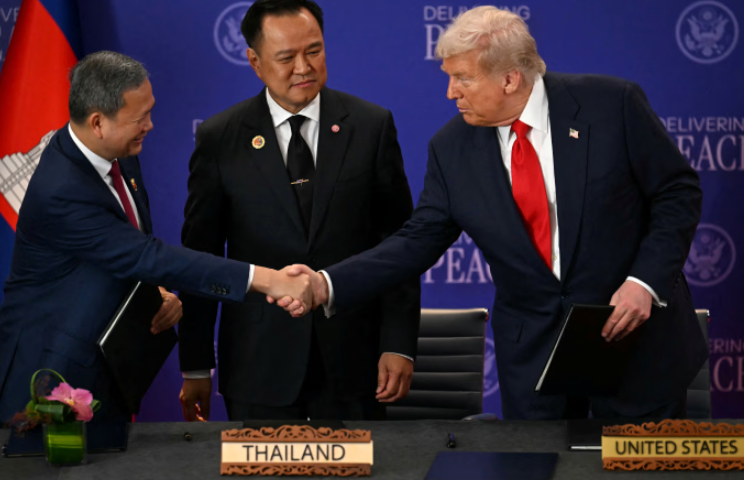
WASHINGTON / BANGKOK – October 28, 2025 (Market Insider) — The United States has reached a series of new trade agreements with Malaysia and Cambodia, and framework deals with Vietnam and Thailand, paving the way for tariff-free access on select goods and potentially reshaping the region’s export landscape.
Under the agreements, Southeast Asian nations will lower import duties and regulatory barriers for American goods — particularly agricultural products, metals, and automobiles — while the U.S. will exempt certain exports from these countries from its 19–20% retaliatory tariffs, according to the White House.
The move marks one of President Donald Trump’s most significant trade breakthroughs in his second term, aimed at boosting U.S. exports and countering China’s growing economic influence in Asia. Although the deals are not yet legally binding, they represent a major diplomatic step toward closer U.S.–ASEAN trade ties.
Malaysia and Cambodia Lead the Way
Malaysia and Cambodia have signed full bilateral trade agreements, agreeing to cut import taxes, relax technical standards, and adopt U.S. regulations on vehicles and agricultural goods.
In return, Washington will waive tariffs on a list of non-U.S.-produced goods, including key agricultural and manufacturing exports from both nations.
As part of the deal, Malaysia has pledged to invest $70 billion in the U.S. over the next decade, including new orders for Boeing aircraft. Cambodia is expected to follow with increased purchases of American agricultural products and industrial machinery.
Strategic Access and Commitments
Beyond tariff relief, the agreements also grant U.S. companies greater access to Southeast Asia’s strategic mineral reserves, a move widely seen as an effort to secure alternative supply chains outside China.
The countries have also committed not to impose penalties or restrictive regulations on American tech firms and to curb the transshipment of Chinese goods to the U.S. at artificially low prices — a longstanding concern in Washington’s trade policy.
The White House emphasized that these pacts will include environmental and labor standard commitments, aligning regional production with U.S. expectations for “fair and sustainable trade.”
Vietnam and Thailand to Follow
In parallel, Washington announced framework agreements with Vietnam and Thailand, laying the foundation for future comprehensive deals. Both nations have agreed in principle to reduce tariffs on U.S. goods, ease investment restrictions, and adopt American technical standards in the automotive and agricultural sectors.
Vietnam and Thailand have also committed to purchasing Boeing aircraft and expanding imports of U.S. farm produce, while Thailand separately signed an accord to boost exports of strategic minerals to the United States.
In exchange, the U.S. will identify a range of Vietnamese and Thai products eligible for tariff exemptions, potentially reversing the current 20% rate on Vietnamese goods.
A Turning Point for U.S.–ASEAN Trade
These moves underscore Washington’s renewed economic engagement with Southeast Asia — a region critical to global supply chains and increasingly caught between U.S. and Chinese influence.
If fully implemented, the new agreements could redirect billions in trade flows, strengthen American export competitiveness, and open new market opportunities for Southeast Asian producers in return.
As one analyst told Market Insider:
“This is less about tariffs and more about geopolitics. The U.S. is building a new economic coalition in Asia — one that trades market access for strategic alignment.”
