
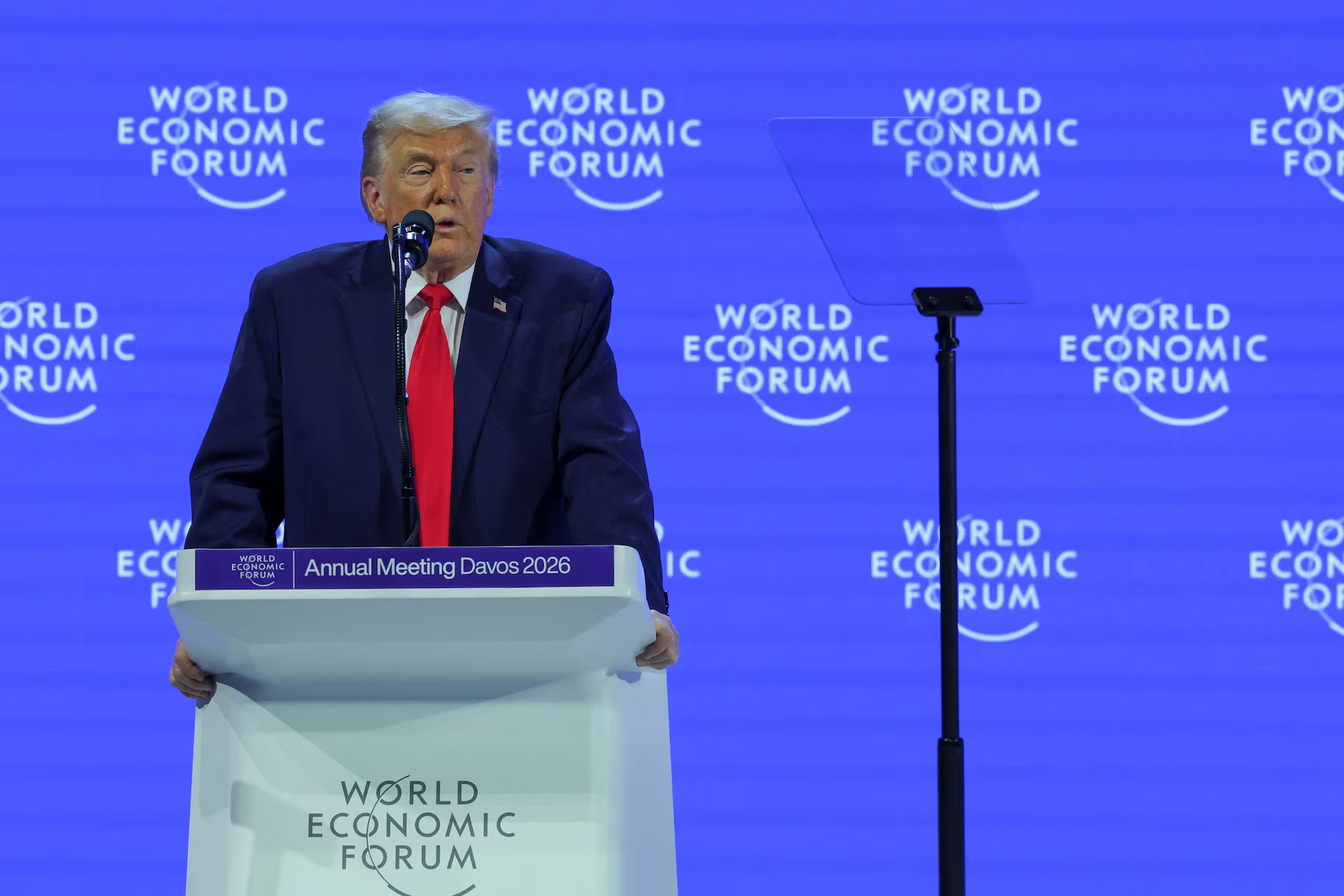
At the World Economic Forum, Trump revives territorial ambitions and trade pressure, shaking markets and testing NATO unity
MARKET INSIDER – U.S President Donald Trump arrived at the World Economic Forum in Davos with a message that instantly unsettled global leaders: America’s economic and security priorities now come with sharper edges. What was expected to be a speech about housing affordability and domestic economics quickly became a flashpoint for global markets as Trump doubled down on threats of sweeping tariffs and reiterated his determination to bring Greenland under U.S. control.
The timing could not have been more volatile. Trump’s renewed tariff warnings—aimed at several European allies—sent U.S. markets tumbling in their first session after his remarks. Investors and policymakers alike are now grappling with the implications of a U.S. president openly linking trade penalties to territorial negotiations with long-standing allies, a move that blurs the line between economic statecraft and geopolitical brinkmanship.
At the heart of the controversy is Greenland’s strategic value. Trump argues that the Arctic island is indispensable to U.S. national security amid rising competition from Russia and China in the High North. Yet Greenland is an autonomous territory within the Kingdom of Denmark, itself a member of NATO—the alliance whose core principle treats an attack on one member as an attack on all. European leaders warn that Trump’s posture risks undermining the very security framework that has anchored transatlantic stability for decades.
European reaction has been swift and increasingly defiant. French President Emmanuel Macron called the tariff threats “unacceptable,” signaling that Europe is prepared to respond in a coordinated manner if economic pressure escalates. Trump, in turn, escalated rhetorically, even floating punitive tariffs on French wine and casting doubt on Macron’s political future—remarks that further inflamed tensions at a forum traditionally devoted to cooperation and consensus.
Behind closed doors in Davos, U.S. officials attempted damage control, urging allies and investors to “take a deep breath” and trust that Trump has a strategy. But on the ground in Greenland, anxiety is rising. Local leaders say residents overwhelmingly oppose U.S. annexation, and opinion polls reinforce that resistance. Meanwhile, Trump has gone a step further by publicly inviting Vladimir Putin to join a proposed “Board of Peace,” adding another layer of geopolitical intrigue to an already combustible mix.
Trump’s Davos appearance underscores a broader shift that global investors cannot ignore: geopolitics, trade, and security are converging faster—and more unpredictably—than at any point in recent memory. Whether this strategy forces concessions or fractures alliances remains to be seen. But one thing is clear: in the new global order Trump is signaling, even allies may find themselves negotiating under pressure, and markets will be the first to react.
