
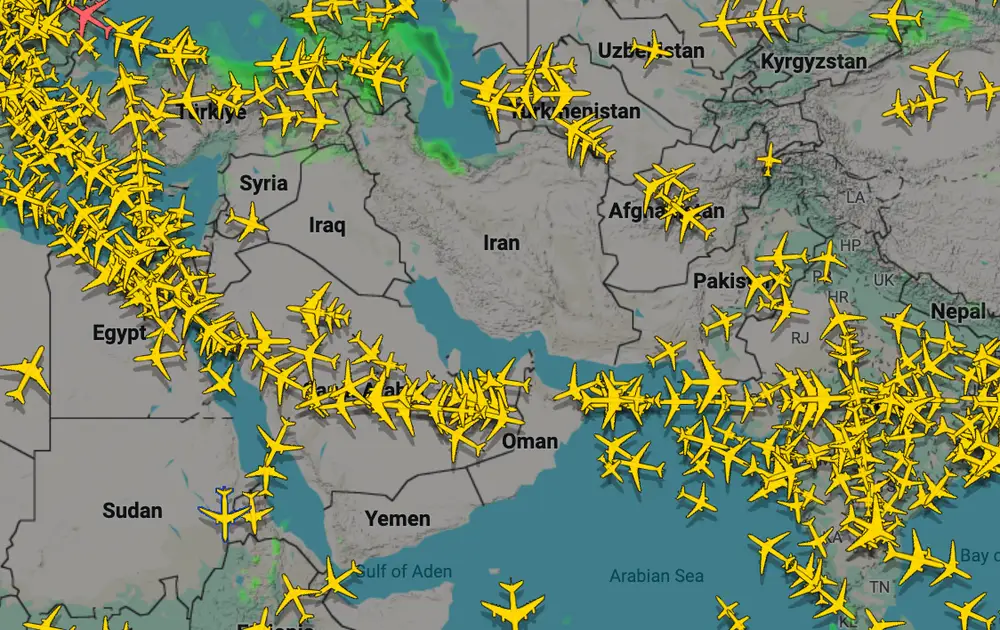
1,600+ flights canceled as Dubai hub shuts, airspace closures ripple worldwide
MARKET INSIDER – Global aviation has been thrust into chaos after U.S.-Israeli strikes on Iran triggered sweeping airspace closures across one of the world’s busiest flight corridors. Iran, Iraq, Kuwait, Bahrain, and Qatar have all shut their skies, while Dubai International Airport—the world’s busiest hub for international traffic—suspended operations following reported damage from a missile strike.
The disruption is not regional; it is global. The Persian Gulf air corridor links Europe, Asia, Africa, and North America, making it a critical artery for long-haul connectivity. As airlines scramble to reroute or cancel flights, the ripple effects are cascading across continents.
According to aviation analytics firm Cirium, roughly 1,600 inbound flights to the region were canceled by Sunday afternoon Central European Time. Including outbound services, cancellations approached 3,200—on top of thousands grounded the previous day. Major Gulf carriers—Emirates, Qatar Airways, and Etihad Airways—have suspended the vast majority of operations, affecting tens of thousands of transit passengers daily.
Dubai International Airport and Abu Dhabi’s Zayed International Airport both reported infrastructure damage, further complicating reopening timelines. Emirates alone operates roughly 500 flights per day from Dubai. Qatar Airways has canceled about 92% of flights to and from Doha, while Etihad has suspended nearly 88% of Abu Dhabi services.
The disruption extends beyond flights bound for the Middle East. The Gulf airspace corridor is a key overflight route for Europe–Asia and transcontinental services. Airlines are diverting aircraft over Saudi Arabia or rerouting entirely, adding fuel costs, crew overtime, and potential compensation expenses. Diversions have created “flights to nowhere,” with aircraft turning back mid-Atlantic or redirecting after 10–14 hours airborne.
This pattern mirrors prior geopolitical shocks. When Russia invaded Ukraine in 2022, airlines were forced into costly detours around Russian airspace. Similar disruptions occurred during tensions between India and Pakistan. But the current Middle East closures strike at a far denser transit network, amplifying the global knock-on effect.
Beyond passenger inconvenience, the financial implications are substantial. Reroutes increase operational costs and strain already tight airline margins. Insurance premiums may rise, while airports outside the region risk congestion from mass diversions.
The bigger question is duration. A short closure may create temporary bottlenecks. A prolonged shutdown would fundamentally alter global aviation flows, potentially reshaping long-haul economics and adding inflationary pressure through higher transport costs.
For now, the skies over one of the world’s most strategic regions are largely empty—a visible reminder that geopolitical conflict can halt globalization’s most interconnected systems in a matter of hours.
